Event submissions
EventsMicromachines 2021 — 1st International Conference on Micromachines and Applications (ICMA2021)
Published

This submission belongs to the session S1. Micromachines for scientific research of the event Micromachines 2021 — 1st International Conference on Micromachines and Applications (ICMA2021)
Published date
14 Apr, 2021
Citation
Sonia Ceron, Abdu Orduña-Diaz, Miguel A. Dominguez, Influence of Inductive Effect in Organic Residuals Content in IZO Thin Films and The Performance on The Behavior of MIS Capacitors on Plastic
, in Proceedings of Micromachines 2021 — 1st International Conference on Micromachines and Applications (ICMA2021), 15 April–30 April 2021, MDPI: Basel, Switzerland, doi: 10.3390/Micromachines2021-09551
Share
Email
Facebook
Twitter
LinkedIn
Influence of Inductive Effect in Organic Residuals Content in IZO Thin Films and The Performance on The Behavior of MIS Capacitors on Plastic
'%3e%3cpath%20d='M12.6647%2010.9104C12.4176%2010.325%2012.0589%209.7933%2011.6088%209.34485C11.16%208.89511%2010.6283%208.53653%2010.0432%208.28891C10.038%208.28629%2010.0327%208.28498%2010.0275%208.28236C10.8437%207.69282%2011.3743%206.73252%2011.3743%205.64907C11.3743%203.85423%209.92005%202.40002%208.12522%202.40002C6.33038%202.40002%204.87618%203.85423%204.87618%205.64907C4.87618%206.73252%205.40677%207.69282%206.22296%208.28367C6.21772%208.28629%206.21248%208.2876%206.20724%208.29022C5.62031%208.53783%205.09365%208.89287%204.64167%209.34616C4.19192%209.79496%203.83334%2010.3266%203.58573%2010.9117C3.34247%2011.4846%203.21128%2012.0987%203.19925%2012.721C3.1989%2012.735%203.20135%2012.7489%203.20646%2012.7619C3.21157%2012.7749%203.21924%2012.7868%203.22901%2012.7968C3.23877%2012.8068%203.25045%2012.8148%203.26334%2012.8202C3.27623%2012.8256%203.29007%2012.8284%203.30406%2012.8284H4.09012C4.14776%2012.8284%204.19362%2012.7825%204.19493%2012.7262C4.22113%2011.7148%204.62726%2010.7676%205.34519%2010.0497C6.08802%209.30686%207.07452%208.89811%208.12522%208.89811C9.17592%208.89811%2010.1624%209.30686%2010.9052%2010.0497C11.6232%2010.7676%2012.0293%2011.7148%2012.0555%2012.7262C12.0568%2012.7839%2012.1027%2012.8284%2012.1603%2012.8284H12.9464C12.9604%2012.8284%2012.9742%2012.8256%2012.9871%2012.8202C13%2012.8148%2013.0117%2012.8068%2013.0214%2012.7968C13.0312%2012.7868%2013.0389%2012.7749%2013.044%2012.7619C13.0491%2012.7489%2013.0515%2012.735%2013.0512%2012.721C13.0381%2012.0947%2012.9084%2011.4856%2012.6647%2010.9104ZM8.12522%207.90243C7.52388%207.90243%206.95792%207.66793%206.53214%207.24215C6.10636%206.81636%205.87185%206.2504%205.87185%205.64907C5.87185%205.04773%206.10636%204.48177%206.53214%204.05599C6.95792%203.63021%207.52388%203.3957%208.12522%203.3957C8.72655%203.3957%209.29252%203.63021%209.7183%204.05599C10.1441%204.48177%2010.3786%205.04773%2010.3786%205.64907C10.3786%206.2504%2010.1441%206.81636%209.7183%207.24215C9.29252%207.66793%208.72655%207.90243%208.12522%207.90243Z'%20fill='%235D1EE1'/%3e%3c/g%3e%3c/svg%3e)
Sonia Ceron 1
Abdu Orduña-Diaz 2
Miguel A. Dominguez 1
1. Benemérita Universidad Autónoma de Puebla
2. Instituto Politécnico Nacional
Abstract
The realization of electronic devices on flexible substrates (flexible electronics) has an important role in large area technological innovation. Semiconductor oxides are an option to implement low processing temperatures on these materials. In this work, flexible metal-insulator-semiconductor (MIS) capacitors were fabricated using zinc oxide (ZnO) and indium-doped zinc oxide (IZO) as semiconductor materials, spin-on glass (SOG) as insulator and indium doped tin oxide (ITO) as contact, deposited by solution techniques at 200 °C on PET substrates. The films were characterized by FTIR spectroscopy and four-points probe. The resistivity of the IZO films decreases with increasing doping. However, the resistivity of the film increases with the 6 wt.% doping concentration. Through FT-IR spectroscopy an irregular behavior was observed when the ZnO films are doped with In 6 wt. %. It was found that at this concentration the film has a lower amount of C-O, COO- and O-H bonds with respect to the rest of the doped and undoped films. These groups can behave as charge traps, limiting the charge transport on the semiconductor thin films. Also, an unusual displacement of the Zn-O and COO- bonds is observed, probably due to an inductive effect. This effect could imply the existence of a permanent dipole which increases the electron density due to the occupied antibonding states. The reduction of organic residuals is corroborated with the hysteresis behavior through the fabrication and characterization of MIS capacitors.
Keywords
inductive effect
FTIR ZnO and IZO thin films
MIS capacitors
solution processes
plastic substrates
Poster
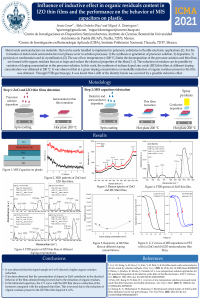
S. Ceron et al. Influence of the inductive effect in organic residual content IZO thin films.pdf
Innovative Solving Process Problems of Micro-Turbine Machining Using Computer-Aided Innovation Method
Modeling of the Density of States in Field-effect Zinc Oxide Semiconductor Devices Fabricated by Ultrasonic Spray Pyrolysis on Plastic Substrates