Event submissions
EventsMicromachines 2021 — 1st International Conference on Micromachines and Applications (ICMA2021)
Published

This submission belongs to the session S9. General of the event Micromachines 2021 — 1st International Conference on Micromachines and Applications (ICMA2021)
Published date
14 Apr, 2021
Citation
Mohsen Azadi, George A Popov, Zhipeng Lu, Andy G Eskenazi, Avery Ji Won Bang, Matthew F Campbell, Howard Hu, Igor Bargatin, Controlled Light-Driven Levitation of Macroscopic Plates, in Proceedings of Micromachines 2021 — 1st International Conference on Micromachines and Applications (ICMA2021), 15 April–30 April 2021, MDPI: Basel, Switzerland, doi: 10.3390/Micromachines2021-09569
Share
Email
Facebook
Twitter
LinkedIn
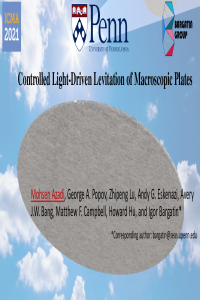
Controlled Light-Driven Levitation of Macroscopic Plates

Mohsen Azadi 1
'%3e%3cpath%20d='M12.6647%2010.9104C12.4176%2010.325%2012.0589%209.7933%2011.6088%209.34485C11.16%208.89511%2010.6283%208.53653%2010.0432%208.28891C10.038%208.28629%2010.0327%208.28498%2010.0275%208.28236C10.8437%207.69282%2011.3743%206.73252%2011.3743%205.64907C11.3743%203.85423%209.92005%202.40002%208.12522%202.40002C6.33038%202.40002%204.87618%203.85423%204.87618%205.64907C4.87618%206.73252%205.40677%207.69282%206.22296%208.28367C6.21772%208.28629%206.21248%208.2876%206.20724%208.29022C5.62031%208.53783%205.09365%208.89287%204.64167%209.34616C4.19192%209.79496%203.83334%2010.3266%203.58573%2010.9117C3.34247%2011.4846%203.21128%2012.0987%203.19925%2012.721C3.1989%2012.735%203.20135%2012.7489%203.20646%2012.7619C3.21157%2012.7749%203.21924%2012.7868%203.22901%2012.7968C3.23877%2012.8068%203.25045%2012.8148%203.26334%2012.8202C3.27623%2012.8256%203.29007%2012.8284%203.30406%2012.8284H4.09012C4.14776%2012.8284%204.19362%2012.7825%204.19493%2012.7262C4.22113%2011.7148%204.62726%2010.7676%205.34519%2010.0497C6.08802%209.30686%207.07452%208.89811%208.12522%208.89811C9.17592%208.89811%2010.1624%209.30686%2010.9052%2010.0497C11.6232%2010.7676%2012.0293%2011.7148%2012.0555%2012.7262C12.0568%2012.7839%2012.1027%2012.8284%2012.1603%2012.8284H12.9464C12.9604%2012.8284%2012.9742%2012.8256%2012.9871%2012.8202C13%2012.8148%2013.0117%2012.8068%2013.0214%2012.7968C13.0312%2012.7868%2013.0389%2012.7749%2013.044%2012.7619C13.0491%2012.7489%2013.0515%2012.735%2013.0512%2012.721C13.0381%2012.0947%2012.9084%2011.4856%2012.6647%2010.9104ZM8.12522%207.90243C7.52388%207.90243%206.95792%207.66793%206.53214%207.24215C6.10636%206.81636%205.87185%206.2504%205.87185%205.64907C5.87185%205.04773%206.10636%204.48177%206.53214%204.05599C6.95792%203.63021%207.52388%203.3957%208.12522%203.3957C8.72655%203.3957%209.29252%203.63021%209.7183%204.05599C10.1441%204.48177%2010.3786%205.04773%2010.3786%205.64907C10.3786%206.2504%2010.1441%206.81636%209.7183%207.24215C9.29252%207.66793%208.72655%207.90243%208.12522%207.90243Z'%20fill='%235D1EE1'/%3e%3c/g%3e%3c/svg%3e)
George A Popov 2
Zhipeng Lu 3
Andy G Eskenazi 2
Avery Ji Won Bang 1
Matthew F Campbell 1
Howard Hu 1

Igor Bargatin 1
1. Department of Mechanical Engineering and Applied Mechanics, University of Pennsylvania
2. Vagelos Integrated Program in Energy Research, University of Pennsylvania
3. Department of Chemistry, University of Pennsylvania
Abstract
Photophoretic or light-driven levitation has been studied extensively in the context of the motion of illuminated micron-sized particles, such as dust grains in the atmosphere under sunlight [1,2], and in relation to Crooks radiometers [3]. When heated by incident light, a micron-sized particle experiences a temperature gradient that in turn results in uneven gas-surface interactions and a net propulsive force [4]. Though thoroughly investigated for micron-sized particles, this phenomenon has rarely been studied to controllably levitate macroscopic objects.
We report light-driven levitation of 0.5-um thick mylar samples that have been modified by depositing a 300-nm-thick layer of carbon nanotubes (CNTs) on a single side. The CNT layer serves three key purposes: 1) It acts as a lightweight light absorber, absorbing ~ 90% of the incident light and elevating the temperature of the sample. 2) It increases the structural rigidity of the mylar film, allowing cm-scale discs with submicron thicknesses to hold their shape. 3) It creates a structured porous surface that traps impinging gas molecules, which results in an accommodation coefficient difference between the top and bottom surfaces for gas-surface interactions. Air molecules that rebound from the CNT-coated side have on average higher velocities than those departing from the opposing uncoated mylar surface. We show that the net force thus created can be used to levitate the mylar films. Moreover, we will demonstrate our ability to manipulate a light field in order to control the flight of levitating samples for extended periods of time.
References:
- Jovanovic, O. Photophoresis—Light induced motion of particles suspended in gas. Journal of quantitative spectroscopy & radiative transfer 110, 889–901, (2009)
- Horvath, Photophoresis – a forgotten force ??, KONA powder and particle journal, 31, 181–199 (2014)
- Ketsdever, N. Gimelshein, S. Gimelshein, and N. Selden, “Radiometric phenomena: From the 19th to the 21st century”, Vacuum 86, 1644-1662 (2012).
- Loesche, G. Wurm, T. Jankowski, M. Kuepper, Photophoresis on particles hotter/colder than the ambient gas in the free molecular flow. J. Aerosol Sci, 97, 22–33 (2016)
Keywords
Photophoretic levitation
high altitude flight
Poster
Azadi_Levitation_micromachines 2021 - v03.pdf
In-Ear Energy Harvesting: Source Characterization and Mechanical Simulator (Part I)
Misconceptions in Piezoelectric Energy Harvesting System Development