Event submissions
EventsMicromachines 2021 — 1st International Conference on Micromachines and Applications (ICMA2021)
Published

This submission belongs to the session S4. Micromachines for bio-chemical applications of the event Micromachines 2021 — 1st International Conference on Micromachines and Applications (ICMA2021)
Published date
16 Apr, 2021
Citation
Matea Bačić, Milena Mlakić, Anita Šalić, Irena Škorić, Bruno Zelić, Photocatalytic oxygenation of heterostilbenes in microflow reactors, in Proceedings of Micromachines 2021 — 1st International Conference on Micromachines and Applications (ICMA2021), 15 April–30 April 2021, MDPI: Basel, Switzerland, doi: 10.3390/Micromachines2021-09585
Share
Email
Facebook
Twitter
LinkedIn
Photocatalytic oxygenation of heterostilbenes in microflow reactors
'%3e%3cpath%20d='M12.6647%2010.9104C12.4176%2010.325%2012.0589%209.7933%2011.6088%209.34485C11.16%208.89511%2010.6283%208.53653%2010.0432%208.28891C10.038%208.28629%2010.0327%208.28498%2010.0275%208.28236C10.8437%207.69282%2011.3743%206.73252%2011.3743%205.64907C11.3743%203.85423%209.92005%202.40002%208.12522%202.40002C6.33038%202.40002%204.87618%203.85423%204.87618%205.64907C4.87618%206.73252%205.40677%207.69282%206.22296%208.28367C6.21772%208.28629%206.21248%208.2876%206.20724%208.29022C5.62031%208.53783%205.09365%208.89287%204.64167%209.34616C4.19192%209.79496%203.83334%2010.3266%203.58573%2010.9117C3.34247%2011.4846%203.21128%2012.0987%203.19925%2012.721C3.1989%2012.735%203.20135%2012.7489%203.20646%2012.7619C3.21157%2012.7749%203.21924%2012.7868%203.22901%2012.7968C3.23877%2012.8068%203.25045%2012.8148%203.26334%2012.8202C3.27623%2012.8256%203.29007%2012.8284%203.30406%2012.8284H4.09012C4.14776%2012.8284%204.19362%2012.7825%204.19493%2012.7262C4.22113%2011.7148%204.62726%2010.7676%205.34519%2010.0497C6.08802%209.30686%207.07452%208.89811%208.12522%208.89811C9.17592%208.89811%2010.1624%209.30686%2010.9052%2010.0497C11.6232%2010.7676%2012.0293%2011.7148%2012.0555%2012.7262C12.0568%2012.7839%2012.1027%2012.8284%2012.1603%2012.8284H12.9464C12.9604%2012.8284%2012.9742%2012.8256%2012.9871%2012.8202C13%2012.8148%2013.0117%2012.8068%2013.0214%2012.7968C13.0312%2012.7868%2013.0389%2012.7749%2013.044%2012.7619C13.0491%2012.7489%2013.0515%2012.735%2013.0512%2012.721C13.0381%2012.0947%2012.9084%2011.4856%2012.6647%2010.9104ZM8.12522%207.90243C7.52388%207.90243%206.95792%207.66793%206.53214%207.24215C6.10636%206.81636%205.87185%206.2504%205.87185%205.64907C5.87185%205.04773%206.10636%204.48177%206.53214%204.05599C6.95792%203.63021%207.52388%203.3957%208.12522%203.3957C8.72655%203.3957%209.29252%203.63021%209.7183%204.05599C10.1441%204.48177%2010.3786%205.04773%2010.3786%205.64907C10.3786%206.2504%2010.1441%206.81636%209.7183%207.24215C9.29252%207.66793%208.72655%207.90243%208.12522%207.90243Z'%20fill='%235D1EE1'/%3e%3c/g%3e%3c/svg%3e)
Matea Bačić 1
Milena Mlakić 2

Anita Šalić 1
Irena Škorić 2

Bruno Zelić 1
1. Department of Reaction Engineering and Catalysis, Faculty of Chemical Engineering and Technology, University of Zagreb, Marulićev trg 19, 10000 Zagreb, Croatia
2. Department of Organic Chemistry, Faculty of Chemical Engineering and Technology, University of Zagreb, Marulićev trg 19, 10000 Zagreb, Croatia
Abstract
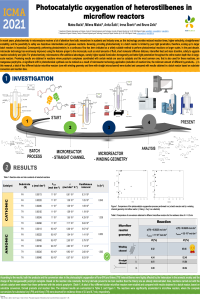
Photochemistry involves processes in which light, the principal reagent, and photocatalysts, open pathways to diversing photochemical products. Promising results are obtained in reactions where porphyrin complexes coordinated with certain metals are used as catalysts. The most common porphyrin complexes used in various organic reactions were manganese porphyrins. Nowadays, batch reactors used for photochemical reactions are commonly replaced with flow reactors. Microflow reactors are one of the reactors types, whose main characteristic is the micro-dimension of channels (max. diameter of 500 μm). Flow chemistry performed on a microscale bring improvements in many aspects of photochemical reactions, such as efficient and fast phase mixing and heat transfer, precise retention time control, homogeneous use of light irradiation throughout the reaction mixture, process safety, and potentially simple scale-up.
In this research, anionic/cationic manganese(III) porphyrins were used as photocatalysts. The reactions were first performed in a batch reactor where complete conversion of the substrate was observed after 2 h for furostilbene and 16 h for thienostilbene substrate, respectively. As a result, the formation of formyl, epoxy, carbonyl, or hydroxy derivatives were observed. A step forward in process development was made by replacing the batch with microflow reactors. A total of four different tubular microflow reactors were studied and compared with results obtained in a batch reactor based on substrate conversion and reaction time. Reactions were significantly accelerated in microflow reactors where the complete substrate conversion for furostilbene substrate was observed for a residence time of 0.7 min and for thienostilbene substrate for 3.5 min, respectively.
Keywords
photocatalysis
microreactors
furostilbene
thienostilbene
Poster
Poster_Photocatalytic oxygenation of heterostilbenes in microflow reactors.pdf
Magnetically actuated glaucoma drainage device with adjustable flow properties after implantation
Lipid-based nanoparticle production in Micromixers