Event submissions
EventsMicromachines 2021 — 1st International Conference on Micromachines and Applications (ICMA2021)
Published

This submission belongs to the session S2. Microfluidic micromachines of the event Micromachines 2021 — 1st International Conference on Micromachines and Applications (ICMA2021)
Published date
16 Apr, 2021
Citation
Jacob Binsley, Elizabeth Martin, Thomas Myers, Stefano Pagliara, Feodor Ogrin, Elasto-Magnetic Pumps Integrated within Microfluidic Devices, in Proceedings of Micromachines 2021 — 1st International Conference on Micromachines and Applications (ICMA2021), 15 April–30 April 2021, MDPI: Basel, Switzerland, doi: 10.3390/Micromachines2021-09590
Share
Email
Facebook
Twitter
LinkedIn
Elasto-Magnetic Pumps Integrated within Microfluidic Devices
'%3e%3cpath%20d='M12.6647%2010.9104C12.4176%2010.325%2012.0589%209.7933%2011.6088%209.34485C11.16%208.89511%2010.6283%208.53653%2010.0432%208.28891C10.038%208.28629%2010.0327%208.28498%2010.0275%208.28236C10.8437%207.69282%2011.3743%206.73252%2011.3743%205.64907C11.3743%203.85423%209.92005%202.40002%208.12522%202.40002C6.33038%202.40002%204.87618%203.85423%204.87618%205.64907C4.87618%206.73252%205.40677%207.69282%206.22296%208.28367C6.21772%208.28629%206.21248%208.2876%206.20724%208.29022C5.62031%208.53783%205.09365%208.89287%204.64167%209.34616C4.19192%209.79496%203.83334%2010.3266%203.58573%2010.9117C3.34247%2011.4846%203.21128%2012.0987%203.19925%2012.721C3.1989%2012.735%203.20135%2012.7489%203.20646%2012.7619C3.21157%2012.7749%203.21924%2012.7868%203.22901%2012.7968C3.23877%2012.8068%203.25045%2012.8148%203.26334%2012.8202C3.27623%2012.8256%203.29007%2012.8284%203.30406%2012.8284H4.09012C4.14776%2012.8284%204.19362%2012.7825%204.19493%2012.7262C4.22113%2011.7148%204.62726%2010.7676%205.34519%2010.0497C6.08802%209.30686%207.07452%208.89811%208.12522%208.89811C9.17592%208.89811%2010.1624%209.30686%2010.9052%2010.0497C11.6232%2010.7676%2012.0293%2011.7148%2012.0555%2012.7262C12.0568%2012.7839%2012.1027%2012.8284%2012.1603%2012.8284H12.9464C12.9604%2012.8284%2012.9742%2012.8256%2012.9871%2012.8202C13%2012.8148%2013.0117%2012.8068%2013.0214%2012.7968C13.0312%2012.7868%2013.0389%2012.7749%2013.044%2012.7619C13.0491%2012.7489%2013.0515%2012.735%2013.0512%2012.721C13.0381%2012.0947%2012.9084%2011.4856%2012.6647%2010.9104ZM8.12522%207.90243C7.52388%207.90243%206.95792%207.66793%206.53214%207.24215C6.10636%206.81636%205.87185%206.2504%205.87185%205.64907C5.87185%205.04773%206.10636%204.48177%206.53214%204.05599C6.95792%203.63021%207.52388%203.3957%208.12522%203.3957C8.72655%203.3957%209.29252%203.63021%209.7183%204.05599C10.1441%204.48177%2010.3786%205.04773%2010.3786%205.64907C10.3786%206.2504%2010.1441%206.81636%209.7183%207.24215C9.29252%207.66793%208.72655%207.90243%208.12522%207.90243Z'%20fill='%235D1EE1'/%3e%3c/g%3e%3c/svg%3e)
Jacob Binsley 1
Elizabeth Martin 1
Thomas Myers 2
Stefano Pagliara 3
Feodor Ogrin 1
1. Department of Physics and Astronomy, University of Exeter, Physics Building, Stocker Road, Exeter, UK
2. Platform Kinetics Limited, Pegholme, Wharfebank Mills, Otley, UK
3. Department of Biosciences, University of Exeter, Living Systems Institute, Stocker Road, Exeter, UK
Abstract
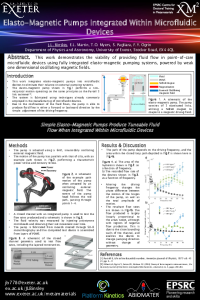
Many lab-on-a-chip devices require a connection to an external pumping system in order to perform their function. While this is not problematic in typical laboratory environments, it is not always practical when applied to point-of-care testing, which is best utilised outside of the laboratory. Therefore, there has been a large amount of ongoing research into producing integrated microfluidic components capable of generating effective fluid flow from on-board the device. This research aims to introduce a system which can produce practical flow rates, and be easily fabricated and actuated using readily available techniques and materials. We show how an asymmetric elasto-magnetic system, inspired by Purcell’s 3-link swimmer can provide this solution through the generation of non-reciprocal motion in an enclosed environment. The device is fabricated monolithically within a microfluidic channel at the time of manufacture, and is actuated using a weak, oscillating magnetic field. The flow rate can be altered dynamically, and the resultant flow direction can be reversed by adjusting the frequency of the driving field. The device is proven, experimentally and numerically, to operate effectively when applied to fluids with a range of viscosities. Such a device may be able to replace external pumping systems in more portable applications.
Keywords
elasto-magnetic
microfluidic
lab-on-a-chip
pump
Poster
Micromachines_ElastoMagneticPumpsIntegratedWithinMicrofluidicDevices.pdf
Experimental studies of the sedimentation, stability and thermal conductivity of two different nanofluids
Optimization of Manufacturing Parameters of 3D Printed Solid Microneedles for Transdermal Drug Delivery