Event submissions
EventsMicromachines 2021 — 1st International Conference on Micromachines and Applications (ICMA2021)
Published

This submission belongs to the session S3. Micromachines for bio-medical applications of the event Micromachines 2021 — 1st International Conference on Micromachines and Applications (ICMA2021)
Published date
16 Apr, 2021
Citation
Kenan Muhamedagić, Amina Tucak, Merima Sirbubalo, Ognjenka Rahić, Lamija Hindija, Jasmina Hadžiabdić, Edina Vranić, Ahmet Čekić, Optimization of Manufacturing Parameters of 3D Printed Solid Microneedles for Transdermal Drug Delivery, in Proceedings of Micromachines 2021 — 1st International Conference on Micromachines and Applications (ICMA2021), 15 April–30 April 2021, MDPI: Basel, Switzerland, doi: 10.3390/Micromachines2021-09591
Share
Email
Facebook
Twitter
LinkedIn
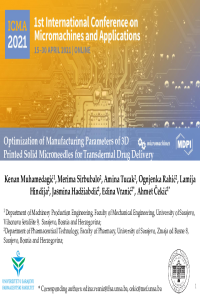
Optimization of Manufacturing Parameters of 3D Printed Solid Microneedles for Transdermal Drug Delivery
'%3e%3cpath%20d='M12.6647%2010.9104C12.4176%2010.325%2012.0589%209.7933%2011.6088%209.34485C11.16%208.89511%2010.6283%208.53653%2010.0432%208.28891C10.038%208.28629%2010.0327%208.28498%2010.0275%208.28236C10.8437%207.69282%2011.3743%206.73252%2011.3743%205.64907C11.3743%203.85423%209.92005%202.40002%208.12522%202.40002C6.33038%202.40002%204.87618%203.85423%204.87618%205.64907C4.87618%206.73252%205.40677%207.69282%206.22296%208.28367C6.21772%208.28629%206.21248%208.2876%206.20724%208.29022C5.62031%208.53783%205.09365%208.89287%204.64167%209.34616C4.19192%209.79496%203.83334%2010.3266%203.58573%2010.9117C3.34247%2011.4846%203.21128%2012.0987%203.19925%2012.721C3.1989%2012.735%203.20135%2012.7489%203.20646%2012.7619C3.21157%2012.7749%203.21924%2012.7868%203.22901%2012.7968C3.23877%2012.8068%203.25045%2012.8148%203.26334%2012.8202C3.27623%2012.8256%203.29007%2012.8284%203.30406%2012.8284H4.09012C4.14776%2012.8284%204.19362%2012.7825%204.19493%2012.7262C4.22113%2011.7148%204.62726%2010.7676%205.34519%2010.0497C6.08802%209.30686%207.07452%208.89811%208.12522%208.89811C9.17592%208.89811%2010.1624%209.30686%2010.9052%2010.0497C11.6232%2010.7676%2012.0293%2011.7148%2012.0555%2012.7262C12.0568%2012.7839%2012.1027%2012.8284%2012.1603%2012.8284H12.9464C12.9604%2012.8284%2012.9742%2012.8256%2012.9871%2012.8202C13%2012.8148%2013.0117%2012.8068%2013.0214%2012.7968C13.0312%2012.7868%2013.0389%2012.7749%2013.044%2012.7619C13.0491%2012.7489%2013.0515%2012.735%2013.0512%2012.721C13.0381%2012.0947%2012.9084%2011.4856%2012.6647%2010.9104ZM8.12522%207.90243C7.52388%207.90243%206.95792%207.66793%206.53214%207.24215C6.10636%206.81636%205.87185%206.2504%205.87185%205.64907C5.87185%205.04773%206.10636%204.48177%206.53214%204.05599C6.95792%203.63021%207.52388%203.3957%208.12522%203.3957C8.72655%203.3957%209.29252%203.63021%209.7183%204.05599C10.1441%204.48177%2010.3786%205.04773%2010.3786%205.64907C10.3786%206.2504%2010.1441%206.81636%209.7183%207.24215C9.29252%207.66793%208.72655%207.90243%208.12522%207.90243Z'%20fill='%235D1EE1'/%3e%3c/g%3e%3c/svg%3e)
Kenan Muhamedagić 1

Amina Tucak 2

Merima Sirbubalo 2

Ognjenka Rahić 2
Lamija Hindija 2
Jasmina Hadžiabdić 2

Edina Vranić 2
Ahmet Čekić 1
1. University of Sarajevo, Faculty of Mechanical Engineering, Department of Machinery Production Engineering
2. University of Sarajevo, Faculty of Pharmacy, Department of Pharmaceutical Technology
Abstract
Microneedles (MNs) have been manufactured using a variety of methods from a range of materials, but most of them are expensive and time-consuming for screening new designs and making any modifications. Therefore, stereolithography (SLA) has emerged as a promising approach for MN fabrication due to its numerous advantages, including simplicity, low cost, and the ability to manufacture complex geometrical products at any time, including modifications to the original designs. This work aimed to print MNs using SLA technology and investigate the effects of post-printing curing conditions on the mechanical properties of 3D-printed MNs.
Solid MNs were designed using CAD software and printed with grey resin (Formlabs, UK) using Form 3 printer (Formlabs, UK). MNs dimensions were 1.2 × 0.4 × 0.05 mm, arranged in 6 rows and 6 columns on a 10 × 10 mm baseplate. MNs were then immersed in an isopropyl alcohol bath to remove unpolymerized resin residues and cured in a UV-A heated chamber (Formlabs, UK). In total, nine samples were taken for each combination of curing temperature (35°C, 50°C, and 70°C) and curing time (5 min, 20 min, and 60 min). Fracture tests were conducted using a hardness apparatus TB24 (Erweka, Germany). MNs were placed on the moving probe of the machine and compressed until fracture.
The optimization of the SLA process parameters for improving the strength of MNs was performed using the Taguchi method. The design of experiments was carried out based on the Taguchi L9 orthogonal array. Experimental results showed that the curing temperature has a significant influence on MN strength improvements. Improvement of the MN strength can be achieved by increasing the curing temperature and curing time.
Keywords
microneedles
3D printing
stereolithography
optimization
transdermal drug delivery
Poster
Micromachines2021- Optimization of Manufacturing Parameters of .pdf
Elasto-Magnetic Pumps Integrated within Microfluidic Devices
Purification of biodiesel produced by lipase catalysed transesterification by two-phase systems based on deep eutectic solvents in a microextractor: Selection of solvents and process optimization