Event submissions
Published
 10.3390/ECA2021-09600 (registering DOI)
 This submission belongs to the session F. Poster of the event The 1st International Electronic Conference on Antibiotics
Published date
19 Apr, 2021
Citation
Rúben Soares, Sandra Cunha, Luís Ferreira, Gilberto Igrejas, Carla Miranda, Patrícia Poeta, Multidrug-resistant Enterococcus faecalis isolated from ornamental animals feed, in Proceedings of The 1st International Electronic Conference on Antibiotics, 8 May–17 May 2021, MDPI: Basel, Switzerland, doi: 10.3390/ECA2021-09600
Share
Email
Facebook
Twitter
LinkedIn
Multidrug-resistant Enterococcus faecalis isolated from ornamental animals feed
'%3e%3cpath%20d='M12.6647%2010.9104C12.4176%2010.325%2012.0589%209.7933%2011.6088%209.34485C11.16%208.89511%2010.6283%208.53653%2010.0432%208.28891C10.038%208.28629%2010.0327%208.28498%2010.0275%208.28236C10.8437%207.69282%2011.3743%206.73252%2011.3743%205.64907C11.3743%203.85423%209.92005%202.40002%208.12522%202.40002C6.33038%202.40002%204.87618%203.85423%204.87618%205.64907C4.87618%206.73252%205.40677%207.69282%206.22296%208.28367C6.21772%208.28629%206.21248%208.2876%206.20724%208.29022C5.62031%208.53783%205.09365%208.89287%204.64167%209.34616C4.19192%209.79496%203.83334%2010.3266%203.58573%2010.9117C3.34247%2011.4846%203.21128%2012.0987%203.19925%2012.721C3.1989%2012.735%203.20135%2012.7489%203.20646%2012.7619C3.21157%2012.7749%203.21924%2012.7868%203.22901%2012.7968C3.23877%2012.8068%203.25045%2012.8148%203.26334%2012.8202C3.27623%2012.8256%203.29007%2012.8284%203.30406%2012.8284H4.09012C4.14776%2012.8284%204.19362%2012.7825%204.19493%2012.7262C4.22113%2011.7148%204.62726%2010.7676%205.34519%2010.0497C6.08802%209.30686%207.07452%208.89811%208.12522%208.89811C9.17592%208.89811%2010.1624%209.30686%2010.9052%2010.0497C11.6232%2010.7676%2012.0293%2011.7148%2012.0555%2012.7262C12.0568%2012.7839%2012.1027%2012.8284%2012.1603%2012.8284H12.9464C12.9604%2012.8284%2012.9742%2012.8256%2012.9871%2012.8202C13%2012.8148%2013.0117%2012.8068%2013.0214%2012.7968C13.0312%2012.7868%2013.0389%2012.7749%2013.044%2012.7619C13.0491%2012.7489%2013.0515%2012.735%2013.0512%2012.721C13.0381%2012.0947%2012.9084%2011.4856%2012.6647%2010.9104ZM8.12522%207.90243C7.52388%207.90243%206.95792%207.66793%206.53214%207.24215C6.10636%206.81636%205.87185%206.2504%205.87185%205.64907C5.87185%205.04773%206.10636%204.48177%206.53214%204.05599C6.95792%203.63021%207.52388%203.3957%208.12522%203.3957C8.72655%203.3957%209.29252%203.63021%209.7183%204.05599C10.1441%204.48177%2010.3786%205.04773%2010.3786%205.64907C10.3786%206.2504%2010.1441%206.81636%209.7183%207.24215C9.29252%207.66793%208.72655%207.90243%208.12522%207.90243Z'%20fill='%235D1EE1'/%3e%3c/g%3e%3c/svg%3e)
Rúben Soares 1
Sandra Cunha 1
Luís Ferreira 1

Gilberto Igrejas 2

Carla Miranda 3

Patrícia Poeta 4
1. Microbiology and Antibiotic Resistance Team (MicroART), Department of Veterinary Sciences, University of Trás-os Montes e Alto Douro, Vila Real, Portugal
2. Associated Laboratory for Green Chemistry (LAQV-REQUIMTE), University NOVA of Lisbon, Caparica, Portugal;
Department of Genetics and Biotechnology, University of Trás-os-Montes e Alto Douro, Vila Real, Portugal;
Functional Genomics and Proteomics Unit
3. Microbiology and Antibiotic Resistance Team (MicroART), Department of Veterinary Sciences, University of Trás-os Montes e Alto Douro, Vila Real, Portugal; Associated Laboratory for Green Chemistry (LAQV-REQUIMTE), University NOVA of Lisbon, Caparica, Por
4. Microbiology and Antibiotic Resistance Team (MicroART), Department of Veterinary Sciences, University of Trás-os Montes e Alto Douro, Vila Real, Portugal;
Associated Laboratory for Green Chemistry (LAQV-REQUIMTE), University NOVA of Lisbon, Caparica, Po
Abstract
Enterococcus faecalis is one of the species most strongly associated with cases of nosocomial infections. This pathogen is resistant to several antimicrobial classes, having an enormous capacity to acquire and transfer resistance genes. The objective of this work was to evaluate the level of antibiotic resistance Enterococcus faecalis isolates recovered from samples of food supplied to ornamental animals. A total of 57 samples of ornamental animal feed (birds, fish, mammals and reptiles) were collected between February and December 2020. Hundred and three Enterococcus faecalis putative isolates, obtained from Slanetz-Bartley and Kanamycin azide aesculin agar selective plates, were recovered from 15 birds, 9 from fish and 4 from reptile feed samples. The identification of isolates was confirmed by standard biochemical tests. Antimicrobial susceptibility was performed using 14 antimicrobial agents by the Kirby-Bauer disk diffusion method, according to the Clinical and Laboratory Standards Institute standards. Enterococcus faecalis isolates showed a higher prevalence of rifampicin resistance (77.7%). Additionally, these isolates also demonstrated resistance to erythromycin (48.5%) and ciprofloxacin (37.9%). None of the isolates showed resistance to gentamicin and streptomycin. Almost half of the isolates (47.6%) showed multidrug-resistance profile; 23.3% showed resistance to 3 different antimicrobial classes, 6.8% to 4 and 17.5% to 5 or more classes. In conclusion, these results indicated a significant presence of E. faecalis in the feeding of ornamental animals, as well as, multidrug-resistant isolates, becoming a public health problem given the proximity and interaction of humans with these animals.
Keywords
Enterococcus faecalis
feed
ornamental animals
antibiotic resistance
Manuscript
sciforum-044028.pdf
Poster
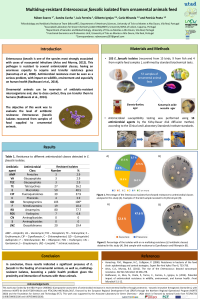
Poster_ECA2021__Soares et al..pdf
Natural antimicrobial peptides and their use in edible food films
THE EFFECT OF AUTOLOGOUS AND HETEROLOGOUS ANTIMICROBIAL PEPTIDES EXTRACT ON RABBIT AND OVINE LEUKOCYTES EVALUATED DURING REPAIR PROCESS.