Event submissions
Published
 10.3390/ECA2021-09611 (registering DOI)
 This submission belongs to the session B. Antimicrobial Discovery, Development, Stewardship and Susceptibility Testing of the event The 1st International Electronic Conference on Antibiotics
Published date
22 Apr, 2021
Citation
Cátia Vieira, Ana T. P. C. Gomes, Mariana Q. Mesquita, Nuno M. M. Moura, M. Graça P. M. S. Neves, M. Amparo F. Faustino, Adelaide Almeida, An Insight Into the Potentiation Effect of Potassium Iodide on aPDT Efficacy, in Proceedings of The 1st International Electronic Conference on Antibiotics, 8 May–17 May 2021, MDPI: Basel, Switzerland, doi: 10.3390/ECA2021-09611
Share
Email
Facebook
Twitter
LinkedIn
An Insight Into the Potentiation Effect of Potassium Iodide on aPDT Efficacy
'%3e%3cpath%20d='M12.6647%2010.9104C12.4176%2010.325%2012.0589%209.7933%2011.6088%209.34485C11.16%208.89511%2010.6283%208.53653%2010.0432%208.28891C10.038%208.28629%2010.0327%208.28498%2010.0275%208.28236C10.8437%207.69282%2011.3743%206.73252%2011.3743%205.64907C11.3743%203.85423%209.92005%202.40002%208.12522%202.40002C6.33038%202.40002%204.87618%203.85423%204.87618%205.64907C4.87618%206.73252%205.40677%207.69282%206.22296%208.28367C6.21772%208.28629%206.21248%208.2876%206.20724%208.29022C5.62031%208.53783%205.09365%208.89287%204.64167%209.34616C4.19192%209.79496%203.83334%2010.3266%203.58573%2010.9117C3.34247%2011.4846%203.21128%2012.0987%203.19925%2012.721C3.1989%2012.735%203.20135%2012.7489%203.20646%2012.7619C3.21157%2012.7749%203.21924%2012.7868%203.22901%2012.7968C3.23877%2012.8068%203.25045%2012.8148%203.26334%2012.8202C3.27623%2012.8256%203.29007%2012.8284%203.30406%2012.8284H4.09012C4.14776%2012.8284%204.19362%2012.7825%204.19493%2012.7262C4.22113%2011.7148%204.62726%2010.7676%205.34519%2010.0497C6.08802%209.30686%207.07452%208.89811%208.12522%208.89811C9.17592%208.89811%2010.1624%209.30686%2010.9052%2010.0497C11.6232%2010.7676%2012.0293%2011.7148%2012.0555%2012.7262C12.0568%2012.7839%2012.1027%2012.8284%2012.1603%2012.8284H12.9464C12.9604%2012.8284%2012.9742%2012.8256%2012.9871%2012.8202C13%2012.8148%2013.0117%2012.8068%2013.0214%2012.7968C13.0312%2012.7868%2013.0389%2012.7749%2013.044%2012.7619C13.0491%2012.7489%2013.0515%2012.735%2013.0512%2012.721C13.0381%2012.0947%2012.9084%2011.4856%2012.6647%2010.9104ZM8.12522%207.90243C7.52388%207.90243%206.95792%207.66793%206.53214%207.24215C6.10636%206.81636%205.87185%206.2504%205.87185%205.64907C5.87185%205.04773%206.10636%204.48177%206.53214%204.05599C6.95792%203.63021%207.52388%203.3957%208.12522%203.3957C8.72655%203.3957%209.29252%203.63021%209.7183%204.05599C10.1441%204.48177%2010.3786%205.04773%2010.3786%205.64907C10.3786%206.2504%2010.1441%206.81636%209.7183%207.24215C9.29252%207.66793%208.72655%207.90243%208.12522%207.90243Z'%20fill='%235D1EE1'/%3e%3c/g%3e%3c/svg%3e)
Cátia Vieira 1
Ana T. P. C. Gomes 2
Mariana Q. Mesquita 3

Nuno M. M. Moura 3

M. Graça P. M. S. Neves 3

M. Amparo F. Faustino 3

Adelaide Almeida 2
1. Department of Biology and CESAM, University of Aveiro, 3810-193 Aveiro, Portugal
2. Department of Biology and CESAM, University of Aveiro, Aveiro, Portugal
3. Department of Chemistry and LAQV-REQUIMTE, University of Aveiro, Aveiro, Portugal
Abstract
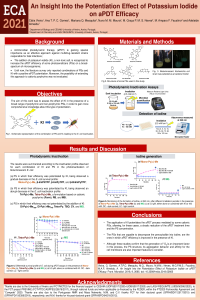
Antimicrobial photodynamic therapy (aPDT) is gaining a special importance as an effective approach against multidrug-resistant strains responsible of fatal infections. The addition of potassium iodide (KI), a non-toxic salt, is recognized to increase the aPDT efficiency of some photosensitizers (PSs) on a broad-spectrum of microorganisms. Until now, the literature survey only reported combinations of PSs and KI with a positive aPDT potentiation. Moreover, the possibility of extending this approach to cationic porphyrins was not evaluated. In order to gain a more comprehensive knowledge about this type of potentiation, in this work we decided to assess the effect of KI in the presence of a broad range of porphyrinic and non-porphyrinic PSs. For this evaluation were selected a series of cationic meso-tetraarylporphyrins charged at meso or β-pyrrolic positions and a set of non-porphyrinic dyes. The aPDT assays mediated by KI were performed using a bioluminescent Escherichia coli strain as a bacterial model. The results indicate that KI has the ability to potentiate the aPDT process mediated by some of the cationic PSs allowing a drastic reduction of the treatment time as well as of the PS concentration. However, the efficacy of some porphyrinic and non-porphyrinic PSs was not improved in the presence of the coadjuvant. This work helped to elucidate that for the series of compounds studied, the PSs capable to decompose the peroxyiodide into iodine (detectable through spectroscopy or by the iodine–starch test) are the most promising to be used in combination with KI, since their efficacy is complemented with the action of iodine. Although these studies confirm that the generation of 1O2 is an important factor in this process, the PS structure, aggregation behavior and affinity for the cell membrane are also important features to consider.
Keywords
antimicrobial photodynamic therapy
cationic porphyrins
phenothiazines
xanthenes
potassium iodide
bioluminescent E. coli
Manuscript
sciforum-044103.pdf
Poster
Poster_Vieira et al. 2018.pdf
The Power of Specialized Biomolecules Against Bacteria
Photodynamic inactivation of methicillin-resistant Staphylococcus aureus on skin using a porphyrinic formulation