Event submissions
Published
 10.3390/ECA2021-09618 (registering DOI)
 This submission belongs to the session F. Poster of the event The 1st International Electronic Conference on Antibiotics
Published date
23 Apr, 2021
Citation
Sandra Cunha, Rúben Soares, Manuel Maia, Gilberto Igrejas, Filipe Silva, Carla Miranda, Patrícia Poeta, Presence of antibiotic-resistant Enterococcus faecalis in colostrum supplied to calves?, in Proceedings of The 1st International Electronic Conference on Antibiotics, 8 May–17 May 2021, MDPI: Basel, Switzerland, doi: 10.3390/ECA2021-09618
Share
Email
Facebook
Twitter
LinkedIn
Presence of antibiotic-resistant Enterococcus faecalis in colostrum supplied to calves?
'%3e%3cpath%20d='M12.6647%2010.9104C12.4176%2010.325%2012.0589%209.7933%2011.6088%209.34485C11.16%208.89511%2010.6283%208.53653%2010.0432%208.28891C10.038%208.28629%2010.0327%208.28498%2010.0275%208.28236C10.8437%207.69282%2011.3743%206.73252%2011.3743%205.64907C11.3743%203.85423%209.92005%202.40002%208.12522%202.40002C6.33038%202.40002%204.87618%203.85423%204.87618%205.64907C4.87618%206.73252%205.40677%207.69282%206.22296%208.28367C6.21772%208.28629%206.21248%208.2876%206.20724%208.29022C5.62031%208.53783%205.09365%208.89287%204.64167%209.34616C4.19192%209.79496%203.83334%2010.3266%203.58573%2010.9117C3.34247%2011.4846%203.21128%2012.0987%203.19925%2012.721C3.1989%2012.735%203.20135%2012.7489%203.20646%2012.7619C3.21157%2012.7749%203.21924%2012.7868%203.22901%2012.7968C3.23877%2012.8068%203.25045%2012.8148%203.26334%2012.8202C3.27623%2012.8256%203.29007%2012.8284%203.30406%2012.8284H4.09012C4.14776%2012.8284%204.19362%2012.7825%204.19493%2012.7262C4.22113%2011.7148%204.62726%2010.7676%205.34519%2010.0497C6.08802%209.30686%207.07452%208.89811%208.12522%208.89811C9.17592%208.89811%2010.1624%209.30686%2010.9052%2010.0497C11.6232%2010.7676%2012.0293%2011.7148%2012.0555%2012.7262C12.0568%2012.7839%2012.1027%2012.8284%2012.1603%2012.8284H12.9464C12.9604%2012.8284%2012.9742%2012.8256%2012.9871%2012.8202C13%2012.8148%2013.0117%2012.8068%2013.0214%2012.7968C13.0312%2012.7868%2013.0389%2012.7749%2013.044%2012.7619C13.0491%2012.7489%2013.0515%2012.735%2013.0512%2012.721C13.0381%2012.0947%2012.9084%2011.4856%2012.6647%2010.9104ZM8.12522%207.90243C7.52388%207.90243%206.95792%207.66793%206.53214%207.24215C6.10636%206.81636%205.87185%206.2504%205.87185%205.64907C5.87185%205.04773%206.10636%204.48177%206.53214%204.05599C6.95792%203.63021%207.52388%203.3957%208.12522%203.3957C8.72655%203.3957%209.29252%203.63021%209.7183%204.05599C10.1441%204.48177%2010.3786%205.04773%2010.3786%205.64907C10.3786%206.2504%2010.1441%206.81636%209.7183%207.24215C9.29252%207.66793%208.72655%207.90243%208.12522%207.90243Z'%20fill='%235D1EE1'/%3e%3c/g%3e%3c/svg%3e)
Sandra Cunha 1
Rúben Soares 1
Manuel Maia 1

Gilberto Igrejas 2,3,4

Filipe Silva 5

Carla Miranda 1,2

Patrícia Poeta 1,2
1. Microbiology and Antibiotic Resistance Team (MicroART), Department of Veterinary Sciences, University of Trás-os-Montes e Alto Douro, Vila Real, Portugal
2. Associated Laboratory for Green Chemistry (LAQV-REQUIMTE), University NOVA of Lisbon, Caparica, Portugal
3. Department of Genetics and Biotechnology, University of Trás-os-Montes e Alto Douro, Vila Real, Portugal
4. Functional Genomics and Proteomics Unit, University of Trás-os-Montes e Alto Douro, Vila Real, Portugal
5. Veterinary and Animal Research Centre (CECAV), University of Trás-os-Montes e Alto Douro, Vila Real, Portugal
Abstract
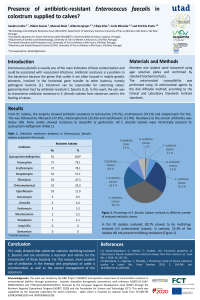
Colostrum can be responsible for colonizing calves gastrointestinal tract by antibiotic-resistant bacteria, such as Enterococcus faecalis one of the main indicators of fecal contamination and associated with nosocomial infections. In this work, the aim to characterize antibiotic resistance in E. faecalis isolates from colostrum used in the feeding of calves. Nineteen one isolates were recovered using agar selective plates and confirmed by biochemical and genetic tests. The antimicrobial susceptibility was performed using 14 antimicrobial agents by the disk diffusion method, according to the Clinical and Laboratory Standards Institute standards. The majority showed antibiotic-resistance to quinupristin-dalfopristin (81.3%), tetracycline (79.1%), erythromycin (79.1%) and streptomycin (57.1%). Isolates were less resistant to rifampicin (47.3%), chloramphenicol (25.3%) and ciprofloxacin (11.0%). Resistance to the remain antibiotics (vancomycin, teicoplanin, nitrofurantoin, fosfomycin and linezolid) was below 10%. None isolate showed resistance to ampicillin or gentamicin. In the 91 isolates analyzed, 85.7% proved to be multidrug-resistant. In conclusion, colostrum contains multidrug-resistant E. faecalis and constitutes a reservoir and vehicle for the transmission of these bacteria. For this reason, more prudent use of antibiotics in the therapy and prophylaxis of cattle is recommended, as well as, the correct management of the colostrum.
Keywords
Enterococcus faecalis
colostrum
dairy calves
antibiotic resistance
multidrug resistance.
Manuscript
sciforum-044034.pdf
Poster
Sandra et al_Poster_ECA2021.pdf
Methicillin-resistant Staphylococcus aureus isolated from the pharynx and nose in children from Mexico City
Escherichia virus MS2, mimetic of SARS-CoV-2, inhibition via essential oils-loaded nanofibers: a potential formulation for antivirus protection masks