Event submissions
Published
 10.3390/ECA2021-09619 (registering DOI)
 This submission belongs to the session F. Poster of the event The 1st International Electronic Conference on Antibiotics
Published date
23 Apr, 2021
Citation
Samira F. da Silva, Joana Domingues, Joana C. Antunes, Helena P. Felgueiras, Escherichia virus MS2, mimetic of SARS-CoV-2, inhibition via essential oils-loaded nanofibers: a potential formulation for antivirus protection masks, in Proceedings of The 1st International Electronic Conference on Antibiotics, 8 May–17 May 2021, MDPI: Basel, Switzerland, doi: 10.3390/ECA2021-09619
Share
Email
Facebook
Twitter
LinkedIn
Escherichia virus MS2, mimetic of SARS-CoV-2, inhibition via essential oils-loaded nanofibers: a potential formulation for antivirus protection masks
'%3e%3cpath%20d='M12.6647%2010.9104C12.4176%2010.325%2012.0589%209.7933%2011.6088%209.34485C11.16%208.89511%2010.6283%208.53653%2010.0432%208.28891C10.038%208.28629%2010.0327%208.28498%2010.0275%208.28236C10.8437%207.69282%2011.3743%206.73252%2011.3743%205.64907C11.3743%203.85423%209.92005%202.40002%208.12522%202.40002C6.33038%202.40002%204.87618%203.85423%204.87618%205.64907C4.87618%206.73252%205.40677%207.69282%206.22296%208.28367C6.21772%208.28629%206.21248%208.2876%206.20724%208.29022C5.62031%208.53783%205.09365%208.89287%204.64167%209.34616C4.19192%209.79496%203.83334%2010.3266%203.58573%2010.9117C3.34247%2011.4846%203.21128%2012.0987%203.19925%2012.721C3.1989%2012.735%203.20135%2012.7489%203.20646%2012.7619C3.21157%2012.7749%203.21924%2012.7868%203.22901%2012.7968C3.23877%2012.8068%203.25045%2012.8148%203.26334%2012.8202C3.27623%2012.8256%203.29007%2012.8284%203.30406%2012.8284H4.09012C4.14776%2012.8284%204.19362%2012.7825%204.19493%2012.7262C4.22113%2011.7148%204.62726%2010.7676%205.34519%2010.0497C6.08802%209.30686%207.07452%208.89811%208.12522%208.89811C9.17592%208.89811%2010.1624%209.30686%2010.9052%2010.0497C11.6232%2010.7676%2012.0293%2011.7148%2012.0555%2012.7262C12.0568%2012.7839%2012.1027%2012.8284%2012.1603%2012.8284H12.9464C12.9604%2012.8284%2012.9742%2012.8256%2012.9871%2012.8202C13%2012.8148%2013.0117%2012.8068%2013.0214%2012.7968C13.0312%2012.7868%2013.0389%2012.7749%2013.044%2012.7619C13.0491%2012.7489%2013.0515%2012.735%2013.0512%2012.721C13.0381%2012.0947%2012.9084%2011.4856%2012.6647%2010.9104ZM8.12522%207.90243C7.52388%207.90243%206.95792%207.66793%206.53214%207.24215C6.10636%206.81636%205.87185%206.2504%205.87185%205.64907C5.87185%205.04773%206.10636%204.48177%206.53214%204.05599C6.95792%203.63021%207.52388%203.3957%208.12522%203.3957C8.72655%203.3957%209.29252%203.63021%209.7183%204.05599C10.1441%204.48177%2010.3786%205.04773%2010.3786%205.64907C10.3786%206.2504%2010.1441%206.81636%209.7183%207.24215C9.29252%207.66793%208.72655%207.90243%208.12522%207.90243Z'%20fill='%235D1EE1'/%3e%3c/g%3e%3c/svg%3e)
Samira F. da Silva 1
Joana Domingues 1

Joana C. Antunes 1

Helena P. Felgueiras 2
1. Centre for Textile Science and Technology, University of Minho
2. Centre for Textile Science and Technology, University of Minho, Portugal
Abstract
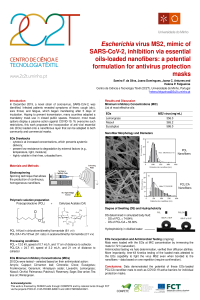
In 2019, a novel strain of coronavirus, SARS-CoV-2, was identified and the use of protective masks became essential. Considering most mask options display a passive-like action against COVID-19, we proposed the incorporation of anti-viral essential oils (EOs) onto nanofibrous mats, to function as inner layers in three-layer masks, and this way actively fight the virus.
Polycaprolactone (PCL) and cellulose acetate (CA) solutions were prepared individually at 14 wt% in chloroform/dimethylformamide (DMF) and 10 wt% in acetone/DMF, respectively, and then combined at 3:1 ratio. Polymeric solutions were processed via eletrospinning at 24.7 kV, 3.2 mL/h and 21 cm. Uniform, beadless nanofibers were obtained. Mats were characterized as mechanically resilient, to endure movements arising from mask handling, and hydrophobic in nature, to repel droplets coming from the exterior. Twenty EOs selected based on their antimicrobial nature were examined for the first time against the Escherichia virus MS2, a mimetic of COVID-19. The most effective were the lemongrass (LO), Niaouli (NO) and eucalyptus (ELO) with a minimum inhibitory concentration (MIC) of 356.0 mg/mL, 365.2 mg/mL and 586.0 mg/mL, respectively. Loading of the nanofibrous mats was accomplished via physisorption using the free -OH groups of the CA as linkers. Mats were loaded with the EOs at MIC concentration for 72 h (saturation) under constant agitation. Presence of the EOs was confirmed along the mats by UV/visible spectroscopy. Kirby-Bauer examinations verified the EOs-loaded mat’s diffusion abilities and antimicrobial effectiveness (formation of halos). Time-kill kinetics reported the elimination of >99% of MS2 virus in 6 h of contact. Data demonstrated the potential of these EOs-loaded PCL/CA nanofibers mats to work as COVID-19 active barriers in protection masks.
Keywords
eletrospinning
hydrophobic barrier
mechanical resistance
antimicrobial
fighting covid-19 virus
Manuscript
sciforum-043914.pdf
Poster
2021.04.22_ECA Samira.pdf
Presence of antibiotic-resistant Enterococcus faecalis in colostrum supplied to calves?
Contribution of urinary tract infections to antibiotic consumption in Europe