Event submissions
Published
 10.3390/ECA2021-09620 (registering DOI)
 This submission belongs to the session F. Poster of the event The 1st International Electronic Conference on Antibiotics
Published date
23 Apr, 2021
Citation
Thomas Kopf, Jean-Marc Bohbot, Heinz Kölbl, Annette Kuhn, Sławomir Poletajew, Florian Wagenlehner, Contribution of urinary tract infections to antibiotic consumption in Europe, in Proceedings of The 1st International Electronic Conference on Antibiotics, 8 May–17 May 2021, MDPI: Basel, Switzerland, doi: 10.3390/ECA2021-09620
Share
Email
Facebook
Twitter
LinkedIn
Contribution of urinary tract infections to antibiotic consumption in Europe
'%3e%3cpath%20d='M12.6647%2010.9104C12.4176%2010.325%2012.0589%209.7933%2011.6088%209.34485C11.16%208.89511%2010.6283%208.53653%2010.0432%208.28891C10.038%208.28629%2010.0327%208.28498%2010.0275%208.28236C10.8437%207.69282%2011.3743%206.73252%2011.3743%205.64907C11.3743%203.85423%209.92005%202.40002%208.12522%202.40002C6.33038%202.40002%204.87618%203.85423%204.87618%205.64907C4.87618%206.73252%205.40677%207.69282%206.22296%208.28367C6.21772%208.28629%206.21248%208.2876%206.20724%208.29022C5.62031%208.53783%205.09365%208.89287%204.64167%209.34616C4.19192%209.79496%203.83334%2010.3266%203.58573%2010.9117C3.34247%2011.4846%203.21128%2012.0987%203.19925%2012.721C3.1989%2012.735%203.20135%2012.7489%203.20646%2012.7619C3.21157%2012.7749%203.21924%2012.7868%203.22901%2012.7968C3.23877%2012.8068%203.25045%2012.8148%203.26334%2012.8202C3.27623%2012.8256%203.29007%2012.8284%203.30406%2012.8284H4.09012C4.14776%2012.8284%204.19362%2012.7825%204.19493%2012.7262C4.22113%2011.7148%204.62726%2010.7676%205.34519%2010.0497C6.08802%209.30686%207.07452%208.89811%208.12522%208.89811C9.17592%208.89811%2010.1624%209.30686%2010.9052%2010.0497C11.6232%2010.7676%2012.0293%2011.7148%2012.0555%2012.7262C12.0568%2012.7839%2012.1027%2012.8284%2012.1603%2012.8284H12.9464C12.9604%2012.8284%2012.9742%2012.8256%2012.9871%2012.8202C13%2012.8148%2013.0117%2012.8068%2013.0214%2012.7968C13.0312%2012.7868%2013.0389%2012.7749%2013.044%2012.7619C13.0491%2012.7489%2013.0515%2012.735%2013.0512%2012.721C13.0381%2012.0947%2012.9084%2011.4856%2012.6647%2010.9104ZM8.12522%207.90243C7.52388%207.90243%206.95792%207.66793%206.53214%207.24215C6.10636%206.81636%205.87185%206.2504%205.87185%205.64907C5.87185%205.04773%206.10636%204.48177%206.53214%204.05599C6.95792%203.63021%207.52388%203.3957%208.12522%203.3957C8.72655%203.3957%209.29252%203.63021%209.7183%204.05599C10.1441%204.48177%2010.3786%205.04773%2010.3786%205.64907C10.3786%206.2504%2010.1441%206.81636%209.7183%207.24215C9.29252%207.66793%208.72655%207.90243%208.12522%207.90243Z'%20fill='%235D1EE1'/%3e%3c/g%3e%3c/svg%3e)
Thomas Kopf 1
Jean-Marc Bohbot 2
Heinz Kölbl 3
Annette Kuhn 4
Sławomir Poletajew 5
Florian Wagenlehner 6
1. MCM Klosterfrau Vertriebsgesellschaft mbH, Cologne, Germany, part of the Klosterfrau Healthcare Group
2. Genito-Urinary Medicine Department, Institute Fournier, Paris, France
3. University Clinic for Gynecology, Clinical Department of General Gynecology and Gynecological Oncology, Vienna, Austria
4. Consultant Urogynecologist Frauenklinik, Inselspital, and University of Bern, Bern, Switzerland
5. Second Department of Urology, Centre of Postgraduate Medical Education, Warsaw, Poland
6. Clinic for Urology, Pediatric Urology and Andrology, Justus-Liebig University, Giessen, Germany
Abstract
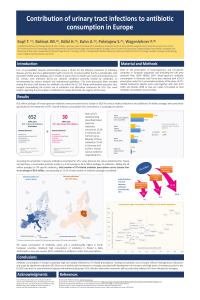
Antimicrobial resistance considerably affects the European Union, with estimated 33,000 yearly fatalities and 1.5 billion € yearly costs for health care needs and productivity loss. As urinary tract infections (UTIs) are common conditions primarily treated by antibiotics, rising antimicrobial resistance compels reconsidering the current use of antibiotics and alternative treatments for such infections. Our insights into the so far unexplored prescription of antibiotics in Europe illuminate the urgency of this issue.
Data on the prescription of broad-spectrum and UTI-specific antibiotics in European outpatient care were obtained from IQVIA MIDAS 2019. Broad-spectrum antibiotic consumption in Germany and France was matched with ICD10 prescription codes for a conservative estimate of UTI-related treatment share and used together with data from OECD and Statista 2020 to map per capita UTI-related to total antibiotic consumption across Europe.
652 million packages of broad-spectrum antibiotics and additional 30 million packages of so called UTI-specific antibiotics were consumed. Per capita consumption varies but is predominantly higher in South Europe. Share of UTI-related among broad-spectrum antibiotic prescriptions amounts to 13.1% in Germany and 5.4% in France, with majority provided for unspecified UTIs (Germany: 72.4%, France: 42.5%). Based on an estimated 9.1% average, UTI-related prescriptions rise to 89.6 million (13.1% of total antibiotic consumption).
Antibiotic consumption in Europe is generally high and notably affected by UTI-related prescriptions. Varying consumption across Europe reflects heterogeneous indications. In view of increasing antimicrobial resistance, effective alternative treatments will be relevant for future therapeutic strategies.
Keywords
Antimicrobial resistance
Antibiotic consumption
Urinary tract infections
outpatient
Europe
Manuscript
sciforum-044211-manuscript.pdf
Poster
Kopf et al ECA 2021 poster - final.pdf
Escherichia virus MS2, mimetic of SARS-CoV-2, inhibition via essential oils-loaded nanofibers: a potential formulation for antivirus protection masks
Main isolated microorganisms and their antimicrobial resistance from uterine lavage in mares.