Event submissions
Published
 10.3390/ECA2021-09621 (registering DOI)
 This submission belongs to the session F. Poster of the event The 1st International Electronic Conference on Antibiotics
Published date
23 Apr, 2021
Citation
Sofía Gabriela Zurita, Pablo Antonio García Blanco, Alfredo García Sánchez, María Gil Molino, Main isolated microorganisms and their antimicrobial resistance from uterine lavage in mares., in Proceedings of The 1st International Electronic Conference on Antibiotics, 8 May–17 May 2021, MDPI: Basel, Switzerland, doi: 10.3390/ECA2021-09621
Share
Email
Facebook
Twitter
LinkedIn
Main isolated microorganisms and their antimicrobial resistance from uterine lavage in mares.
'%3e%3cpath%20d='M12.6647%2010.9104C12.4176%2010.325%2012.0589%209.7933%2011.6088%209.34485C11.16%208.89511%2010.6283%208.53653%2010.0432%208.28891C10.038%208.28629%2010.0327%208.28498%2010.0275%208.28236C10.8437%207.69282%2011.3743%206.73252%2011.3743%205.64907C11.3743%203.85423%209.92005%202.40002%208.12522%202.40002C6.33038%202.40002%204.87618%203.85423%204.87618%205.64907C4.87618%206.73252%205.40677%207.69282%206.22296%208.28367C6.21772%208.28629%206.21248%208.2876%206.20724%208.29022C5.62031%208.53783%205.09365%208.89287%204.64167%209.34616C4.19192%209.79496%203.83334%2010.3266%203.58573%2010.9117C3.34247%2011.4846%203.21128%2012.0987%203.19925%2012.721C3.1989%2012.735%203.20135%2012.7489%203.20646%2012.7619C3.21157%2012.7749%203.21924%2012.7868%203.22901%2012.7968C3.23877%2012.8068%203.25045%2012.8148%203.26334%2012.8202C3.27623%2012.8256%203.29007%2012.8284%203.30406%2012.8284H4.09012C4.14776%2012.8284%204.19362%2012.7825%204.19493%2012.7262C4.22113%2011.7148%204.62726%2010.7676%205.34519%2010.0497C6.08802%209.30686%207.07452%208.89811%208.12522%208.89811C9.17592%208.89811%2010.1624%209.30686%2010.9052%2010.0497C11.6232%2010.7676%2012.0293%2011.7148%2012.0555%2012.7262C12.0568%2012.7839%2012.1027%2012.8284%2012.1603%2012.8284H12.9464C12.9604%2012.8284%2012.9742%2012.8256%2012.9871%2012.8202C13%2012.8148%2013.0117%2012.8068%2013.0214%2012.7968C13.0312%2012.7868%2013.0389%2012.7749%2013.044%2012.7619C13.0491%2012.7489%2013.0515%2012.735%2013.0512%2012.721C13.0381%2012.0947%2012.9084%2011.4856%2012.6647%2010.9104ZM8.12522%207.90243C7.52388%207.90243%206.95792%207.66793%206.53214%207.24215C6.10636%206.81636%205.87185%206.2504%205.87185%205.64907C5.87185%205.04773%206.10636%204.48177%206.53214%204.05599C6.95792%203.63021%207.52388%203.3957%208.12522%203.3957C8.72655%203.3957%209.29252%203.63021%209.7183%204.05599C10.1441%204.48177%2010.3786%205.04773%2010.3786%205.64907C10.3786%206.2504%2010.1441%206.81636%209.7183%207.24215C9.29252%207.66793%208.72655%207.90243%208.12522%207.90243Z'%20fill='%235D1EE1'/%3e%3c/g%3e%3c/svg%3e)
Sofía Gabriela Zurita 1
Pablo Antonio García Blanco 2
Alfredo García Sánchez 3
María Gil Molino 1
1. Service of sample processing and diagnosis, Clinical Veterinary Teaching Hospital of the University of Extremadura, Cáceres, Spain
2. Infectious Pathology Department, Faculty of Veterinary Medicine, University of Extremadura, Cáceres, Spain
3. Department of Animal Production, CICYTEX-La Orden, Guadajira, Spain
Abstract
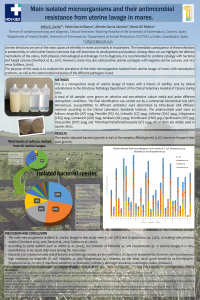
This work is a retrospective study of uterine lavage of mares with a history of sterility, sent by clinical veterinarians to the Infectious Pathology Department of the Clinical Veterinary Hospital of Cáceres during 2019.
The purpose of this study is to evaluate the prevalence of the main microorganisms isolated from uterine lavage of mares with reproductive problems, as well as the antimicrobial resistance of the different pathogens found.
A total of 66 samples were grown on selective and non-selective culture media and under different atmospheric conditions. The final identification was carried out by a commercial biochemical test (API; Biomerieux). Susceptibilities to different antibiotics were determined by Kirby-Bauer disk diffusion methods according to the Clinical Laboratory Standards Institute. The antimicrobials used were as follows: Ampicillin, Penicillin, Cefazolin, Ceftiofur, Cefquinome, Gentamicin, Amikacin, Enrofloxacin, Ciprofloxacin, Doxycycline and Trimethoprim/Sulfamethoxazole. All of them are widely used in equine clinics.
The results indicated a bacterial growth in 63.6% of the samples. Mixed growth (24.2%) was more frequent than pure growth. The most commonly isolated bacterial species was Escherichia coli (28.6%), followed by Streptococcus sp. (23.8%), Klebsiella sp. (15.9%) and Pseudomonas sp. (12.7%). On the other hand, fungi were isolated in 4.6% of them.
The main resistances observed in E. coli were to Doxycycline (44.4%), Ampicillin and Cefquinoma (38.9%), whereas the antibiotic to which they were most sensitive was Enrofloxacin (83.3%). In the case of Streptococcus sp., the most of these were resistant to Amikacin (100%) and Enrofloxacin (66.7%) and sensitive to Ceftiofur (88.7%). Klebsiella sp. was resistant to Ampicillin in all strains (100%) and Cefquinome (60%), and sensitive to Enrofloxacin (80%). Finally, Pseudomonas sp. showed high resistance to Ampicillin (75%) and Doxycycline and Trimethoprim / Sulfamethoxazole (62.5%) and showed a great sensitivity to Enrofloxacin (100%).
Keywords
Mares
Uterine lavage
Antimicrobial resistance
Manuscript
POSTER Lavados uterinos (1).pdf
Poster
POSTER Lavados uterinos (1).pdf
Contribution of urinary tract infections to antibiotic consumption in Europe
Antimicrobial activity of phytochemical-antibiotic combinations against pathogenic bacteria