Event submissions
Published
 10.3390/ECA2021-09630 (registering DOI)
 This submission belongs to the session F. Poster of the event The 1st International Electronic Conference on Antibiotics
Published date
26 Apr, 2021
Citation
Shelby L Reimer, Daniel R Beniac, Shannon L Hiebert, Timothy F Booth, Patrick M Chong, Garrett R Westmacott, George G Zhanel, Denice C Bay, Comparative analysis of outer membrane vesicles from cationic adapted Escherichia coli isolates reveals unique vesicle membrane morphologies and different antimicrobial susceptibilities when supplemented to unadapted E. coli, in Proceedings of The 1st International Electronic Conference on Antibiotics, 8 May–17 May 2021, MDPI: Basel, Switzerland, doi: 10.3390/ECA2021-09630
Share
Email
Facebook
Twitter
LinkedIn
Comparative analysis of outer membrane vesicles from cationic adapted Escherichia coli isolates reveals unique vesicle membrane morphologies and different antimicrobial susceptibilities when supplemented to unadapted E. coli
'%3e%3cpath%20d='M12.6647%2010.9104C12.4176%2010.325%2012.0589%209.7933%2011.6088%209.34485C11.16%208.89511%2010.6283%208.53653%2010.0432%208.28891C10.038%208.28629%2010.0327%208.28498%2010.0275%208.28236C10.8437%207.69282%2011.3743%206.73252%2011.3743%205.64907C11.3743%203.85423%209.92005%202.40002%208.12522%202.40002C6.33038%202.40002%204.87618%203.85423%204.87618%205.64907C4.87618%206.73252%205.40677%207.69282%206.22296%208.28367C6.21772%208.28629%206.21248%208.2876%206.20724%208.29022C5.62031%208.53783%205.09365%208.89287%204.64167%209.34616C4.19192%209.79496%203.83334%2010.3266%203.58573%2010.9117C3.34247%2011.4846%203.21128%2012.0987%203.19925%2012.721C3.1989%2012.735%203.20135%2012.7489%203.20646%2012.7619C3.21157%2012.7749%203.21924%2012.7868%203.22901%2012.7968C3.23877%2012.8068%203.25045%2012.8148%203.26334%2012.8202C3.27623%2012.8256%203.29007%2012.8284%203.30406%2012.8284H4.09012C4.14776%2012.8284%204.19362%2012.7825%204.19493%2012.7262C4.22113%2011.7148%204.62726%2010.7676%205.34519%2010.0497C6.08802%209.30686%207.07452%208.89811%208.12522%208.89811C9.17592%208.89811%2010.1624%209.30686%2010.9052%2010.0497C11.6232%2010.7676%2012.0293%2011.7148%2012.0555%2012.7262C12.0568%2012.7839%2012.1027%2012.8284%2012.1603%2012.8284H12.9464C12.9604%2012.8284%2012.9742%2012.8256%2012.9871%2012.8202C13%2012.8148%2013.0117%2012.8068%2013.0214%2012.7968C13.0312%2012.7868%2013.0389%2012.7749%2013.044%2012.7619C13.0491%2012.7489%2013.0515%2012.735%2013.0512%2012.721C13.0381%2012.0947%2012.9084%2011.4856%2012.6647%2010.9104ZM8.12522%207.90243C7.52388%207.90243%206.95792%207.66793%206.53214%207.24215C6.10636%206.81636%205.87185%206.2504%205.87185%205.64907C5.87185%205.04773%206.10636%204.48177%206.53214%204.05599C6.95792%203.63021%207.52388%203.3957%208.12522%203.3957C8.72655%203.3957%209.29252%203.63021%209.7183%204.05599C10.1441%204.48177%2010.3786%205.04773%2010.3786%205.64907C10.3786%206.2504%2010.1441%206.81636%209.7183%207.24215C9.29252%207.66793%208.72655%207.90243%208.12522%207.90243Z'%20fill='%235D1EE1'/%3e%3c/g%3e%3c/svg%3e)
Shelby L Reimer 1
Daniel R Beniac 2
Shannon L Hiebert 2
Timothy F Booth 2
Patrick M Chong 2
Garrett R Westmacott 2
George G Zhanel 1
Denice C Bay 1
1. Department of Medical Microbiology and Infectious Diseases, University of Manitoba, Winnipeg, Manitoba, Canada
2. National Microbiology Laboratory, Public Health Agency of Canada, Winnipeg, Manitoba, Canada
Abstract
Cationic antimicrobials (CA) such as the therapeutic antibiotic colistin (COL) and antiseptics cetrimide (CET) and chlorhexidine (CHX) all exert their mechanism of action by disrupting bacterial membranes, leading to cell content leakage and death. Resistance to CAs is rapidly increasing and of the many antimicrobial resistance mechanisms that may contribute, the role of outer membrane vesicle (OMV) formation is least understood. Here, we gradually adapted E. coli BW215113 K-12 to COL, CET, and CHX by prolonged exposure in vitro to determine how each CA impacts OMV formation. We assessed OMVs isolated from each CA-adapted strain by nanoparticle tracking analysis (NTA) and cryo-transmission electron microscopy (cryo-TEM), and compared OMV proteomes using liquid chromatography-mass spectroscopy. The results of NTA analysis showed that all three CA-adapted strains had increased OMV formation as compared to unadapted BW25113 (WT), where CA-adapted OMVs were significantly larger. Cryo-TEM analyses revealed that each strain’s OMVs had distinctive morphological alterations, where CET-OMVs looked similar to unadapted WT OMVs but were encapsulated and aggregated, CHX-OMVs were multilamellar and COL-OMVs were large (4-12X) and tubular as compared to WT OMVs. Proteomic analysis highlighted significant increases in EptC abundance in COL-OMVs and decreased abundance of MlaA in CHX-OMVs. Antimicrobial susceptibility testing of E. coli BW25113 K-12 supplemented with purified CA-adapted OMVs demonstrated that CET-OMVs did not alter CET susceptibility, CHX-OMVs enhanced BW25113 tolerance to CHX exposure by 2-fold, and COL-OMV supplementation to BW25113 increased COL susceptibility by 2-fold compared to unadapted WT OMVs. Hence, CA adaptation by E. coli has significant ramifications on OMV production and morphology, and CA-adapted OMV exposure has significant consequences for bacterial antimicrobial susceptibility.
Keywords
Antimicrobial resistance
Cationic Antimicrobials
Colistin
Cetrimide
Chlorhexidine
Outer membrane vesicles
Manuscript
sciforum-044307.pdf
Poster
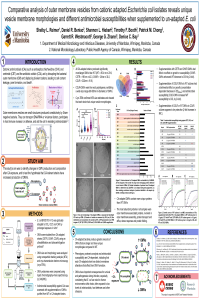
ShelbyReimer_ECA2021_PosterPresentation.pdf
Prevalence of Beta-lactamase producing Enterobacteriaceae in fresh vegetables
Characterization of fosA3, fosA8, and novel fosA7.5 genes from fosfomycin-resistant Escherichia coli clinical isolates obtained from Canadian hospitals through the CANWARD study