Event submissions
Published
 10.3390/ECA2021-09631 (registering DOI)
 This submission belongs to the session A. Antimicrobial Resistance Mechanisms and Intrinsic Microbial Factors Contributing to Resistance of the event The 1st International Electronic Conference on Antibiotics
Published date
26 Apr, 2021
Citation
Kieran A Milner, Denice C. Bay, David Alexander, Andrew Walkty, James A Karlowsky, Meenu K Sharma, George G Zhanel, Characterization of fosA3, fosA8, and novel fosA7.5 genes from fosfomycin-resistant Escherichia coli clinical isolates obtained from Canadian hospitals through the CANWARD study, in Proceedings of The 1st International Electronic Conference on Antibiotics, 8 May–17 May 2021, MDPI: Basel, Switzerland, doi: 10.3390/ECA2021-09631
Share
Email
Facebook
Twitter
LinkedIn
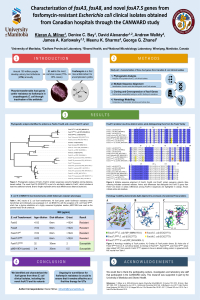
Characterization of fosA3, fosA8, and novel fosA7.5 genes from fosfomycin-resistant Escherichia coli clinical isolates obtained from Canadian hospitals through the CANWARD study
'%3e%3cpath%20d='M12.6647%2010.9104C12.4176%2010.325%2012.0589%209.7933%2011.6088%209.34485C11.16%208.89511%2010.6283%208.53653%2010.0432%208.28891C10.038%208.28629%2010.0327%208.28498%2010.0275%208.28236C10.8437%207.69282%2011.3743%206.73252%2011.3743%205.64907C11.3743%203.85423%209.92005%202.40002%208.12522%202.40002C6.33038%202.40002%204.87618%203.85423%204.87618%205.64907C4.87618%206.73252%205.40677%207.69282%206.22296%208.28367C6.21772%208.28629%206.21248%208.2876%206.20724%208.29022C5.62031%208.53783%205.09365%208.89287%204.64167%209.34616C4.19192%209.79496%203.83334%2010.3266%203.58573%2010.9117C3.34247%2011.4846%203.21128%2012.0987%203.19925%2012.721C3.1989%2012.735%203.20135%2012.7489%203.20646%2012.7619C3.21157%2012.7749%203.21924%2012.7868%203.22901%2012.7968C3.23877%2012.8068%203.25045%2012.8148%203.26334%2012.8202C3.27623%2012.8256%203.29007%2012.8284%203.30406%2012.8284H4.09012C4.14776%2012.8284%204.19362%2012.7825%204.19493%2012.7262C4.22113%2011.7148%204.62726%2010.7676%205.34519%2010.0497C6.08802%209.30686%207.07452%208.89811%208.12522%208.89811C9.17592%208.89811%2010.1624%209.30686%2010.9052%2010.0497C11.6232%2010.7676%2012.0293%2011.7148%2012.0555%2012.7262C12.0568%2012.7839%2012.1027%2012.8284%2012.1603%2012.8284H12.9464C12.9604%2012.8284%2012.9742%2012.8256%2012.9871%2012.8202C13%2012.8148%2013.0117%2012.8068%2013.0214%2012.7968C13.0312%2012.7868%2013.0389%2012.7749%2013.044%2012.7619C13.0491%2012.7489%2013.0515%2012.735%2013.0512%2012.721C13.0381%2012.0947%2012.9084%2011.4856%2012.6647%2010.9104ZM8.12522%207.90243C7.52388%207.90243%206.95792%207.66793%206.53214%207.24215C6.10636%206.81636%205.87185%206.2504%205.87185%205.64907C5.87185%205.04773%206.10636%204.48177%206.53214%204.05599C6.95792%203.63021%207.52388%203.3957%208.12522%203.3957C8.72655%203.3957%209.29252%203.63021%209.7183%204.05599C10.1441%204.48177%2010.3786%205.04773%2010.3786%205.64907C10.3786%206.2504%2010.1441%206.81636%209.7183%207.24215C9.29252%207.66793%208.72655%207.90243%208.12522%207.90243Z'%20fill='%235D1EE1'/%3e%3c/g%3e%3c/svg%3e)
Kieran A Milner 1
Denice C. Bay 1
David Alexander 1,2
Andrew Walkty 1,3
James A Karlowsky 1,3
Meenu K Sharma 1,4
George G Zhanel 1
1. Department of Medical Microbiology and Infectious Diseases, Max Rady College of Medicine, University of Manitoba, Winnipeg, Canada
2. Cadham Provincial Laboratory, Winnipeg, Canada
3. Shared Health, Winnipeg, Canada
4. Public Health Agency of Canada – National Microbiology Laboratory, Winnipeg, Canada
Abstract
Fosfomycin is a first line antibiotic indicated for the treatment of acute uncomplicated cystitis in adult women infected with Escherichia coli or Enterococcus faecalis. Resistance to fosfomycin can be conferred by plasmid-transferable fos genes, which encode modified versions of glutathione transferase enzymes that can inactivate this antibiotic. In Canada, fosfomycin resistance and fos gene detection among E. coli clinical isolates are rare and have not been well described to date. Here, we characterize the fosA genes from three E. coli clinical isolates recovered from Canadian patients (two from urine, one from blood), and two additional fosA genes from the fosA7.5 family. Phylogenetic analysis of these FosA sequences showed close homology to previously characterized FosA proteins. Cloning and overexpression of each fosA sequence in E. coli BW25113 for antimicrobial susceptibility testing confirmed that all fosA genes exhibited fosfomycin-resistant phenotypes (MIC values of >512 and >1024 µg/mL) with the exception of one fosA7.5 variant. Homology modelling of each FosA protein suggests that residue alterations in this inactive fosA7.5 variant may impact fosfomycin drug interactions at the active site region. The findings from this study identify and functionally characterize FosA3, FosA8, as well as novel FosA7.5 members and highlight the importance of phenotypic characterization of fosA genes.
Keywords
fosfomycin
fosA7
escherichia coli
urinary tract infections
novel fosA
Manuscript
sciforum-044310_poster.pdf
Poster
sciforum-044310_poster.pdf
Comparative analysis of outer membrane vesicles from cationic adapted Escherichia coli isolates reveals unique vesicle membrane morphologies and different antimicrobial susceptibilities when supplemented to unadapted E. coli
A new series of Cinnamoyl analogs compound unveil both efflux pump inhibition and antibacterial activity