Event submissions
Published
 10.3390/ECA2021-09635 (registering DOI)
 This submission belongs to the session F. Poster of the event The 1st International Electronic Conference on Antibiotics
Published date
26 Apr, 2021
Citation
Abdullahi Temitope Jamiu, Jacobus Albertyn, Olihile Sebolai, Carolina Pohl-Albertyn, Arachidonic acid is a potential inhibitor of Abc1 transporter of Candida krusei, in Proceedings of The 1st International Electronic Conference on Antibiotics, 8 May–17 May 2021, MDPI: Basel, Switzerland, doi: 10.3390/ECA2021-09635
Share
Email
Facebook
Twitter
LinkedIn
Arachidonic acid is a potential inhibitor of Abc1 transporter of Candida krusei
'%3e%3cpath%20d='M12.6647%2010.9104C12.4176%2010.325%2012.0589%209.7933%2011.6088%209.34485C11.16%208.89511%2010.6283%208.53653%2010.0432%208.28891C10.038%208.28629%2010.0327%208.28498%2010.0275%208.28236C10.8437%207.69282%2011.3743%206.73252%2011.3743%205.64907C11.3743%203.85423%209.92005%202.40002%208.12522%202.40002C6.33038%202.40002%204.87618%203.85423%204.87618%205.64907C4.87618%206.73252%205.40677%207.69282%206.22296%208.28367C6.21772%208.28629%206.21248%208.2876%206.20724%208.29022C5.62031%208.53783%205.09365%208.89287%204.64167%209.34616C4.19192%209.79496%203.83334%2010.3266%203.58573%2010.9117C3.34247%2011.4846%203.21128%2012.0987%203.19925%2012.721C3.1989%2012.735%203.20135%2012.7489%203.20646%2012.7619C3.21157%2012.7749%203.21924%2012.7868%203.22901%2012.7968C3.23877%2012.8068%203.25045%2012.8148%203.26334%2012.8202C3.27623%2012.8256%203.29007%2012.8284%203.30406%2012.8284H4.09012C4.14776%2012.8284%204.19362%2012.7825%204.19493%2012.7262C4.22113%2011.7148%204.62726%2010.7676%205.34519%2010.0497C6.08802%209.30686%207.07452%208.89811%208.12522%208.89811C9.17592%208.89811%2010.1624%209.30686%2010.9052%2010.0497C11.6232%2010.7676%2012.0293%2011.7148%2012.0555%2012.7262C12.0568%2012.7839%2012.1027%2012.8284%2012.1603%2012.8284H12.9464C12.9604%2012.8284%2012.9742%2012.8256%2012.9871%2012.8202C13%2012.8148%2013.0117%2012.8068%2013.0214%2012.7968C13.0312%2012.7868%2013.0389%2012.7749%2013.044%2012.7619C13.0491%2012.7489%2013.0515%2012.735%2013.0512%2012.721C13.0381%2012.0947%2012.9084%2011.4856%2012.6647%2010.9104ZM8.12522%207.90243C7.52388%207.90243%206.95792%207.66793%206.53214%207.24215C6.10636%206.81636%205.87185%206.2504%205.87185%205.64907C5.87185%205.04773%206.10636%204.48177%206.53214%204.05599C6.95792%203.63021%207.52388%203.3957%208.12522%203.3957C8.72655%203.3957%209.29252%203.63021%209.7183%204.05599C10.1441%204.48177%2010.3786%205.04773%2010.3786%205.64907C10.3786%206.2504%2010.1441%206.81636%209.7183%207.24215C9.29252%207.66793%208.72655%207.90243%208.12522%207.90243Z'%20fill='%235D1EE1'/%3e%3c/g%3e%3c/svg%3e)
Abdullahi Temitope Jamiu 1
Jacobus Albertyn 1
Olihile Sebolai 1

Carolina Pohl-Albertyn 1
1. University of the Free State
Abstract
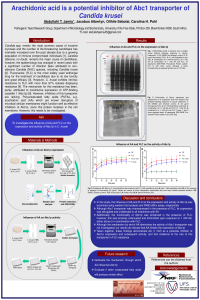
With innate resistance to fluconazole (FLC) and rapid acquired resistance to other antifungal drugs, Candida krusei represents a potential multidrug-resistant pathogen. The mechanism of intrinsic FLC resistance in this yeast has been chiefly attributed to decreased susceptibility of FLC target, lanosterol 14α-demethylase (Erg11p), however, the role of efflux pump transporters remains controversial, and requires further investigation. Furthermore, although the overexpression of these transporters, including ATP-binding cassette 1 protein (Abc1p), results in multidrug-resistance phenotype, their inhibitors are limited. More so, there is currently no class of antifungal that specifically targets these transporters. Polyunsaturated fatty acids (PUFAs), including arachidonic acid (AA), which are known disruptors of the cellular membranes might function well as effective efflux pump inhibitors; however, this needs to be investigated. Hence, this study attempted to examine the influence of AA (with or without FLC) on the expression and activity of a representative ABC transporter, Abc1p, in C. krusei. This was carried out by exposing C. krusei biofilms to varying concentrations of AA alone or in combination FLC, and determining Abc1p expression and function using western blot analysis and Rhodamine 6G efflux assay, respectively. Our results demonstrate that Abc1p is overexpressed following exposure to FLC alone, but not in any treatments with AA. Furthermore, Abc1p exhibited increased functionality in the presence of FLC; however, this was severely diminished upon exposure to 1 mM AA, either alone or in combination with FLC. These findings demonstrate AA as a potential inhibitor of Abc1p expression, and subsequent activity. However, further research is necessary to fully delineate how AA influences this transporter.
Keywords
Candida krusei
Antifungal resistance
Arachidonic acid
Efflux pump transporter
Manuscript
AT Jamiu poster_ECA2021 - Final version.pdf
Poster
AT Jamiu poster_ECA2021 - Final version.pdf
Sodium alginate/gelatin wet-spun fibers as a delivery platform for Nisin Z controlled release: antibacterial features against Staphylococcus aureus
Extracellular Vesicles Promote Mycobacterial Killing in Macrophages in Combination with Antibiotics