Event submissions
Published
 10.3390/ECA2021-09637 (registering DOI)
 This submission belongs to the session F. Poster of the event The 1st International Electronic Conference on Antibiotics
Published date
26 Apr, 2021
Citation
Dustin Maydaniuk, Bin Wu, Dang Truong, Sajani Liyanage, Mingdi Yan, Silvia T Cardona, Auranofin derivatives as potent bactericidal antimicrobials against cystic fibrosis pathogen Burkholderia cenocepacia, in Proceedings of The 1st International Electronic Conference on Antibiotics, 8 May–17 May 2021, MDPI: Basel, Switzerland, doi: 10.3390/ECA2021-09637
Share
Email
Facebook
Twitter
LinkedIn
Auranofin derivatives as potent bactericidal antimicrobials against cystic fibrosis pathogen Burkholderia cenocepacia
'%3e%3cpath%20d='M12.6647%2010.9104C12.4176%2010.325%2012.0589%209.7933%2011.6088%209.34485C11.16%208.89511%2010.6283%208.53653%2010.0432%208.28891C10.038%208.28629%2010.0327%208.28498%2010.0275%208.28236C10.8437%207.69282%2011.3743%206.73252%2011.3743%205.64907C11.3743%203.85423%209.92005%202.40002%208.12522%202.40002C6.33038%202.40002%204.87618%203.85423%204.87618%205.64907C4.87618%206.73252%205.40677%207.69282%206.22296%208.28367C6.21772%208.28629%206.21248%208.2876%206.20724%208.29022C5.62031%208.53783%205.09365%208.89287%204.64167%209.34616C4.19192%209.79496%203.83334%2010.3266%203.58573%2010.9117C3.34247%2011.4846%203.21128%2012.0987%203.19925%2012.721C3.1989%2012.735%203.20135%2012.7489%203.20646%2012.7619C3.21157%2012.7749%203.21924%2012.7868%203.22901%2012.7968C3.23877%2012.8068%203.25045%2012.8148%203.26334%2012.8202C3.27623%2012.8256%203.29007%2012.8284%203.30406%2012.8284H4.09012C4.14776%2012.8284%204.19362%2012.7825%204.19493%2012.7262C4.22113%2011.7148%204.62726%2010.7676%205.34519%2010.0497C6.08802%209.30686%207.07452%208.89811%208.12522%208.89811C9.17592%208.89811%2010.1624%209.30686%2010.9052%2010.0497C11.6232%2010.7676%2012.0293%2011.7148%2012.0555%2012.7262C12.0568%2012.7839%2012.1027%2012.8284%2012.1603%2012.8284H12.9464C12.9604%2012.8284%2012.9742%2012.8256%2012.9871%2012.8202C13%2012.8148%2013.0117%2012.8068%2013.0214%2012.7968C13.0312%2012.7868%2013.0389%2012.7749%2013.044%2012.7619C13.0491%2012.7489%2013.0515%2012.735%2013.0512%2012.721C13.0381%2012.0947%2012.9084%2011.4856%2012.6647%2010.9104ZM8.12522%207.90243C7.52388%207.90243%206.95792%207.66793%206.53214%207.24215C6.10636%206.81636%205.87185%206.2504%205.87185%205.64907C5.87185%205.04773%206.10636%204.48177%206.53214%204.05599C6.95792%203.63021%207.52388%203.3957%208.12522%203.3957C8.72655%203.3957%209.29252%203.63021%209.7183%204.05599C10.1441%204.48177%2010.3786%205.04773%2010.3786%205.64907C10.3786%206.2504%2010.1441%206.81636%209.7183%207.24215C9.29252%207.66793%208.72655%207.90243%208.12522%207.90243Z'%20fill='%235D1EE1'/%3e%3c/g%3e%3c/svg%3e)
Dustin Maydaniuk 1
Bin Wu 2
Dang Truong 2
Sajani Liyanage 2

Mingdi Yan 2
Silvia T Cardona 1
1. University of Manitoba
2. University of Massachusetts Lowell
Abstract
The Burkholderia cepacia complex (Bcc), is a group of closely related bacterial pathogens which commonly infects people with the genetic disease cystic fibrosis. Bcc infections cause a severe drop in lung function and cepacia syndrome, a life-threatening type of sepsis. A species of the Bcc, Burkholderia cenocepacia is inherently resistant to many of the antibiotics currently used in the clinics, leading to persistent infections. One way of developing novel antibiotics is to repurpose approved drugs and develop them as antimicrobials. One example is auranofin; however, auranofin is inactive in many Gram-negative bacteria, possibly due to the presence of the highly impermeable outer membrane. We hypothesized that derivatives of auranofin could inhibit the growth of the multidrug resistant pathogen B. cenocepacia and these compounds could be possible candidates for further drug development. We have found two auranofin derivatives that are potent against B. cenocepacia and are comparable in activity to clinical antibiotics. The auranofin derivatives are bactericidal to both exponential and stationary phase cells and have lower minimum inhibitory concentrations (MICs) than clinical antibiotics. Further, these compounds can also kill persister cells created by other antibiotics. A continuously growing culture exposed to the drugs did not develop spontaneous resistance over the course of 24 days, showing resistance will not be easy to generate. Thus, the two auranofin derivatives have ideal characteristics to be further developed into antimicrobials to clear B. cenocepacia lung infections in cystic fibrosis patients.
Keywords
Antimicrobials
Burkholderia
cystic fibrosis
auranofin
Manuscript
EAC Poster_Dustin_Maydaniuk.pdf
Poster
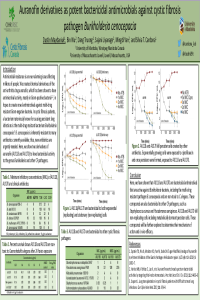
EAC Poster_Dustin_Maydaniuk.pdf
Extracellular Vesicles Promote Mycobacterial Killing in Macrophages in Combination with Antibiotics
Targeting intracellular S. aureus in Infection Modelling by Ikarugamycin Compound and their Toxicity toward Bovine Mammary Epithelial Cells