Event submissions
Published
 10.3390/ECA2021-09643 (registering DOI)
 This submission belongs to the session F. Poster of the event The 1st International Electronic Conference on Antibiotics
Published date
26 Apr, 2021
Citation
Maria Margarida Aguiar, Marília Ferreira, António Salvador Barreto, Ana Rita Henriques, Challenge testing kefir made with a lyophilized starter against four common foodborne pathogens, in Proceedings of The 1st International Electronic Conference on Antibiotics, 8 May–17 May 2021, MDPI: Basel, Switzerland, doi: 10.3390/ECA2021-09643
Share
Email
Facebook
Twitter
LinkedIn
Challenge testing kefir made with a lyophilized starter against four common foodborne pathogens
'%3e%3cpath%20d='M12.6647%2010.9104C12.4176%2010.325%2012.0589%209.7933%2011.6088%209.34485C11.16%208.89511%2010.6283%208.53653%2010.0432%208.28891C10.038%208.28629%2010.0327%208.28498%2010.0275%208.28236C10.8437%207.69282%2011.3743%206.73252%2011.3743%205.64907C11.3743%203.85423%209.92005%202.40002%208.12522%202.40002C6.33038%202.40002%204.87618%203.85423%204.87618%205.64907C4.87618%206.73252%205.40677%207.69282%206.22296%208.28367C6.21772%208.28629%206.21248%208.2876%206.20724%208.29022C5.62031%208.53783%205.09365%208.89287%204.64167%209.34616C4.19192%209.79496%203.83334%2010.3266%203.58573%2010.9117C3.34247%2011.4846%203.21128%2012.0987%203.19925%2012.721C3.1989%2012.735%203.20135%2012.7489%203.20646%2012.7619C3.21157%2012.7749%203.21924%2012.7868%203.22901%2012.7968C3.23877%2012.8068%203.25045%2012.8148%203.26334%2012.8202C3.27623%2012.8256%203.29007%2012.8284%203.30406%2012.8284H4.09012C4.14776%2012.8284%204.19362%2012.7825%204.19493%2012.7262C4.22113%2011.7148%204.62726%2010.7676%205.34519%2010.0497C6.08802%209.30686%207.07452%208.89811%208.12522%208.89811C9.17592%208.89811%2010.1624%209.30686%2010.9052%2010.0497C11.6232%2010.7676%2012.0293%2011.7148%2012.0555%2012.7262C12.0568%2012.7839%2012.1027%2012.8284%2012.1603%2012.8284H12.9464C12.9604%2012.8284%2012.9742%2012.8256%2012.9871%2012.8202C13%2012.8148%2013.0117%2012.8068%2013.0214%2012.7968C13.0312%2012.7868%2013.0389%2012.7749%2013.044%2012.7619C13.0491%2012.7489%2013.0515%2012.735%2013.0512%2012.721C13.0381%2012.0947%2012.9084%2011.4856%2012.6647%2010.9104ZM8.12522%207.90243C7.52388%207.90243%206.95792%207.66793%206.53214%207.24215C6.10636%206.81636%205.87185%206.2504%205.87185%205.64907C5.87185%205.04773%206.10636%204.48177%206.53214%204.05599C6.95792%203.63021%207.52388%203.3957%208.12522%203.3957C8.72655%203.3957%209.29252%203.63021%209.7183%204.05599C10.1441%204.48177%2010.3786%205.04773%2010.3786%205.64907C10.3786%206.2504%2010.1441%206.81636%209.7183%207.24215C9.29252%207.66793%208.72655%207.90243%208.12522%207.90243Z'%20fill='%235D1EE1'/%3e%3c/g%3e%3c/svg%3e)
Maria Margarida Aguiar 1
Marília Ferreira 1
António Salvador Barreto 1
Ana Rita Henriques 1
1. CIISA - Centre for Interdisciplinary Research in Animal Health, Faculty of Veterinary Medicine, University of Lisbon
Abstract
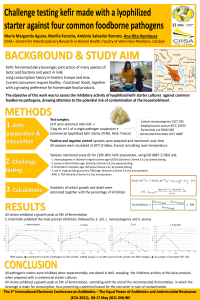
Kefir is a fermented dairy beverage produced by the joint action of many species of lactic acid bacteria and yeast in milk. While barely known in Western Europe, kefir has long been made available and is widely consumed in Eastern Europe and Asia. Recent trends in healthy, homemade products, however, added to the beverage’s artisanal character and acclaimed beneficial properties, managed to attract consumer attention. Still, production remains mostly artisanal and fermentation environments are, therefore, seldomly controlled. While the inhibitory activity of kefir made with kefir grains – the traditional kefir starter culture – has already been investigated, its industrial counterpart – lyophilized cultures - has hardly received any attention in this regard. Thus, in order to assess the inhibitory activity of lyophilized kefir starter cultures and draw attention to the potential dangers of a contamination at household level, common foodborne bacteria were assessed in a challenge test. Representative strains of Listeria monocytogenes CECT 935, Staphylococcus aureus ATCC 25923, Escherichia coli DSMZ 682 and Salmonella enteritidis CECT 4300T were inoculated in kefir during its preparation. Viable cell counts were monitored for 120h after kefir preparation. Results revealed that all of the tested strains exhibited a peak in their growth at 24h of fermentation, presenting a potential hazard for the consumer. Still, inhibition was observed with S. enteritidis exhibiting the most prompt inhibition, followed by E. coli, L. monocytogenes and S. aureus.
Keywords
kefir
starter culture
inhibitory activity
Salmonella enteritidis
Listeria monocytogenes
Escherichia coli
Staphylococcus aureus
Manuscript
sciforum-045154.pdf
Poster
sciforum-045154.pdf
The antibiotic resistance, gelatinase production and biofilm formation among Enterococcus strains – the correlation analysis using PCR techniques
Prediction of Antibiotic Activity against Burkholderia cenocepacia Using a Machine Learning Model