Event submissions
Published
 10.3390/ECA2021-09649 (registering DOI)
 This submission belongs to the session B. Antimicrobial Discovery, Development, Stewardship and Susceptibility Testing of the event The 1st International Electronic Conference on Antibiotics
Published date
26 Apr, 2021
Citation
Heakal Mohamed, Elena Marusich, Sergey Leonov, Antimicrobial Activity of Extract from Hermetia illucens (Black Soldier Fly) Larvae against Multi Drug-Resistant (MDR) Human Pathogenic Bacteria., in Proceedings of The 1st International Electronic Conference on Antibiotics, 8 May–17 May 2021, MDPI: Basel, Switzerland, doi: 10.3390/ECA2021-09649
Share
Email
Facebook
Twitter
LinkedIn
Antimicrobial Activity of Extract from Hermetia illucens (Black Soldier Fly) Larvae against Multi Drug-Resistant (MDR) Human Pathogenic Bacteria.

Heakal Mohamed 1

Elena Marusich 1
'%3e%3cpath%20d='M12.6647%2010.9104C12.4176%2010.325%2012.0589%209.7933%2011.6088%209.34485C11.16%208.89511%2010.6283%208.53653%2010.0432%208.28891C10.038%208.28629%2010.0327%208.28498%2010.0275%208.28236C10.8437%207.69282%2011.3743%206.73252%2011.3743%205.64907C11.3743%203.85423%209.92005%202.40002%208.12522%202.40002C6.33038%202.40002%204.87618%203.85423%204.87618%205.64907C4.87618%206.73252%205.40677%207.69282%206.22296%208.28367C6.21772%208.28629%206.21248%208.2876%206.20724%208.29022C5.62031%208.53783%205.09365%208.89287%204.64167%209.34616C4.19192%209.79496%203.83334%2010.3266%203.58573%2010.9117C3.34247%2011.4846%203.21128%2012.0987%203.19925%2012.721C3.1989%2012.735%203.20135%2012.7489%203.20646%2012.7619C3.21157%2012.7749%203.21924%2012.7868%203.22901%2012.7968C3.23877%2012.8068%203.25045%2012.8148%203.26334%2012.8202C3.27623%2012.8256%203.29007%2012.8284%203.30406%2012.8284H4.09012C4.14776%2012.8284%204.19362%2012.7825%204.19493%2012.7262C4.22113%2011.7148%204.62726%2010.7676%205.34519%2010.0497C6.08802%209.30686%207.07452%208.89811%208.12522%208.89811C9.17592%208.89811%2010.1624%209.30686%2010.9052%2010.0497C11.6232%2010.7676%2012.0293%2011.7148%2012.0555%2012.7262C12.0568%2012.7839%2012.1027%2012.8284%2012.1603%2012.8284H12.9464C12.9604%2012.8284%2012.9742%2012.8256%2012.9871%2012.8202C13%2012.8148%2013.0117%2012.8068%2013.0214%2012.7968C13.0312%2012.7868%2013.0389%2012.7749%2013.044%2012.7619C13.0491%2012.7489%2013.0515%2012.735%2013.0512%2012.721C13.0381%2012.0947%2012.9084%2011.4856%2012.6647%2010.9104ZM8.12522%207.90243C7.52388%207.90243%206.95792%207.66793%206.53214%207.24215C6.10636%206.81636%205.87185%206.2504%205.87185%205.64907C5.87185%205.04773%206.10636%204.48177%206.53214%204.05599C6.95792%203.63021%207.52388%203.3957%208.12522%203.3957C8.72655%203.3957%209.29252%203.63021%209.7183%204.05599C10.1441%204.48177%2010.3786%205.04773%2010.3786%205.64907C10.3786%206.2504%2010.1441%206.81636%209.7183%207.24215C9.29252%207.66793%208.72655%207.90243%208.12522%207.90243Z'%20fill='%235D1EE1'/%3e%3c/g%3e%3c/svg%3e)
Sergey Leonov 1
1. School of Biological and Medical Physics, Moscow Institute of Physics and Technology (National Research University)
Abstract
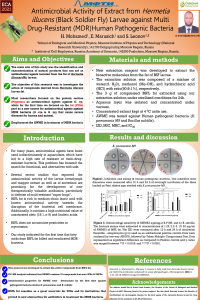
Hermetia illucens (Hi) larvae fat is a sustainable reservoir of bioactive rich compounds. This study aimed to evaluate the antimicrobial activity of bioactive compounds sequentially extracted from compressed fat of Hi larvae. From our previous studies was determined that the Hi fat considers as a sustainable reservoir of antimicrobial agents with pronounced multidrug-resistant (MDR) antibacterial activities, which can be isolated through the three sequential extractions approach. The third acidic water-methanol extract (AWME3) turned out to be the most potent among the other extracts. Ten antibiotics used to assess the susceptibility assay against human pathogenic bacteria strains Klebsiella pneumoniae and Bacillus subtilis, and demonstrated that they were MDR strains. Antimicrobial activities for AWME3 against K. pneumoniae and B. subtilis were determined using the disk diffusion method. The inhibition zone diameters caused by the AWME3 ranged between 11.55±0.34 mm and 16.52±0.74 mm at concentration 20 mg/ml against K. pneumoniae M9 and B. subtilis, respectively. B. subtilis was the most resistant strain to AWME3 compared to K. pneumoniae strains. The minimum inhibition concentration (MIC) was 250 µg/ mL for all bacteria strains, while the minimum bactericidal concentration (MBC) values were 250 and 500 µg/ mL against K. pneumoniae and B. subtilis, respectively. Half of the inhibition concentration (IC50) values were ranged between 147.9±0.01 µg/mL and 160.1±0.008 µg/mL against B. subtilis and K. pneumoniae M9, respectively. GC-MS analysis showed that AWME3 composed of 33 compounds, where free fatty acids such as cis-oleic, palmitic, lauric, stearic and myristic acid were the most abundant in the content of AWME3. This study proved the sustainability of the larvae fat constituents during the sequential extraction from the same biomass of H. illucens larvae fat. In addition, the AWME3 might be considered as an alternative to antibiotics against MDR bacteria with high potential for many bacterial diseases treatments, and beneficial for novel antimicrobial drugs discovery against human bacterial pathogens.
Keywords
H. illucens
fatty acids
GC-MS
MDR bacteria
Manuscript
sciforum-045369-Poster.pdf
Poster
sciforum-045369-Poster.pdf
Differentiation of trimethoprim resistance genes among Eschericha coli strains from an environment with intensive supply of antibiotic
Metagenomic Exploration of Antibiotic Resistance of Neonatal Gut Under Intensive Care