Event submissions
EventsMicromachines 2021 — 1st International Conference on Micromachines and Applications (ICMA2021)
Published

This submission belongs to the session S4. Micromachines for bio-chemical applications of the event Micromachines 2021 — 1st International Conference on Micromachines and Applications (ICMA2021)
Published date
27 Apr, 2021
Citation
Tamara Jurina, Ivana Čulo, Maja Benković, Jasenka Gajdoš Kljusurić, Davor Valinger, Ana Jurinjak Tušek, The Effect of Micromixer Geometry on The Diameters of Emulsion Droplets: NIR Spectroscopy and Artificial Neural Networks Modeling, in Proceedings of Micromachines 2021 — 1st International Conference on Micromachines and Applications (ICMA2021), 15 April–30 April 2021, MDPI: Basel, Switzerland, doi: 10.3390/Micromachines2021-09658
Share
Email
Facebook
Twitter
LinkedIn
The Effect of Micromixer Geometry on The Diameters of Emulsion Droplets: NIR Spectroscopy and Artificial Neural Networks Modeling
'%3e%3cpath%20d='M12.6647%2010.9104C12.4176%2010.325%2012.0589%209.7933%2011.6088%209.34485C11.16%208.89511%2010.6283%208.53653%2010.0432%208.28891C10.038%208.28629%2010.0327%208.28498%2010.0275%208.28236C10.8437%207.69282%2011.3743%206.73252%2011.3743%205.64907C11.3743%203.85423%209.92005%202.40002%208.12522%202.40002C6.33038%202.40002%204.87618%203.85423%204.87618%205.64907C4.87618%206.73252%205.40677%207.69282%206.22296%208.28367C6.21772%208.28629%206.21248%208.2876%206.20724%208.29022C5.62031%208.53783%205.09365%208.89287%204.64167%209.34616C4.19192%209.79496%203.83334%2010.3266%203.58573%2010.9117C3.34247%2011.4846%203.21128%2012.0987%203.19925%2012.721C3.1989%2012.735%203.20135%2012.7489%203.20646%2012.7619C3.21157%2012.7749%203.21924%2012.7868%203.22901%2012.7968C3.23877%2012.8068%203.25045%2012.8148%203.26334%2012.8202C3.27623%2012.8256%203.29007%2012.8284%203.30406%2012.8284H4.09012C4.14776%2012.8284%204.19362%2012.7825%204.19493%2012.7262C4.22113%2011.7148%204.62726%2010.7676%205.34519%2010.0497C6.08802%209.30686%207.07452%208.89811%208.12522%208.89811C9.17592%208.89811%2010.1624%209.30686%2010.9052%2010.0497C11.6232%2010.7676%2012.0293%2011.7148%2012.0555%2012.7262C12.0568%2012.7839%2012.1027%2012.8284%2012.1603%2012.8284H12.9464C12.9604%2012.8284%2012.9742%2012.8256%2012.9871%2012.8202C13%2012.8148%2013.0117%2012.8068%2013.0214%2012.7968C13.0312%2012.7868%2013.0389%2012.7749%2013.044%2012.7619C13.0491%2012.7489%2013.0515%2012.735%2013.0512%2012.721C13.0381%2012.0947%2012.9084%2011.4856%2012.6647%2010.9104ZM8.12522%207.90243C7.52388%207.90243%206.95792%207.66793%206.53214%207.24215C6.10636%206.81636%205.87185%206.2504%205.87185%205.64907C5.87185%205.04773%206.10636%204.48177%206.53214%204.05599C6.95792%203.63021%207.52388%203.3957%208.12522%203.3957C8.72655%203.3957%209.29252%203.63021%209.7183%204.05599C10.1441%204.48177%2010.3786%205.04773%2010.3786%205.64907C10.3786%206.2504%2010.1441%206.81636%209.7183%207.24215C9.29252%207.66793%208.72655%207.90243%208.12522%207.90243Z'%20fill='%235D1EE1'/%3e%3c/g%3e%3c/svg%3e)
Tamara Jurina 1
Ivana Čulo 1

Maja Benković 1

Jasenka Gajdoš Kljusurić 1

Davor Valinger 1

Ana Jurinjak Tušek 1
1. University of Zagreb, Faculty of Food Technology and Biotechnology
Abstract
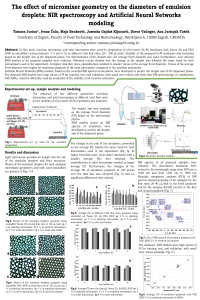
In this work, teardrop micromixer and swirl micromixer were used for preparation of oil-in-water (O/W) emulsions with Tween 20 and PEG 2000 as emulsifiers (concentrations: 2 % and 4 %) at different total flow rates (20 - 280 µL/min). Stability of the prepared O/W emulsions was evaluated based on the droplet size of the dispersed phase. For determination of the droplet size, the average Feret diameter was used. Furthermore, near infrared (NIR) spectra of all prepared samples were collected. Obtained results showed that the change in the droplet size followed the same trend for both micromixers used in the experiment. At higher total flow rates, emulsification resulted in smaller values of the average Feret diameter. Values of the average Feret diameter were higher for emulsions prepared in the swirl micromixer, compared to the teardrop micromixer. Artificial Neural Network (ANNs) models, based on the recorded NIR spectra of emulsions, were developed to predict the droplet size of the dispersed phase. The obtained ANN models have high values of R2 for training, test, and validation, with small error values and show that NIR spectroscopy, in combination with ANNs, could be efficiently used for evaluation of the stability of oil-in-water emulsions.
Keywords
micromixer geometry
average Feret diameter
oil in water emulsions
Artificial Neural Network models
NIR spectra
Poster
sciforum-044614-Poster-revision.pdf
Nanoscopic Biosensors in Microfluidics