Event submissions
Published
 10.3390/IECAG2021-09671 (registering DOI)
 This submission belongs to the session S6. Sustainable and Resilient Farming Systems of the event The 1st International Electronic Conference on Agronomy
Published date
01 May, 2021
Citation
Ezequiel Peral-Aranega, Paula García-Fraile, Raúl Rivas, Assessment of Bacillus megaterium as durum wheat (Triticum durum) biofertilizer, in Proceedings of The 1st International Electronic Conference on Agronomy, 3 May–17 May 2021, MDPI: Basel, Switzerland, doi: 10.3390/IECAG2021-09671
Share
Email
Facebook
Twitter
LinkedIn
Assessment of Bacillus megaterium as durum wheat (Triticum durum) biofertilizer
'%3e%3cpath%20d='M12.6647%2010.9104C12.4176%2010.325%2012.0589%209.7933%2011.6088%209.34485C11.16%208.89511%2010.6283%208.53653%2010.0432%208.28891C10.038%208.28629%2010.0327%208.28498%2010.0275%208.28236C10.8437%207.69282%2011.3743%206.73252%2011.3743%205.64907C11.3743%203.85423%209.92005%202.40002%208.12522%202.40002C6.33038%202.40002%204.87618%203.85423%204.87618%205.64907C4.87618%206.73252%205.40677%207.69282%206.22296%208.28367C6.21772%208.28629%206.21248%208.2876%206.20724%208.29022C5.62031%208.53783%205.09365%208.89287%204.64167%209.34616C4.19192%209.79496%203.83334%2010.3266%203.58573%2010.9117C3.34247%2011.4846%203.21128%2012.0987%203.19925%2012.721C3.1989%2012.735%203.20135%2012.7489%203.20646%2012.7619C3.21157%2012.7749%203.21924%2012.7868%203.22901%2012.7968C3.23877%2012.8068%203.25045%2012.8148%203.26334%2012.8202C3.27623%2012.8256%203.29007%2012.8284%203.30406%2012.8284H4.09012C4.14776%2012.8284%204.19362%2012.7825%204.19493%2012.7262C4.22113%2011.7148%204.62726%2010.7676%205.34519%2010.0497C6.08802%209.30686%207.07452%208.89811%208.12522%208.89811C9.17592%208.89811%2010.1624%209.30686%2010.9052%2010.0497C11.6232%2010.7676%2012.0293%2011.7148%2012.0555%2012.7262C12.0568%2012.7839%2012.1027%2012.8284%2012.1603%2012.8284H12.9464C12.9604%2012.8284%2012.9742%2012.8256%2012.9871%2012.8202C13%2012.8148%2013.0117%2012.8068%2013.0214%2012.7968C13.0312%2012.7868%2013.0389%2012.7749%2013.044%2012.7619C13.0491%2012.7489%2013.0515%2012.735%2013.0512%2012.721C13.0381%2012.0947%2012.9084%2011.4856%2012.6647%2010.9104ZM8.12522%207.90243C7.52388%207.90243%206.95792%207.66793%206.53214%207.24215C6.10636%206.81636%205.87185%206.2504%205.87185%205.64907C5.87185%205.04773%206.10636%204.48177%206.53214%204.05599C6.95792%203.63021%207.52388%203.3957%208.12522%203.3957C8.72655%203.3957%209.29252%203.63021%209.7183%204.05599C10.1441%204.48177%2010.3786%205.04773%2010.3786%205.64907C10.3786%206.2504%2010.1441%206.81636%209.7183%207.24215C9.29252%207.66793%208.72655%207.90243%208.12522%207.90243Z'%20fill='%235D1EE1'/%3e%3c/g%3e%3c/svg%3e)
Ezequiel Peral-Aranega 1,2
Paula García-Fraile 1,3,4

Raúl Rivas 1,3,5
1. Microbiology and Genetics Department, University of Salamanca
2. Spanish-Portuguese Institute for Agricultural Research (CIALE)
3. Spanish-Portuguese Institute for Agricultural Research (CIALE)
4. Associated Research Unit of Plant-Microorganism Interaction, University of Salamanca-IRNASA-CSIC
5. Associated Research Unit of Plant-Microorganism Interaction (University of Salamanca-IRNASA-CSIC)
Abstract
According to the UN, the World population is going to achieve 9.700 million people by 2050. Finding a sustainable and efficient way to feed the growing population is one of the major challenges of this generation. Cereal grain crops are the major source of carbohydrates, protein, vitamin B and minerals in human feeding, among them maize, wheat, and rice are the most important cereals. Crop yields can be improved by plant growth promoting (PGP) bacteria in substitution of chemical fertilization, which has shown to cause a wide list of environmental harms.
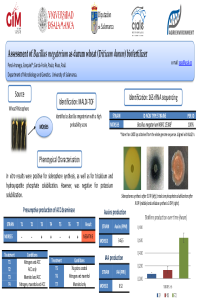
Bacterial strains were isolated from the rhizosphere of cereals crop fields nearby Salamanca (Spain) and characterized by both MALDI-TOF and 16S rRNA sequencing. Bacillus megaterium strain was identified and characterized phenotypically in order to analyze the PGP potential. Within the assessments performed, positive results were obtained for phosphates solubilization, auxins synthesis, and siderophores, cellulose, and biofilm production.
Wheat seedlings in planta assays during the early days revealed that Bacillus megaterium improved the plant growth, for which colonization test were performed to evaluate the capacity of this strain to associate with the crop. Inoculated seedlings were grown in controlled conditions; after that, root slides were immunolocalized with GFP-labelled uricase antibody and visualized on fluorescence microscopy. Additionally, the genome was sequenced and bioinformatics analyzes showed interesting annotations regarding PGP potential.
Finally, the strain was inoculated on wheat seedlings and left to grow on greenhouse conditions until harvesting. Aerial biomass was recollected, measured, and weighted; furthermore, grains were counted and physicochemically analyzed to evaluate the nutrient quality. Promising results were obtained on both, grain yield and nutrient quality parameters.
Authors acknowledge the Diputación de Salamanca for funding this research through the project 18VB2I/463AC06, which belongs to “III Convocatoria de Proyectos de Investigación” of “VIII Centenario” of the University of Salamanca.
Keywords
PGP
Rhizobia
Yield
Crop
Environment
Sustainable
Wheat
Manuscript
sciforum-043241.pdf
Poster
EPA presentation.pdf
Remote Visual Monitoring System for Tunnel Grown Crops
Effect of biological preparations and different nitrogen fertilization on soil properties and spring wheat crop