Event submissions
Published

This submission belongs to the session S8. Posters of the event The 1st International Electronic Conference on Agronomy
Published date
01 May, 2021
Citation
Dušan Vasić, Ilinka Pećinar, Bojana Špirović-Trifunović, Dragana Paunović, Jelena Popović-Djordjević, Chemical characterization of rosehip (Rosa canina L.) seed: application of Raman spectroscopy and gas chromatography, in Proceedings of The 1st International Electronic Conference on Agronomy, 3 May–17 May 2021, MDPI: Basel, Switzerland, doi: 10.3390/IECAG2021-09674
Share
Email
Facebook
Twitter
LinkedIn
Chemical characterization of rosehip (Rosa canina L.) seed: application of Raman spectroscopy and gas chromatography
'%3e%3cpath%20d='M12.6647%2010.9104C12.4176%2010.325%2012.0589%209.7933%2011.6088%209.34485C11.16%208.89511%2010.6283%208.53653%2010.0432%208.28891C10.038%208.28629%2010.0327%208.28498%2010.0275%208.28236C10.8437%207.69282%2011.3743%206.73252%2011.3743%205.64907C11.3743%203.85423%209.92005%202.40002%208.12522%202.40002C6.33038%202.40002%204.87618%203.85423%204.87618%205.64907C4.87618%206.73252%205.40677%207.69282%206.22296%208.28367C6.21772%208.28629%206.21248%208.2876%206.20724%208.29022C5.62031%208.53783%205.09365%208.89287%204.64167%209.34616C4.19192%209.79496%203.83334%2010.3266%203.58573%2010.9117C3.34247%2011.4846%203.21128%2012.0987%203.19925%2012.721C3.1989%2012.735%203.20135%2012.7489%203.20646%2012.7619C3.21157%2012.7749%203.21924%2012.7868%203.22901%2012.7968C3.23877%2012.8068%203.25045%2012.8148%203.26334%2012.8202C3.27623%2012.8256%203.29007%2012.8284%203.30406%2012.8284H4.09012C4.14776%2012.8284%204.19362%2012.7825%204.19493%2012.7262C4.22113%2011.7148%204.62726%2010.7676%205.34519%2010.0497C6.08802%209.30686%207.07452%208.89811%208.12522%208.89811C9.17592%208.89811%2010.1624%209.30686%2010.9052%2010.0497C11.6232%2010.7676%2012.0293%2011.7148%2012.0555%2012.7262C12.0568%2012.7839%2012.1027%2012.8284%2012.1603%2012.8284H12.9464C12.9604%2012.8284%2012.9742%2012.8256%2012.9871%2012.8202C13%2012.8148%2013.0117%2012.8068%2013.0214%2012.7968C13.0312%2012.7868%2013.0389%2012.7749%2013.044%2012.7619C13.0491%2012.7489%2013.0515%2012.735%2013.0512%2012.721C13.0381%2012.0947%2012.9084%2011.4856%2012.6647%2010.9104ZM8.12522%207.90243C7.52388%207.90243%206.95792%207.66793%206.53214%207.24215C6.10636%206.81636%205.87185%206.2504%205.87185%205.64907C5.87185%205.04773%206.10636%204.48177%206.53214%204.05599C6.95792%203.63021%207.52388%203.3957%208.12522%203.3957C8.72655%203.3957%209.29252%203.63021%209.7183%204.05599C10.1441%204.48177%2010.3786%205.04773%2010.3786%205.64907C10.3786%206.2504%2010.1441%206.81636%209.7183%207.24215C9.29252%207.66793%208.72655%207.90243%208.12522%207.90243Z'%20fill='%235D1EE1'/%3e%3c/g%3e%3c/svg%3e)
Dušan Vasić 1

Ilinka Pećinar 2
Bojana Špirović-Trifunović 1
Dragana Paunović 1

Jelena Popović-Djordjević 3
1. University of Belgrade-Faculty of Agriculture, Belgrade, Serbia
2. University of Belgrade-Faculty of Agriculture, Belgrade, Serbia
3. University of Belgrade -Faculty of Agriculture, Belgrade, Serbia
Abstract
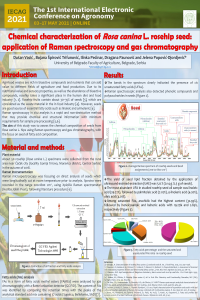
Rosehip seeds represent the waste material in the food industry, in production of marmalade, jam, beverages, jelly, syrup, tea, etc. Utilization of fruits by-products and wastes such as seeds could be useful for obtaining a new source of oil and/or functional food. In the recent years, rosehip seeds have been used in the cosmetic and pharmaceutical industries, due to their specific fatty acid composition. The aim of this study was to assess the chemical composition of seed from Rosa canina L. hips, with the focus on seed oil fatty acid profile. In this respect, analytical methods in situ Raman spectroscopy (RS) and gas chromatography (GC) were used. Ultrasound-assisted extraction (UAE) was applied for isolation of lipid fraction. Fatty acids in form of methyl esters (FAMEs) were analyzed by gas chromatography with a flame ionization detector (GC/FID). Raman spectra showed the presence of lipids, fatty acids, poliphenolics and saccharides (including cellulose) as the predominant classes of compounds in seeds. Bands at 1266, 1328, 1369 and 1655 cm-1, were associated to lipids and unsaturated fatty acids (UFAs). The spectra also indicated cis isomers in the lipid fraction. Seeds contained 5.6 % of oil, and GC analysis confirmed the presence of UFAs. Linoleic acid (w-6) and α-linolenic acid (w-3) (29.72 and 4.20 %, respectively) were the most abundant ones, whereas among saturated FAs, arachidic acid was found in the unusually high percent. Raman spectroscopy was applied as the fast and nondestructive analytical method, and spectra provided information about the structure of chemical species which contributed strongly to seed spectral signature. Results of GC analysis showed that rosehip seeds are good source of nutritionally valuable fatty acids that might be utilized in products specified as functional food.
Keywords
rosehip
seeds
waste material
Raman spectroscopy
gas chromatography
fatty acids
essential FAs
Manuscript
sciforum-043077.pdf
Poster
Poster-Vasić et al..pdf
Analysis of the core microbiome of blueberry and blackberry plants as a first step in the design of efficient bacterial biofertilizers
Water saving techniques and practices for on-farm surface irrigation systems