Event submissions
Published
 10.3390/IECAG2021-09679 (registering DOI)
 This submission belongs to the session S8. Posters of the event The 1st International Electronic Conference on Agronomy
Published date
01 May, 2021
Citation
Paula Garcia Fraile, José David Flores-Félix, Fernando Sanchez-Juanes, Raúl Rivas, Pedro Francisco Mateos, Alvaro Peix, José Mariano Igual, Encarna Velázquez, Eustoquio Martínez-Molina, Identification of quinoa seed bacterial endophytes and selection of strains for biofertilization of quinoa crops, in Proceedings of The 1st International Electronic Conference on Agronomy, 3 May–17 May 2021, MDPI: Basel, Switzerland, doi: 10.3390/IECAG2021-09679
Share
Email
Facebook
Twitter
LinkedIn
Identification of quinoa seed bacterial endophytes and selection of strains for biofertilization of quinoa crops
'%3e%3cpath%20d='M12.6647%2010.9104C12.4176%2010.325%2012.0589%209.7933%2011.6088%209.34485C11.16%208.89511%2010.6283%208.53653%2010.0432%208.28891C10.038%208.28629%2010.0327%208.28498%2010.0275%208.28236C10.8437%207.69282%2011.3743%206.73252%2011.3743%205.64907C11.3743%203.85423%209.92005%202.40002%208.12522%202.40002C6.33038%202.40002%204.87618%203.85423%204.87618%205.64907C4.87618%206.73252%205.40677%207.69282%206.22296%208.28367C6.21772%208.28629%206.21248%208.2876%206.20724%208.29022C5.62031%208.53783%205.09365%208.89287%204.64167%209.34616C4.19192%209.79496%203.83334%2010.3266%203.58573%2010.9117C3.34247%2011.4846%203.21128%2012.0987%203.19925%2012.721C3.1989%2012.735%203.20135%2012.7489%203.20646%2012.7619C3.21157%2012.7749%203.21924%2012.7868%203.22901%2012.7968C3.23877%2012.8068%203.25045%2012.8148%203.26334%2012.8202C3.27623%2012.8256%203.29007%2012.8284%203.30406%2012.8284H4.09012C4.14776%2012.8284%204.19362%2012.7825%204.19493%2012.7262C4.22113%2011.7148%204.62726%2010.7676%205.34519%2010.0497C6.08802%209.30686%207.07452%208.89811%208.12522%208.89811C9.17592%208.89811%2010.1624%209.30686%2010.9052%2010.0497C11.6232%2010.7676%2012.0293%2011.7148%2012.0555%2012.7262C12.0568%2012.7839%2012.1027%2012.8284%2012.1603%2012.8284H12.9464C12.9604%2012.8284%2012.9742%2012.8256%2012.9871%2012.8202C13%2012.8148%2013.0117%2012.8068%2013.0214%2012.7968C13.0312%2012.7868%2013.0389%2012.7749%2013.044%2012.7619C13.0491%2012.7489%2013.0515%2012.735%2013.0512%2012.721C13.0381%2012.0947%2012.9084%2011.4856%2012.6647%2010.9104ZM8.12522%207.90243C7.52388%207.90243%206.95792%207.66793%206.53214%207.24215C6.10636%206.81636%205.87185%206.2504%205.87185%205.64907C5.87185%205.04773%206.10636%204.48177%206.53214%204.05599C6.95792%203.63021%207.52388%203.3957%208.12522%203.3957C8.72655%203.3957%209.29252%203.63021%209.7183%204.05599C10.1441%204.48177%2010.3786%205.04773%2010.3786%205.64907C10.3786%206.2504%2010.1441%206.81636%209.7183%207.24215C9.29252%207.66793%208.72655%207.90243%208.12522%207.90243Z'%20fill='%235D1EE1'/%3e%3c/g%3e%3c/svg%3e)
Paula Garcia Fraile 1,2,3

José David Flores-Félix 1,2,3
Fernando Sanchez-Juanes 4

Raúl Rivas 1,2,3
Pedro Francisco Mateos 1,2,3
Alvaro Peix 3,5
José Mariano Igual 3,5
Encarna Velázquez 1,2,3
Eustoquio Martínez-Molina 1,2,3
1. University of Salamanca
2. Instituto Hispano-Luso de Investigaciones Agrarias (CIALE)
3. Unidad Asociada USAL-IRNASA (CSIC)
4. Instituto de Investigación Biomédica de Salamanca (IBSAL), Complejo Asistencial Universitario de Salamanca, Universidad de Salamanca, CSIC
5. Instituto de Recursos Naturales y Agrobiología, IRNASA-CSIC, Salamanca
Abstract
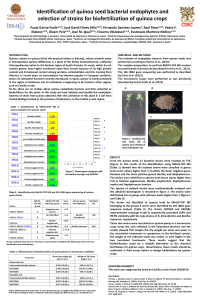
Quinua, quínoa or quinua (from the quechua kinwa or kinuwa), whose scientifc name is Chenopodium quinoa Willdenow, is a plant of the family Amaranthaceae, subfamily Chenopodiaceae native to the Andean region of South America. Its seeds, which do not contain gluten, have higher nutritional value than cereals because of its high protein content and its balanced content among proteins, carbohydrates and fats. Coming from America, in recent years its consumption has become popular in European countries, where its cultivation has been recently introduced. In Spain, quinoa is mainly produced in “Andalucía”, but its cultivation is beginning to be tested in other regions such as “Castilla y León”. So far there are no studies about quinoa endophytic bacteria and their potential as biofertilizers for this plant. For this reason in this study we have isolated and identify the endophytic bacteria of seeds from quinoa obtained after the cultivation of this plant in a soil from “Castilla y León”. The isolated strains were classified into the genera Bacillus, Staphylococcus and Pantoea after MALDI-TOF MS and 16S rRNA gene sequence analyses. After the analysis of several in vitro plant growth promotion mechanisms, two strains belonging to the genus Bacillus were selected for inoculation of quinoa plants in microcosms assays , which were carried up to seed production in greenhouse using two soils collected in Salamanca province (“Castilla y León”) as substrate. The results showed that despite the dry weight per plant was lower in the inoculation treatments with respect to the fertilized control, the weight of the collected seeds was similar or even higher in the two inoculation treatments. These results suggest that the biofertilization could be a reliable alternative to the chemical fertilization for quinoa crops.
This project has received funding from the Junta de Castilla and León Government under the Grant SA293P18
Keywords
quinoa
endophytes
biofertilizarion
PGPBs
crops production
Manuscript
sciforum-043525.pdf
Poster
Postervirtualfondooro.pdf
Use of microbial biostimulants to enhance the salinity tolerance of tomato transplants
Developing a subpopulation-based model for the olive fruit fly Bactrocera oleae (Diptera: Tephritidae): conceptual model outline