Event submissions
Published
 10.3390/IECAG2021-09681 (registering DOI)
 This submission belongs to the session S8. Posters of the event The 1st International Electronic Conference on Agronomy
Published date
01 May, 2021
Citation
Jozef Fejér, Ľuboš Nastišin, Janka Majdanová, Results of oilseed poppy breeding and production potential of new varieties, in Proceedings of The 1st International Electronic Conference on Agronomy, 3 May–17 May 2021, MDPI: Basel, Switzerland, doi: 10.3390/IECAG2021-09681
Share
Email
Facebook
Twitter
LinkedIn
Results of oilseed poppy breeding and production potential of new varieties
'%3e%3cpath%20d='M12.6647%2010.9104C12.4176%2010.325%2012.0589%209.7933%2011.6088%209.34485C11.16%208.89511%2010.6283%208.53653%2010.0432%208.28891C10.038%208.28629%2010.0327%208.28498%2010.0275%208.28236C10.8437%207.69282%2011.3743%206.73252%2011.3743%205.64907C11.3743%203.85423%209.92005%202.40002%208.12522%202.40002C6.33038%202.40002%204.87618%203.85423%204.87618%205.64907C4.87618%206.73252%205.40677%207.69282%206.22296%208.28367C6.21772%208.28629%206.21248%208.2876%206.20724%208.29022C5.62031%208.53783%205.09365%208.89287%204.64167%209.34616C4.19192%209.79496%203.83334%2010.3266%203.58573%2010.9117C3.34247%2011.4846%203.21128%2012.0987%203.19925%2012.721C3.1989%2012.735%203.20135%2012.7489%203.20646%2012.7619C3.21157%2012.7749%203.21924%2012.7868%203.22901%2012.7968C3.23877%2012.8068%203.25045%2012.8148%203.26334%2012.8202C3.27623%2012.8256%203.29007%2012.8284%203.30406%2012.8284H4.09012C4.14776%2012.8284%204.19362%2012.7825%204.19493%2012.7262C4.22113%2011.7148%204.62726%2010.7676%205.34519%2010.0497C6.08802%209.30686%207.07452%208.89811%208.12522%208.89811C9.17592%208.89811%2010.1624%209.30686%2010.9052%2010.0497C11.6232%2010.7676%2012.0293%2011.7148%2012.0555%2012.7262C12.0568%2012.7839%2012.1027%2012.8284%2012.1603%2012.8284H12.9464C12.9604%2012.8284%2012.9742%2012.8256%2012.9871%2012.8202C13%2012.8148%2013.0117%2012.8068%2013.0214%2012.7968C13.0312%2012.7868%2013.0389%2012.7749%2013.044%2012.7619C13.0491%2012.7489%2013.0515%2012.735%2013.0512%2012.721C13.0381%2012.0947%2012.9084%2011.4856%2012.6647%2010.9104ZM8.12522%207.90243C7.52388%207.90243%206.95792%207.66793%206.53214%207.24215C6.10636%206.81636%205.87185%206.2504%205.87185%205.64907C5.87185%205.04773%206.10636%204.48177%206.53214%204.05599C6.95792%203.63021%207.52388%203.3957%208.12522%203.3957C8.72655%203.3957%209.29252%203.63021%209.7183%204.05599C10.1441%204.48177%2010.3786%205.04773%2010.3786%205.64907C10.3786%206.2504%2010.1441%206.81636%209.7183%207.24215C9.29252%207.66793%208.72655%207.90243%208.12522%207.90243Z'%20fill='%235D1EE1'/%3e%3c/g%3e%3c/svg%3e)
Jozef Fejér 1
Ľuboš Nastišin 2
Janka Majdanová 3
1. Faculty of Humanities and Natural Sciences, Department of Ecology, University of Prešov, 17. November St., SK-080 01 Prešov, Slovakia
2. National Agricultural and Food Centre, Research Institute of Plant Production, Research and Breeding Station Malý Šariš 221, SK-080 01 Prešov, Slovakia
3. The Central Control and Testing Institute in Agriculture, Department of Variety Testing, Testing Station Beluša, Továrenská 421/2, SK-018 61 Beluša, Slovakia
Abstract
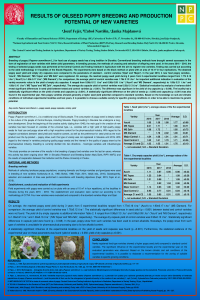
Breeding of poppy (Papaver somniferum L.) for food use of poppy seeds has a long tradition in Slovakia. Conventional breeding methods have brought several successes in the form of registration of new varieties with better yield parameters. In breeding process, the methods of crossing and selection of offspring were used. In the years 2016 – 2018, the testing of selected poppy seeds was performed at the Central Control and Testing Institute in Agriculture with the aim to register new varieties. Testing was carried out according to the valid methodology in 5 localities of the Slovak Republic. The experiments were based on the block method on plots with an area of 10 m2 in four replications. The obtained poppy seed yield and empty dry capsules were compared to the parameters of standard - control varieties ('Opal' and 'Major'). In the year 2019, 4 new food poppy varieties - 'Azurit', 'MS Diamant', 'MS Topas' and 'MS Zafir' were registered. On average, the reached poppy seed yield during 3 years from 5 experimental localities ranged from 1.77 t.ha-1 ± 0.16 ('Azurit') to 1.90 t.ha-1 ± 0.17 ('MS Diamant'). For comparison, the average yield of control varieties was 1.76 t.ha-1 ± 0.12. An important additional indication in evaluation of the variety economic value is the yield of empty dry capsules. It ranged from 0.98 t.ha-1 ± 0.12 and 0.98 t.ha-1 ± 0.09 ('Azurit' and 'MS Diamant', respectively) to 1.09 t.ha-1 ± 0.21 and 1.09 t.ha-1 ± 0.16 ('MS Topas' and 'MS Zafir', respectively). The average dry capsule yield of control varieties was 0.93 t.ha-1 ± 0.13. Statistical evaluation by analysis of variance didn't reveal significant differences in seed yield between tested and control varieties (p = 0.661). The difference was significant in the yield of dry capsules (p = 0.048). The locality had a statistically significant effect on the yield of seeds and capsules (p <0.001). A statistically significant difference on the yield of seeds (p = 0.050) and capsules (p <0.001) was also found in the experimental year. New poppy varieties showed generally a higher seed yield potential compared to standard varieties. Based on the knowledge on soil and climatic conditions of individual experimental localities and test years, it is possible to choose a suitable variety for specific growing conditions in order to be able to maximize its genetic potential.
Keywords
Papaver somniferum L.
poppy seeds
poppy capsules
variety
yield
Manuscript
sciforum-043673.pdf
Poster
Poster_Fejer et al.pdf
Developing a subpopulation-based model for the olive fruit fly Bactrocera oleae (Diptera: Tephritidae): conceptual model outline
Oak barrel effects on Chardonnay wine composition