Event submissions
Published
 10.3390/IECAG2021-09684 (registering DOI)
 This submission belongs to the session S8. Posters of the event The 1st International Electronic Conference on Agronomy
Published date
01 May, 2021
Citation
Diana Ionela Stegarus, Ecaterina Lengyel, Daniela Sandru, Petru Alexe, Violeta-Carolina Niculescu, The influence of climatic factors on the elemental composition of Feteasca Regala wine from three southern regions, in Proceedings of The 1st International Electronic Conference on Agronomy, 3 May–17 May 2021, MDPI: Basel, Switzerland, doi: 10.3390/IECAG2021-09684
Share
Email
Facebook
Twitter
LinkedIn
The influence of climatic factors on the elemental composition of Feteasca Regala wine from three southern regions
'%3e%3cpath%20d='M12.6647%2010.9104C12.4176%2010.325%2012.0589%209.7933%2011.6088%209.34485C11.16%208.89511%2010.6283%208.53653%2010.0432%208.28891C10.038%208.28629%2010.0327%208.28498%2010.0275%208.28236C10.8437%207.69282%2011.3743%206.73252%2011.3743%205.64907C11.3743%203.85423%209.92005%202.40002%208.12522%202.40002C6.33038%202.40002%204.87618%203.85423%204.87618%205.64907C4.87618%206.73252%205.40677%207.69282%206.22296%208.28367C6.21772%208.28629%206.21248%208.2876%206.20724%208.29022C5.62031%208.53783%205.09365%208.89287%204.64167%209.34616C4.19192%209.79496%203.83334%2010.3266%203.58573%2010.9117C3.34247%2011.4846%203.21128%2012.0987%203.19925%2012.721C3.1989%2012.735%203.20135%2012.7489%203.20646%2012.7619C3.21157%2012.7749%203.21924%2012.7868%203.22901%2012.7968C3.23877%2012.8068%203.25045%2012.8148%203.26334%2012.8202C3.27623%2012.8256%203.29007%2012.8284%203.30406%2012.8284H4.09012C4.14776%2012.8284%204.19362%2012.7825%204.19493%2012.7262C4.22113%2011.7148%204.62726%2010.7676%205.34519%2010.0497C6.08802%209.30686%207.07452%208.89811%208.12522%208.89811C9.17592%208.89811%2010.1624%209.30686%2010.9052%2010.0497C11.6232%2010.7676%2012.0293%2011.7148%2012.0555%2012.7262C12.0568%2012.7839%2012.1027%2012.8284%2012.1603%2012.8284H12.9464C12.9604%2012.8284%2012.9742%2012.8256%2012.9871%2012.8202C13%2012.8148%2013.0117%2012.8068%2013.0214%2012.7968C13.0312%2012.7868%2013.0389%2012.7749%2013.044%2012.7619C13.0491%2012.7489%2013.0515%2012.735%2013.0512%2012.721C13.0381%2012.0947%2012.9084%2011.4856%2012.6647%2010.9104ZM8.12522%207.90243C7.52388%207.90243%206.95792%207.66793%206.53214%207.24215C6.10636%206.81636%205.87185%206.2504%205.87185%205.64907C5.87185%205.04773%206.10636%204.48177%206.53214%204.05599C6.95792%203.63021%207.52388%203.3957%208.12522%203.3957C8.72655%203.3957%209.29252%203.63021%209.7183%204.05599C10.1441%204.48177%2010.3786%205.04773%2010.3786%205.64907C10.3786%206.2504%2010.1441%206.81636%209.7183%207.24215C9.29252%207.66793%208.72655%207.90243%208.12522%207.90243Z'%20fill='%235D1EE1'/%3e%3c/g%3e%3c/svg%3e)
Diana Ionela Stegarus 1
Ecaterina Lengyel 2
Daniela Sandru 2
Petru Alexe 3

Violeta-Carolina Niculescu 4
1. National Research and Development Institute for Cryogenic and Isotopic Technologies – ICSI Ramnicu Valcea
2. University Lucian Blaga of Sibiu, Faculty of Agricultural Sciences, Food Industry and Environmental Protection, Sibiu, Romania
3. Dunărea de Jos University of Galati, Faculty of Food Science and Engineering, Galati, Romania
4. National Research and Development Institute for Cryogenic and Isotopic Technologies - ICSI Ramnicu Valcea
Abstract
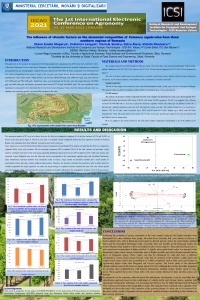
The research targeted the investigation of the aromatic profile for 2019 Feteasca Regala wine resulted from three romanian traditional wineyards: Samburesti, Corcova and Avincis Dragasani. After the liquid / liquid extraction, 42 aroma compounds were identified and quantified by gas chromatography coupled with mass spectrometry (GC-MS), the obtained results differentiating them based on the area of origin and climatic factors. The higher alcohols varyed between 28644.53 µg /L and 33969.27 µg / L, while the esters showed values between 4221.10 µg /L and 7901.25 µg /L. Significant amounts were also observed for fatty acids, between 5310.99 µg /L and 6045.15 µg /L, while lactones showed values starting from 727.39 µg /L and accumulated up to 988.01 µg/L. The most significant results were noticeable in the case of Feteasca Regală wine from Avincis Dragasani, where the climatic indicators were in an optimal ratio, imposing specific quantifiable elements.
Acknowledgements. This work was supported by the project ANTREPRENORDOC, in the framework of Human Resources Development Operational Programme 2014-2020, financed from the European Social Fund under the contract number 36355/23.05.2019 HRD OP /380/6/13 – SMIS Code: 123847.
Keywords
aroma compounds
climatic indicators
Feteasca Regala wine
GC-MS
Manuscript
sciforum-044258.pdf
Poster
V_Niculescu_2_revision.pdf
Comparison LAI estimates from of high resolution satellite observations using different biophysical processors
Sustainability issues and consumption requirements, agricultural land production practices from a climate change perspective