Event submissions
Published

This submission belongs to the session S3. Agronomic Innovations for Sustainable Intensification of Horticultural Production Systems of the event The 1st International Electronic Conference on Agronomy
Published date
20 Jan, 2022
Citation
Elena Ikkonen, Svetlana Chazhengina, Valeria Sidorova, Effect of shungite application on the temperature sensitivity of Allium cepa respiration under two soil water regime, in Proceedings of The 1st International Electronic Conference on Agronomy, 3 May–17 May 2021, MDPI: Basel, Switzerland, doi: 10.3390/IECAG2021-09688
Share
Email
Facebook
Twitter
LinkedIn
Effect of shungite application on the temperature sensitivity of Allium cepa respiration under two soil water regime
'%3e%3cpath%20d='M12.6647%2010.9104C12.4176%2010.325%2012.0589%209.7933%2011.6088%209.34485C11.16%208.89511%2010.6283%208.53653%2010.0432%208.28891C10.038%208.28629%2010.0327%208.28498%2010.0275%208.28236C10.8437%207.69282%2011.3743%206.73252%2011.3743%205.64907C11.3743%203.85423%209.92005%202.40002%208.12522%202.40002C6.33038%202.40002%204.87618%203.85423%204.87618%205.64907C4.87618%206.73252%205.40677%207.69282%206.22296%208.28367C6.21772%208.28629%206.21248%208.2876%206.20724%208.29022C5.62031%208.53783%205.09365%208.89287%204.64167%209.34616C4.19192%209.79496%203.83334%2010.3266%203.58573%2010.9117C3.34247%2011.4846%203.21128%2012.0987%203.19925%2012.721C3.1989%2012.735%203.20135%2012.7489%203.20646%2012.7619C3.21157%2012.7749%203.21924%2012.7868%203.22901%2012.7968C3.23877%2012.8068%203.25045%2012.8148%203.26334%2012.8202C3.27623%2012.8256%203.29007%2012.8284%203.30406%2012.8284H4.09012C4.14776%2012.8284%204.19362%2012.7825%204.19493%2012.7262C4.22113%2011.7148%204.62726%2010.7676%205.34519%2010.0497C6.08802%209.30686%207.07452%208.89811%208.12522%208.89811C9.17592%208.89811%2010.1624%209.30686%2010.9052%2010.0497C11.6232%2010.7676%2012.0293%2011.7148%2012.0555%2012.7262C12.0568%2012.7839%2012.1027%2012.8284%2012.1603%2012.8284H12.9464C12.9604%2012.8284%2012.9742%2012.8256%2012.9871%2012.8202C13%2012.8148%2013.0117%2012.8068%2013.0214%2012.7968C13.0312%2012.7868%2013.0389%2012.7749%2013.044%2012.7619C13.0491%2012.7489%2013.0515%2012.735%2013.0512%2012.721C13.0381%2012.0947%2012.9084%2011.4856%2012.6647%2010.9104ZM8.12522%207.90243C7.52388%207.90243%206.95792%207.66793%206.53214%207.24215C6.10636%206.81636%205.87185%206.2504%205.87185%205.64907C5.87185%205.04773%206.10636%204.48177%206.53214%204.05599C6.95792%203.63021%207.52388%203.3957%208.12522%203.3957C8.72655%203.3957%209.29252%203.63021%209.7183%204.05599C10.1441%204.48177%2010.3786%205.04773%2010.3786%205.64907C10.3786%206.2504%2010.1441%206.81636%209.7183%207.24215C9.29252%207.66793%208.72655%207.90243%208.12522%207.90243Z'%20fill='%235D1EE1'/%3e%3c/g%3e%3c/svg%3e)
Elena Ikkonen 1
Svetlana Chazhengina 2
Valeria Sidorova 3
1. 1Institute of Biology, Karelian Research Center RAS
2. Institute of Geology, Karelian Research Center RAS, Puskinskaja, 11, 185610, Petrozavodsk, Russia;
3. Institute of Biology, Karelian Research Center RAS, Puskinskaja, 11, 185610, Petrozavodsk, Russia
Abstract
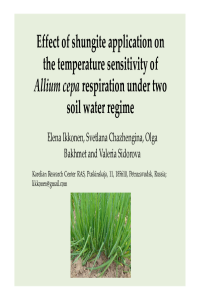
For agricultural soils with low natural fertility, the possibility of using rock powders as an alternative source of nutrients and/or improver of soil physical parameters is under discussion and study. Shungite rocks, volcanic sedimentary rock formed mainly on a silicate basis, are characterized by the high content of carbon and nutrients. This study aimed to evaluate if shungite application to Umbric Podzols may affect leaf and root mitochondrial respiratory pathways, and leaf response to a temperature change. A pot culture experiment was conducted with Allium cepa L. seedlings, using soil shungite concentrations of 0, 5, 10, and 20 g kg-1 and two soil water regimes: well-watered (WW) and drying-wetting (DW) cycles. Soil water deficit increased total respiration (Vt) of onion leaves, but not roots, under low (13°C) and high (33°C) measurement temperature. Shungite application affected leaf Vt only at 13°C: it increased the Vt rate under WW and decreased one under DW. An increase in measurement temperature enhanced the sensitivity of leaf respiration to the inhibitor of the alternative respiratory pathway (salicylhydroxamic acid, SHAM). Shungite application increased the contribution of SHAM-sensitive pathway to the leaf Vt rate under WW, but not DW regime, regardless of the leaf temperature. In contrast to SHAM-resistant pathway, the temperature sensitivity of the SHAM-sensitive rate decreased following the decrease in soil water availability. Shungite application increased the temperature sensitivity of both SHAM-sensitive and SHAM-resistant pathways under DW, and significantly decreased these parameters under WW. In summary, the decrease of temperature sensitivity of alternative SHAM-sensitive respiratory pathway with a decrease of soil water availability or shungite-related decrease of both SHAM-sensitive and SHAM-resistant leaf respiration may play an important role in enhancing the resistance of plant respiration to stress temperature.
Keywords
Onion
rock powder
alternative respiratory pathway
soil water deficit
Manuscript
sciforum_041217_original_IECAG2021_Ikkonen_et_al-done.pdf
Poster
Presentation Ikkonen et al..pdf
Essential oils as potential biopesticides in the control of the genus Meloidogyne: A review
Nematodicidal activity of essential oils and volatiles on the cyst nematodes Globodera and Heterodera