Event submissions
Published

This submission belongs to the session S8. Posters of the event The 1st International Electronic Conference on Agronomy
Published date
01 May, 2021
Citation
Isis Vega, Sofia Pontigo, Paula Cartes, THE IMPACT OF SI FERTILIZATION ON HEALTHY ATTRIBUTES AND YIELD OF GRAINS OF WHEAT PLANTS GROWN UNDER P DEFICIENCY, in Proceedings of The 1st International Electronic Conference on Agronomy, 3 May–17 May 2021, MDPI: Basel, Switzerland, doi: 10.3390/IECAG2021-09701
Share
Email
Facebook
Twitter
LinkedIn
THE IMPACT OF SI FERTILIZATION ON HEALTHY ATTRIBUTES AND YIELD OF GRAINS OF WHEAT PLANTS GROWN UNDER P DEFICIENCY
'%3e%3cpath%20d='M12.6647%2010.9104C12.4176%2010.325%2012.0589%209.7933%2011.6088%209.34485C11.16%208.89511%2010.6283%208.53653%2010.0432%208.28891C10.038%208.28629%2010.0327%208.28498%2010.0275%208.28236C10.8437%207.69282%2011.3743%206.73252%2011.3743%205.64907C11.3743%203.85423%209.92005%202.40002%208.12522%202.40002C6.33038%202.40002%204.87618%203.85423%204.87618%205.64907C4.87618%206.73252%205.40677%207.69282%206.22296%208.28367C6.21772%208.28629%206.21248%208.2876%206.20724%208.29022C5.62031%208.53783%205.09365%208.89287%204.64167%209.34616C4.19192%209.79496%203.83334%2010.3266%203.58573%2010.9117C3.34247%2011.4846%203.21128%2012.0987%203.19925%2012.721C3.1989%2012.735%203.20135%2012.7489%203.20646%2012.7619C3.21157%2012.7749%203.21924%2012.7868%203.22901%2012.7968C3.23877%2012.8068%203.25045%2012.8148%203.26334%2012.8202C3.27623%2012.8256%203.29007%2012.8284%203.30406%2012.8284H4.09012C4.14776%2012.8284%204.19362%2012.7825%204.19493%2012.7262C4.22113%2011.7148%204.62726%2010.7676%205.34519%2010.0497C6.08802%209.30686%207.07452%208.89811%208.12522%208.89811C9.17592%208.89811%2010.1624%209.30686%2010.9052%2010.0497C11.6232%2010.7676%2012.0293%2011.7148%2012.0555%2012.7262C12.0568%2012.7839%2012.1027%2012.8284%2012.1603%2012.8284H12.9464C12.9604%2012.8284%2012.9742%2012.8256%2012.9871%2012.8202C13%2012.8148%2013.0117%2012.8068%2013.0214%2012.7968C13.0312%2012.7868%2013.0389%2012.7749%2013.044%2012.7619C13.0491%2012.7489%2013.0515%2012.735%2013.0512%2012.721C13.0381%2012.0947%2012.9084%2011.4856%2012.6647%2010.9104ZM8.12522%207.90243C7.52388%207.90243%206.95792%207.66793%206.53214%207.24215C6.10636%206.81636%205.87185%206.2504%205.87185%205.64907C5.87185%205.04773%206.10636%204.48177%206.53214%204.05599C6.95792%203.63021%207.52388%203.3957%208.12522%203.3957C8.72655%203.3957%209.29252%203.63021%209.7183%204.05599C10.1441%204.48177%2010.3786%205.04773%2010.3786%205.64907C10.3786%206.2504%2010.1441%206.81636%209.7183%207.24215C9.29252%207.66793%208.72655%207.90243%208.12522%207.90243Z'%20fill='%235D1EE1'/%3e%3c/g%3e%3c/svg%3e)
Isis Vega 1

Sofia Pontigo 1,2
Paula Cartes 1,2
1. Center of Plant, Soil Interaction and Natural Resources Biotechnology, Scientific and Biotechnological Bioresource Nucleus (BIOREN-UFRO), Universidad de La Frontera, 4780000 Temuco, Chile.
2. Departamento de Ciencias Químicas y Recursos Naturales, Universidad de La Frontera, 4780000 Temuco, Chile.
Abstract
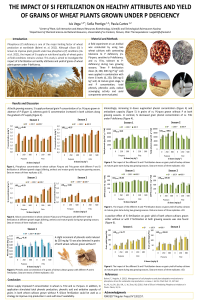
Phosphorus (P) deficiency is one of the major limiting factor of wheat production at worldwide. Although silicon (Si) is known to improve plant growth under low phosphorus (P) conditions, the impact of Si supply on nutritional quality of wheat grains at field conditions remains unclear. This study is aimed to investigate the impact of Si fertilization on healthy attributes and yield of grains of wheat plants grown under P deficiency. A field experiment on an Andisol was conducted by using two wheat cultivars with contrasting tolerance to P deficiency (cv. Púrpura, sensitive to P-deficiency; and cv. Fritz, tolerant to P-deficiency) during two growing seasons. Three P fertilization doses (0, 200, 400 mg P kg-1 soil) were applied in combination with three Si levels (0, 250, 500 mg Si kg-1 soil). At mature grain stage, Si and P concentration, total phenols, phenolics acids, radical scavenging activity and yield components were evaluated. At both growing seasons, Si supply enhanced grain P concentration of cv. Púrpura grown in absence of P, whereas grain Si concentration increased in both cultivars along the gradient of P supply. Interestingly, increasing Si doses augmented phenol concentration and antioxidant capacity in grains of cv. Púrpura grown without P at both growing seasons. In contrast, Si decreased grain phenol concentration of cv. Fritz under P deficiency. A slight increment of phenolic acids induced by 250 mg kg-1 Si was also detected in grains of both wheat cultivars grown without P. A positive effect of Si fertilization on yield components and grain yield of both wheat cultivars grown either without or with P fertilization at both growing seasons was also found. Acknowledgments. FONDECYT Regular Project N°1201257.
Keywords
Silicon
P deficiency
wheat
grains
phenols
Manuscript
sciforum-043895.pdf
Poster
poster-sciforum-043895.pdf
Analysis of Fusarium graminearum Antifungal Protein and Latrodectin-I effect over growth and toxigenesis of Aspergillus fungi with agrofood impact
Regolith as baseline to a future space farm