Event submissions
Published

This submission belongs to the session S8. Posters of the event The 1st International Electronic Conference on Agronomy
Published date
01 May, 2021
Citation
Sofia Pontigo, Isis Vega, Paula Cartes, SILICON INDUCES THE BIOSYNTHESIS OF LIGNIN IN WHEAT CULTIVARS GROWN UNDER PHOSPHORUS STRESS, in Proceedings of The 1st International Electronic Conference on Agronomy, 3 May–17 May 2021, MDPI: Basel, Switzerland, doi: 10.3390/IECAG2021-09706
Share
Email
Facebook
Twitter
LinkedIn
SILICON INDUCES THE BIOSYNTHESIS OF LIGNIN IN WHEAT CULTIVARS GROWN UNDER PHOSPHORUS STRESS

Sofia Pontigo 1,2
'%3e%3cpath%20d='M12.6647%2010.9104C12.4176%2010.325%2012.0589%209.7933%2011.6088%209.34485C11.16%208.89511%2010.6283%208.53653%2010.0432%208.28891C10.038%208.28629%2010.0327%208.28498%2010.0275%208.28236C10.8437%207.69282%2011.3743%206.73252%2011.3743%205.64907C11.3743%203.85423%209.92005%202.40002%208.12522%202.40002C6.33038%202.40002%204.87618%203.85423%204.87618%205.64907C4.87618%206.73252%205.40677%207.69282%206.22296%208.28367C6.21772%208.28629%206.21248%208.2876%206.20724%208.29022C5.62031%208.53783%205.09365%208.89287%204.64167%209.34616C4.19192%209.79496%203.83334%2010.3266%203.58573%2010.9117C3.34247%2011.4846%203.21128%2012.0987%203.19925%2012.721C3.1989%2012.735%203.20135%2012.7489%203.20646%2012.7619C3.21157%2012.7749%203.21924%2012.7868%203.22901%2012.7968C3.23877%2012.8068%203.25045%2012.8148%203.26334%2012.8202C3.27623%2012.8256%203.29007%2012.8284%203.30406%2012.8284H4.09012C4.14776%2012.8284%204.19362%2012.7825%204.19493%2012.7262C4.22113%2011.7148%204.62726%2010.7676%205.34519%2010.0497C6.08802%209.30686%207.07452%208.89811%208.12522%208.89811C9.17592%208.89811%2010.1624%209.30686%2010.9052%2010.0497C11.6232%2010.7676%2012.0293%2011.7148%2012.0555%2012.7262C12.0568%2012.7839%2012.1027%2012.8284%2012.1603%2012.8284H12.9464C12.9604%2012.8284%2012.9742%2012.8256%2012.9871%2012.8202C13%2012.8148%2013.0117%2012.8068%2013.0214%2012.7968C13.0312%2012.7868%2013.0389%2012.7749%2013.044%2012.7619C13.0491%2012.7489%2013.0515%2012.735%2013.0512%2012.721C13.0381%2012.0947%2012.9084%2011.4856%2012.6647%2010.9104ZM8.12522%207.90243C7.52388%207.90243%206.95792%207.66793%206.53214%207.24215C6.10636%206.81636%205.87185%206.2504%205.87185%205.64907C5.87185%205.04773%206.10636%204.48177%206.53214%204.05599C6.95792%203.63021%207.52388%203.3957%208.12522%203.3957C8.72655%203.3957%209.29252%203.63021%209.7183%204.05599C10.1441%204.48177%2010.3786%205.04773%2010.3786%205.64907C10.3786%206.2504%2010.1441%206.81636%209.7183%207.24215C9.29252%207.66793%208.72655%207.90243%208.12522%207.90243Z'%20fill='%235D1EE1'/%3e%3c/g%3e%3c/svg%3e)
Isis Vega 1
Paula Cartes 1,2
1. Center of Plant, Soil Interaction and Natural Resources Biotechnology, Scientific and Biotechnological Bioresource Nucleus (BIOREN-UFRO), Universidad de La Frontera, 4780000 Temuco, Chile
2. Departamento de Ciencias Químicas y Recursos Naturales, Universidad de La Frontera, 4780000 Temuco, Chile.
Abstract
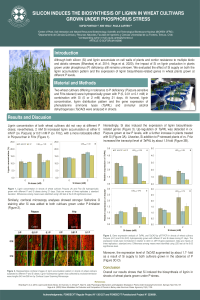
Although both silicon (Si) and lignin accumulate on plant cell walls and confer resistance to multiple biotic and abiotic stresses, the impact of Si on lignin production in plants grown under phosphorus (P) stress still remains unknown. We evaluated the effect of Si on the lignin accumulation pattern and the expression of lignin biosynthesis-related genes in wheat grown at different P levels. Two wheat cultivars differing in tolerance to P deficiency (Púrpura-sensitive and Fritz-tolerant) were hydroponically grown with P (0, 0.01 or 0.1 mM) in combination with Si (0, 1 or 2 mM) during 21 days. At harvest, lignin concentration, lignin distribution pattern and the gene expression of phenylalanine ammonia lyase (TaPAL) and cinnamyl alcohol dehydrogenase (TaCAD) were analyzed in shoots. Lignin concentration of both wheat cultivars did not vary at different P doses; nevertheless, 2 mM Si increased lignin accumulation at either 0 mM P (cv. Púrpura) or 0.01 mM P (cv. Fritz), with a more noticeable effect in Púrpura than in Fritz. In fact, confocal microscopy analyses showed stronger Safranine O staining after Si was added to both cultivars grown under P-limitation. Interestingly, Si also induced the expression of lignin biosynthesis-related genes. Up-regulation of TaPAL was detected in cv. Púrpura grown at low P levels, with a further increase in plants treated with Si. Likewise, Si addition to P-stressed plants of cv. Fritz increased the transcript level of TaPAL by 1.5-fold. Similarly, the expression level of TaCAD augmented by 1.7- fold as a result of Si supply to both cultivars grown at low P. Overall our results shows that Si induced the biosynthesis of lignin in shoots of wheat plants grown under P stress. Acknowledgments. FONDECYT Regular Project N° 1201257 and FONDECYT Postdoctoral Project N° 3200901.
Keywords
Silicon
P deficiency
phenols
lignin
wheat
Manuscript
sciforum-043896.pdf
Poster
poster-sciforum-043896.pdf
Evaluation of the potential of a Rhizobium sp. strain to improve the productivity of Lactuca sativa L. under salinity
SILICON DIFFERENTIALLY MODULATES PHENOLIC METABOLISM AND ANTIOXIDANT CAPACITY OF BARLEY CULTIVARS SUBJECTED TO PHOSPHORUS DEFICIENCY