Event submissions
Published

This submission belongs to the session S8. Posters of the event The 1st International Electronic Conference on Agronomy
Published date
01 May, 2021
Citation
Paula Cartes, Isis Vega, Sofia Pontigo, SILICON DIFFERENTIALLY MODULATES PHENOLIC METABOLISM AND ANTIOXIDANT CAPACITY OF BARLEY CULTIVARS SUBJECTED TO PHOSPHORUS DEFICIENCY , in Proceedings of The 1st International Electronic Conference on Agronomy, 3 May–17 May 2021, MDPI: Basel, Switzerland, doi: 10.3390/IECAG2021-09707
Share
Email
Facebook
Twitter
LinkedIn
SILICON DIFFERENTIALLY MODULATES PHENOLIC METABOLISM AND ANTIOXIDANT CAPACITY OF BARLEY CULTIVARS SUBJECTED TO PHOSPHORUS DEFICIENCY
'%3e%3cpath%20d='M12.6647%2010.9104C12.4176%2010.325%2012.0589%209.7933%2011.6088%209.34485C11.16%208.89511%2010.6283%208.53653%2010.0432%208.28891C10.038%208.28629%2010.0327%208.28498%2010.0275%208.28236C10.8437%207.69282%2011.3743%206.73252%2011.3743%205.64907C11.3743%203.85423%209.92005%202.40002%208.12522%202.40002C6.33038%202.40002%204.87618%203.85423%204.87618%205.64907C4.87618%206.73252%205.40677%207.69282%206.22296%208.28367C6.21772%208.28629%206.21248%208.2876%206.20724%208.29022C5.62031%208.53783%205.09365%208.89287%204.64167%209.34616C4.19192%209.79496%203.83334%2010.3266%203.58573%2010.9117C3.34247%2011.4846%203.21128%2012.0987%203.19925%2012.721C3.1989%2012.735%203.20135%2012.7489%203.20646%2012.7619C3.21157%2012.7749%203.21924%2012.7868%203.22901%2012.7968C3.23877%2012.8068%203.25045%2012.8148%203.26334%2012.8202C3.27623%2012.8256%203.29007%2012.8284%203.30406%2012.8284H4.09012C4.14776%2012.8284%204.19362%2012.7825%204.19493%2012.7262C4.22113%2011.7148%204.62726%2010.7676%205.34519%2010.0497C6.08802%209.30686%207.07452%208.89811%208.12522%208.89811C9.17592%208.89811%2010.1624%209.30686%2010.9052%2010.0497C11.6232%2010.7676%2012.0293%2011.7148%2012.0555%2012.7262C12.0568%2012.7839%2012.1027%2012.8284%2012.1603%2012.8284H12.9464C12.9604%2012.8284%2012.9742%2012.8256%2012.9871%2012.8202C13%2012.8148%2013.0117%2012.8068%2013.0214%2012.7968C13.0312%2012.7868%2013.0389%2012.7749%2013.044%2012.7619C13.0491%2012.7489%2013.0515%2012.735%2013.0512%2012.721C13.0381%2012.0947%2012.9084%2011.4856%2012.6647%2010.9104ZM8.12522%207.90243C7.52388%207.90243%206.95792%207.66793%206.53214%207.24215C6.10636%206.81636%205.87185%206.2504%205.87185%205.64907C5.87185%205.04773%206.10636%204.48177%206.53214%204.05599C6.95792%203.63021%207.52388%203.3957%208.12522%203.3957C8.72655%203.3957%209.29252%203.63021%209.7183%204.05599C10.1441%204.48177%2010.3786%205.04773%2010.3786%205.64907C10.3786%206.2504%2010.1441%206.81636%209.7183%207.24215C9.29252%207.66793%208.72655%207.90243%208.12522%207.90243Z'%20fill='%235D1EE1'/%3e%3c/g%3e%3c/svg%3e)
Paula Cartes 1,2
Isis Vega 2

Sofia Pontigo 1,2
1. Departamento de Ciencias Químicas y Recursos Naturales, Universidad de La Frontera, 4780000 Temuco, Chile.
2. Center of Plant, Soil Interaction and Natural Resources Biotechnology, Scientific and Biotechnological Bioresource Nucleus (BIOREN-UFRO), Universidad de La Frontera, 4780000 Temuco, Chile.
Abstract
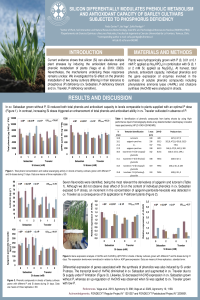
Current evidence shows that silicon (Si) can alleviate multiple plant stresses by inducing the antioxidant defense and phenolic metabolism of plants. Nevertheless, the mechanisms underlying these responses remains unclear. We investigated the Si effect on the phenolic metabolism of two barley cultivars differing in their tolerance to phosphorus (P) deficiency (cv. Sebastian, P-deficiency tolerant and cv. Traveler, P-deficiency sensitive). Plants were hydroponically grown with P (0, 0.01 or 0.1 mM P; applied as Na2HPO4) in combination with Si (0, 1 or 2 mM Si; applied as Na2SiO3). At harvest, total phenols, antioxidant capacity, individual phenolics and the gene expression of enzymes involved in the synthesis of soluble phenolic compounds including phenylalanine ammonia lyase (HvPAL) and chalcone synthase (HvCHS) were analyzed in shoots. In cv. Sebastian grown without P, Si reduced both total phenols and antioxidant capacity to levels comparable to plants supplied with an optimal P dose. In contrast, increasing Si doses triggered an enhancement of total phenols and antioxidant ability in cv. Traveler cultivated in absence of P. Seven flavonoids were identified, being the most relevant the derivatives of apigenin and lutonarin. Although we did not observe clear effect of Si on the content of individual phenolics in cv. Sebastian exposed to P stress, an increment in the concentration of apigenin-pentoxide-hexoside was detected in cv. Traveler as a consequence of Si application to P-deficient plants. Differential expression of genes associated with the synthesis of phenolics was also induced by Si under P-stress. The transcript level of HvPAL diminished in cv. Sebastian and augmented in cv. Traveler due to Si supply under P limitation. Likewise, Si decreased HvCHS expression in cv. Sebastian grown without P, whereas an up-regulation of HvCHS was observed when Si was applied to cv. Traveler grown with low P. Acknowledgments. FONDECYT Regular Project N°1201257.
Keywords
Silicon
P stress
antioxidant phenols
phenylalanine ammonia lyase gene
chalcone synthase gene
barley
Manuscript
sciforum-043900.pdf
Poster
poster-sciforum-043900.pdf
SILICON INDUCES THE BIOSYNTHESIS OF LIGNIN IN WHEAT CULTIVARS GROWN UNDER PHOSPHORUS STRESS
Efficiency of potassium and phosphate solubilizing Actinobacteria in wheat plant growth promotion