Event submissions
Published

This submission belongs to the session S2. Sustainable Management Practices for Soil Health and Food Security of the event The 1st International Electronic Conference on Agronomy
Published date
01 May, 2021
Citation
Jerentulina Vijayarasa, Kandiah Pakeerathan, Nagarathnam Thiruchchelvan, Gunasingam Mikunthan, Bio-remediation agro-based industry's wastewater and mass production of Spirulina (Spirulina platensis (Gomont) Geitler 1925), in Proceedings of The 1st International Electronic Conference on Agronomy, 3 May–17 May 2021, MDPI: Basel, Switzerland, doi: 10.3390/IECAG2021-09716
Share
Email
Facebook
Twitter
LinkedIn
Bio-remediation agro-based industry's wastewater and mass production of Spirulina (Spirulina platensis (Gomont) Geitler 1925)
'%3e%3cpath%20d='M12.6647%2010.9104C12.4176%2010.325%2012.0589%209.7933%2011.6088%209.34485C11.16%208.89511%2010.6283%208.53653%2010.0432%208.28891C10.038%208.28629%2010.0327%208.28498%2010.0275%208.28236C10.8437%207.69282%2011.3743%206.73252%2011.3743%205.64907C11.3743%203.85423%209.92005%202.40002%208.12522%202.40002C6.33038%202.40002%204.87618%203.85423%204.87618%205.64907C4.87618%206.73252%205.40677%207.69282%206.22296%208.28367C6.21772%208.28629%206.21248%208.2876%206.20724%208.29022C5.62031%208.53783%205.09365%208.89287%204.64167%209.34616C4.19192%209.79496%203.83334%2010.3266%203.58573%2010.9117C3.34247%2011.4846%203.21128%2012.0987%203.19925%2012.721C3.1989%2012.735%203.20135%2012.7489%203.20646%2012.7619C3.21157%2012.7749%203.21924%2012.7868%203.22901%2012.7968C3.23877%2012.8068%203.25045%2012.8148%203.26334%2012.8202C3.27623%2012.8256%203.29007%2012.8284%203.30406%2012.8284H4.09012C4.14776%2012.8284%204.19362%2012.7825%204.19493%2012.7262C4.22113%2011.7148%204.62726%2010.7676%205.34519%2010.0497C6.08802%209.30686%207.07452%208.89811%208.12522%208.89811C9.17592%208.89811%2010.1624%209.30686%2010.9052%2010.0497C11.6232%2010.7676%2012.0293%2011.7148%2012.0555%2012.7262C12.0568%2012.7839%2012.1027%2012.8284%2012.1603%2012.8284H12.9464C12.9604%2012.8284%2012.9742%2012.8256%2012.9871%2012.8202C13%2012.8148%2013.0117%2012.8068%2013.0214%2012.7968C13.0312%2012.7868%2013.0389%2012.7749%2013.044%2012.7619C13.0491%2012.7489%2013.0515%2012.735%2013.0512%2012.721C13.0381%2012.0947%2012.9084%2011.4856%2012.6647%2010.9104ZM8.12522%207.90243C7.52388%207.90243%206.95792%207.66793%206.53214%207.24215C6.10636%206.81636%205.87185%206.2504%205.87185%205.64907C5.87185%205.04773%206.10636%204.48177%206.53214%204.05599C6.95792%203.63021%207.52388%203.3957%208.12522%203.3957C8.72655%203.3957%209.29252%203.63021%209.7183%204.05599C10.1441%204.48177%2010.3786%205.04773%2010.3786%205.64907C10.3786%206.2504%2010.1441%206.81636%209.7183%207.24215C9.29252%207.66793%208.72655%207.90243%208.12522%207.90243Z'%20fill='%235D1EE1'/%3e%3c/g%3e%3c/svg%3e)
Jerentulina Vijayarasa 1
Kandiah Pakeerathan 2

Nagarathnam Thiruchchelvan 3
Gunasingam Mikunthan 4
1. Research Student, Department of Agricultural Biology, Faculty of Agriculture, University of Jaffna, Ariviyal nagar, 44 000, Kilinochchi, Sri Lanka
2. Head and Senior Lecturer,
Department of Agricultural Biology, University of Jaffna, 44000, Ariviyal Nagar, Kilinochchi
3. Department of Agricultural Biology, Faculty of Agriculture, University of Jaffna, Ariviyal Nagar, 44000, Kilinochchi, Sri Lanka
4. Professor and Dean,
Faculty of Graduate Studies, University of Jaffna, 40000, Sri Lanka
Abstract
The Spirulina Spirulina platensis (Gomont) Geitler 1925, is a cyanobacteria and used as ecologically sound nutrient-rich dietary supplement. These microalgae have the capability to produce the least-cost protein per unit area than livestock, therefore, being investigated to address malnutrition and food security. Apart from the variety of components like animal feed, fertilizer, and cosmetics produced from Spirulina, phytoremediation of wastewater using Spirulina is an economically viable and environmentally sound tactic. A study carried out with the objectives of quick removal of waste from selected wastewater from agro-based industries, and identify the suitable organic wastes as the costless media for growing S. platensis for its powder production. Wastewater from the fish pond, poultry unit, grain soaked water, and parboiled rice liquid waste was selected as treatments and inoculated with the stock culture of S. platensis. Treatments were replicated three times along with the Zarrouk’s medium as standard control and arranged in a randomized complete block design. The chemical parameters of wastes such as OD value, pH and EC(mS/cm), and the data on the growth of Spirulina using UH5300- Spectrophotometer with a wavelength of 560nm, were measured in 2 days’ interval. The derived data were analyzed using SAS 9.4, and significance among treatments was determined according to the Duncan multiple range test at P <0.05. The results show that the poultry wastewater was identified as a suitable medium for S. platensis growth with the harvestable density of 0.8 at a very low concentration (25 %) in 7 days compare to the standard Zarrouk’s medium. The Maximum and significant OD value of 1.313 was observed on the 15th day in poultry wastewater, and non-significant among other treatments at P <0.05. In fish pond wastewater the maximum OD value of 0.567 was obtained on the 15th day. pH value of poultry wastewater declined from 9.28 to 7.5 after 15 days. The EC values among the treatment were not significant. Among the selected liquid medium poultry wastewater promotes better growth of S. platensis than other locally available wastewater tested. This experiment concludes that agro-based industry's wastewater can be bio-remediated by growing Spirulina, and nutrient-enriched wastewater can be used for mass culturing of Spirulina without nutrient supplements.
Keywords
Agricultural waste
Costless media
Spirulina platensis
Optical density
Manuscript
sciforum-043206 E abstract Spriulina Tulina 13 03 2021 revised 06 05 2021.pdf
Poster
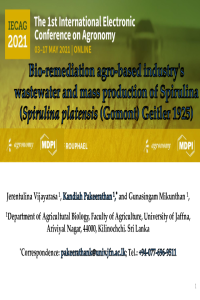
sciforum-043206 presentation Spriulina Tulina 13 03 2021.pdf
Meeting Agricultural Sustainability through Plant Growth Promoting Bacteria: An Examination of the Mechanisms for Improved Host Uptake of Zinc Nutrient in Maize using Functional Mutants of Azospirillum brasilense
Effect of herbicide mixtures on Heracleum sosnowskyi control