Event submissions
Published

This submission belongs to the session S3. Agronomic Innovations for Sustainable Intensification of Horticultural Production Systems of the event The 1st International Electronic Conference on Agronomy
Published date
01 May, 2021
Citation
Sofia Faliagka, Rafailia Germani, Paraskevi Agrafioti, Panagiotis Xidas, Christos G. Athanassiou, Nikolaos Katsoulas, SiO₂ applications as an alternative to insect control in greenhouses, in Proceedings of The 1st International Electronic Conference on Agronomy, 3 May–17 May 2021, MDPI: Basel, Switzerland, doi: 10.3390/IECAG2021-09720
Share
Email
Facebook
Twitter
LinkedIn
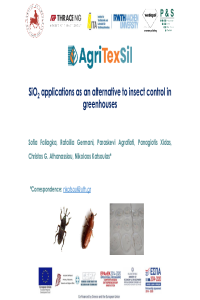
SiO2 applications as an alternative to insect control in greenhouses
'%3e%3cpath%20d='M12.6647%2010.9104C12.4176%2010.325%2012.0589%209.7933%2011.6088%209.34485C11.16%208.89511%2010.6283%208.53653%2010.0432%208.28891C10.038%208.28629%2010.0327%208.28498%2010.0275%208.28236C10.8437%207.69282%2011.3743%206.73252%2011.3743%205.64907C11.3743%203.85423%209.92005%202.40002%208.12522%202.40002C6.33038%202.40002%204.87618%203.85423%204.87618%205.64907C4.87618%206.73252%205.40677%207.69282%206.22296%208.28367C6.21772%208.28629%206.21248%208.2876%206.20724%208.29022C5.62031%208.53783%205.09365%208.89287%204.64167%209.34616C4.19192%209.79496%203.83334%2010.3266%203.58573%2010.9117C3.34247%2011.4846%203.21128%2012.0987%203.19925%2012.721C3.1989%2012.735%203.20135%2012.7489%203.20646%2012.7619C3.21157%2012.7749%203.21924%2012.7868%203.22901%2012.7968C3.23877%2012.8068%203.25045%2012.8148%203.26334%2012.8202C3.27623%2012.8256%203.29007%2012.8284%203.30406%2012.8284H4.09012C4.14776%2012.8284%204.19362%2012.7825%204.19493%2012.7262C4.22113%2011.7148%204.62726%2010.7676%205.34519%2010.0497C6.08802%209.30686%207.07452%208.89811%208.12522%208.89811C9.17592%208.89811%2010.1624%209.30686%2010.9052%2010.0497C11.6232%2010.7676%2012.0293%2011.7148%2012.0555%2012.7262C12.0568%2012.7839%2012.1027%2012.8284%2012.1603%2012.8284H12.9464C12.9604%2012.8284%2012.9742%2012.8256%2012.9871%2012.8202C13%2012.8148%2013.0117%2012.8068%2013.0214%2012.7968C13.0312%2012.7868%2013.0389%2012.7749%2013.044%2012.7619C13.0491%2012.7489%2013.0515%2012.735%2013.0512%2012.721C13.0381%2012.0947%2012.9084%2011.4856%2012.6647%2010.9104ZM8.12522%207.90243C7.52388%207.90243%206.95792%207.66793%206.53214%207.24215C6.10636%206.81636%205.87185%206.2504%205.87185%205.64907C5.87185%205.04773%206.10636%204.48177%206.53214%204.05599C6.95792%203.63021%207.52388%203.3957%208.12522%203.3957C8.72655%203.3957%209.29252%203.63021%209.7183%204.05599C10.1441%204.48177%2010.3786%205.04773%2010.3786%205.64907C10.3786%206.2504%2010.1441%206.81636%209.7183%207.24215C9.29252%207.66793%208.72655%207.90243%208.12522%207.90243Z'%20fill='%235D1EE1'/%3e%3c/g%3e%3c/svg%3e)
Sofia Faliagka 1
Rafailia Germani 1

Paraskevi Agrafioti 1
Panagiotis Xidas 2

Christos G. Athanassiou 1

Nikolaos Katsoulas 1
1. University of Thessaly, Dept. of Agriculture Crop Production and Rural Environment, Fytokou Str., 38446, Volos, Greece
2. THRACE Nonwovens & Geosynthetics S.A., Magiko, Xanthi, Greece
Abstract
Silicon dioxide (SiO2) has been extensively studied as an alternative method to pest management chemical applications in agriculture. The present work aimed to evaluate the insecticidal efficacy of different SiO2 dust formulations and their effectiveness when integrated into the textiles of an insect-proof net. For this reason, Sitophilus oryzae and Tribolium confusum were exposed to three inert dust formulations, namely Sylobloc® S200, S200-OH, and S200MEC to investigate their effect on the mortality of the aforementioned stored-product insects. The results of this series of bioassays showed that Sylobloc® S200 was the most effective dust among all the formulations tested. Thus, five samples of the same 50 mesh size insect-proof net were coated with the S200 dust followed either by different coating repetitions or by the addition of paraffin. T. confusum was indicated as the most tolerant species, as the recorded mortality rate was significantly low when exposed to all samples tested. However, the mortality rate of S. oryzae was strongly related to the coating repetition as well as the exposure intervals. The highest mortality (70%) was detected after 7 days of exposure to the net and it consisted of three coating repetitions while no paraffin was added to its surface. The results of the present study underline the insecticidal efficacy of SiO2 treated nets against storage insects and their subsequent application in greenhouses for the control of more susceptible insects. This research has been co-financed by the European Union and Greek national funds through the National Action “Bilateral and Multilateral E&T Cooperation Greece-Germany”(project code: T2DGΕ-0120).
Keywords
Silicon dioxide
insecticidal efficacy
insect-proof net
greenhouse
horticulture
Manuscript
sciforum_043631_AgriTexSil_MDPI_Proceedings-done.pdf
Poster
AgriTexSil_MDPI_Proceedings_presentation.pdf
Dairy cattle under grazing systems: An estimate of the carbon footprint in the northern Andes of Ecuador
Exploit biodiversity in viticultural systems to reduce pest damage and pesticide use, and increase ecosystem services provision – BIOVINE