Event submissions
Published

This submission belongs to the session S8. Posters of the event The 1st International Electronic Conference on Agronomy
Published date
01 May, 2021
Citation
Małgorzata Haliniarz, Sylwia Chojnacka, Ewa Kwiecińska-Poppe, Low-input agriculture as a chance to preserve endangered species of segetal flora, in Proceedings of The 1st International Electronic Conference on Agronomy, 3 May–17 May 2021, MDPI: Basel, Switzerland, doi: 10.3390/IECAG2021-09740
Share
Email
Facebook
Twitter
LinkedIn
Low-input agriculture as a chance to preserve endangered species of segetal flora

Małgorzata Haliniarz 1
'%3e%3cpath%20d='M12.6647%2010.9104C12.4176%2010.325%2012.0589%209.7933%2011.6088%209.34485C11.16%208.89511%2010.6283%208.53653%2010.0432%208.28891C10.038%208.28629%2010.0327%208.28498%2010.0275%208.28236C10.8437%207.69282%2011.3743%206.73252%2011.3743%205.64907C11.3743%203.85423%209.92005%202.40002%208.12522%202.40002C6.33038%202.40002%204.87618%203.85423%204.87618%205.64907C4.87618%206.73252%205.40677%207.69282%206.22296%208.28367C6.21772%208.28629%206.21248%208.2876%206.20724%208.29022C5.62031%208.53783%205.09365%208.89287%204.64167%209.34616C4.19192%209.79496%203.83334%2010.3266%203.58573%2010.9117C3.34247%2011.4846%203.21128%2012.0987%203.19925%2012.721C3.1989%2012.735%203.20135%2012.7489%203.20646%2012.7619C3.21157%2012.7749%203.21924%2012.7868%203.22901%2012.7968C3.23877%2012.8068%203.25045%2012.8148%203.26334%2012.8202C3.27623%2012.8256%203.29007%2012.8284%203.30406%2012.8284H4.09012C4.14776%2012.8284%204.19362%2012.7825%204.19493%2012.7262C4.22113%2011.7148%204.62726%2010.7676%205.34519%2010.0497C6.08802%209.30686%207.07452%208.89811%208.12522%208.89811C9.17592%208.89811%2010.1624%209.30686%2010.9052%2010.0497C11.6232%2010.7676%2012.0293%2011.7148%2012.0555%2012.7262C12.0568%2012.7839%2012.1027%2012.8284%2012.1603%2012.8284H12.9464C12.9604%2012.8284%2012.9742%2012.8256%2012.9871%2012.8202C13%2012.8148%2013.0117%2012.8068%2013.0214%2012.7968C13.0312%2012.7868%2013.0389%2012.7749%2013.044%2012.7619C13.0491%2012.7489%2013.0515%2012.735%2013.0512%2012.721C13.0381%2012.0947%2012.9084%2011.4856%2012.6647%2010.9104ZM8.12522%207.90243C7.52388%207.90243%206.95792%207.66793%206.53214%207.24215C6.10636%206.81636%205.87185%206.2504%205.87185%205.64907C5.87185%205.04773%206.10636%204.48177%206.53214%204.05599C6.95792%203.63021%207.52388%203.3957%208.12522%203.3957C8.72655%203.3957%209.29252%203.63021%209.7183%204.05599C10.1441%204.48177%2010.3786%205.04773%2010.3786%205.64907C10.3786%206.2504%2010.1441%206.81636%209.7183%207.24215C9.29252%207.66793%208.72655%207.90243%208.12522%207.90243Z'%20fill='%235D1EE1'/%3e%3c/g%3e%3c/svg%3e)
Sylwia Chojnacka 1
Ewa Kwiecińska-Poppe 1
1. Department of Herbology and Plant Cultivation Techniques, Faculty of Agrobioengineering, University of Life Sciences in Lublin, Akademicka 13, 20-950 Lublin, Poland
Abstract
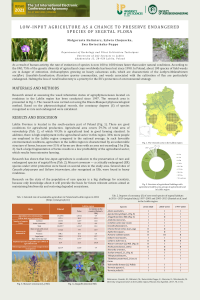
As a result of human activity, the rate of extinction of species is now 100 to 1000 times faster than under natural conditions. According to the FAO, 75% of the genetic diversity of agricultural crops worldwide has been lost since 1990. In Poland, about 100 species of field weeds are in danger of extinction. Archaeophytes growing on heavy calcareous soils, which are characteristic of the Lathyro-Melandrietum noctiflori, Caucalido-Scandicetum, Kicxietum spuriae communities, and weeds associated with the cultivation of flax are particularly endangered. Halting the loss of rural biodiversity is a priority for the EU's protection of environmental strategy.
Research aimed at assessing the weed infestation status of agrophytocoenoses located on rendzinas in the Lublin Province (Poland) has been conducted since 1997. The research was carried out using the Braun-Blanquet phytosociological method. Lublin Province is located in the south-eastern part of Poland. There are good conditions for agricultural production. Agricultural land covers 57.9% of the total area of the voivodship, of which 99.3% is agricultural land in good farming standard. In such favorable environmental conditions, agriculture in the Lublin Province is characterized by an unfavorable structure of farms. 55.6% of over 180 thousand of farms are those with an area not exceeding 5 ha. Such a large fragmentation of farms results in a low profitability of the agricultural sector, which results from extensive farming. Research has shown that low-input agriculture is conducive to the preservation of rare and endangered species of segetal flora. Muscari comosum — a critically endangered (ER) species under strict protection were found on several sites in the study area. Several sites of Caucalis platycarpos and Galium tricornutum, also recognized as ERs, were found in heavy rendzinas. Moreover, numerous sites of such rare species as: Adonis aestivalis, Anthemis tinctoria, Thymelaea passerina, Anagallis foemina, Chaenorhinum minus and Euphorbia exigua were located.
Research on the state of the population of rare species is a big challenge for scientists, because only knowledge about it will provide the basis for future relevant actions aimed at maintaining biodiversity and restoring degraded ecosystems
Keywords
endangered species
rare species
low-input agriculture
extensive farming
Lublin Province
Manuscript
sciforum-043817.pdf
Poster
poster.pdf
Classification of Hyperspectral Images with CNN in Agricultural Lands
Comparison of remote sensing soil electrical conductivity from PlanetScope and ground measured data in wheat and beet yields