Event submissions
Published

This submission belongs to the session Session 5. Complex Systems of the event Entropy 2021: The Scientific Tool of the 21st Century
Published date
02 May, 2021
Citation
Javier Benito, Oscar Parreño, Miguel Herranz, Pablo Ramos, Nikos Karayiannis, Manuel Laso, Confined Polymers as Self-Avoiding Random Walks on Restricted Lattices, in Proceedings of Entropy 2021: The Scientific Tool of the 21st Century, 5 May–7 May 2021, MDPI: Basel, Switzerland, doi: 10.3390/Entropy2021-09744
Share
Email
Facebook
Twitter
LinkedIn
Confined Polymers as Self-Avoiding Random Walks on Restricted Lattices
'%3e%3cpath%20d='M12.6647%2010.9104C12.4176%2010.325%2012.0589%209.7933%2011.6088%209.34485C11.16%208.89511%2010.6283%208.53653%2010.0432%208.28891C10.038%208.28629%2010.0327%208.28498%2010.0275%208.28236C10.8437%207.69282%2011.3743%206.73252%2011.3743%205.64907C11.3743%203.85423%209.92005%202.40002%208.12522%202.40002C6.33038%202.40002%204.87618%203.85423%204.87618%205.64907C4.87618%206.73252%205.40677%207.69282%206.22296%208.28367C6.21772%208.28629%206.21248%208.2876%206.20724%208.29022C5.62031%208.53783%205.09365%208.89287%204.64167%209.34616C4.19192%209.79496%203.83334%2010.3266%203.58573%2010.9117C3.34247%2011.4846%203.21128%2012.0987%203.19925%2012.721C3.1989%2012.735%203.20135%2012.7489%203.20646%2012.7619C3.21157%2012.7749%203.21924%2012.7868%203.22901%2012.7968C3.23877%2012.8068%203.25045%2012.8148%203.26334%2012.8202C3.27623%2012.8256%203.29007%2012.8284%203.30406%2012.8284H4.09012C4.14776%2012.8284%204.19362%2012.7825%204.19493%2012.7262C4.22113%2011.7148%204.62726%2010.7676%205.34519%2010.0497C6.08802%209.30686%207.07452%208.89811%208.12522%208.89811C9.17592%208.89811%2010.1624%209.30686%2010.9052%2010.0497C11.6232%2010.7676%2012.0293%2011.7148%2012.0555%2012.7262C12.0568%2012.7839%2012.1027%2012.8284%2012.1603%2012.8284H12.9464C12.9604%2012.8284%2012.9742%2012.8256%2012.9871%2012.8202C13%2012.8148%2013.0117%2012.8068%2013.0214%2012.7968C13.0312%2012.7868%2013.0389%2012.7749%2013.044%2012.7619C13.0491%2012.7489%2013.0515%2012.735%2013.0512%2012.721C13.0381%2012.0947%2012.9084%2011.4856%2012.6647%2010.9104ZM8.12522%207.90243C7.52388%207.90243%206.95792%207.66793%206.53214%207.24215C6.10636%206.81636%205.87185%206.2504%205.87185%205.64907C5.87185%205.04773%206.10636%204.48177%206.53214%204.05599C6.95792%203.63021%207.52388%203.3957%208.12522%203.3957C8.72655%203.3957%209.29252%203.63021%209.7183%204.05599C10.1441%204.48177%2010.3786%205.04773%2010.3786%205.64907C10.3786%206.2504%2010.1441%206.81636%209.7183%207.24215C9.29252%207.66793%208.72655%207.90243%208.12522%207.90243Z'%20fill='%235D1EE1'/%3e%3c/g%3e%3c/svg%3e)
Javier Benito 1
Oscar Parreño 1
Miguel Herranz 1
Pablo Ramos 1

Nikos Karayiannis 1

Manuel Laso 1
1. Institute for Optoelectronics and Microtechnology (ISOM) and ETSI Industriales, Universidad Politecnica de Madrid (UPM), José Gutierrez Abascal 2, 28006, Madrid, Spain
Abstract
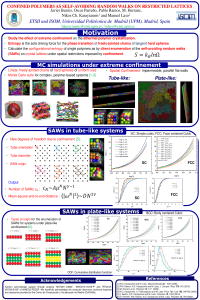
Through extensive Monte Carlo simulations [1] we study the crystallization of freely-jointed chains of tangent hard spheres under conditions of extreme confinement. The latter is realized through the presence of flat, parallel and impenetrable walls in one or more dimensions [2]. Extreme confinement corresponds to the state where the inter-wall distance, in at least one dimension, approaches the monomer size. Results are presented for quasi-1D (tube-like) and quasi-2D (plate-like) polymer templates. In both cases we observe the entropy-driven formation of highly ordered regions of close-packed, slightly defective crystals of different orientations. In a second stage we map the confined polymer chains onto the self-avoiding random walk (SAW) model on restricted lattices [3]. We enumerate all possible chain configurations (or SAWs) on a specific regular lattice subject to spatial restrictions arising from confinement. Through this we can determine the conformational component of entropy and eventually predict the thermodynamic stability of each distinct polymer crystal. In parallel, we obtain approximate expression for the SAW behavior as a function of chain length, type of lattice, and level of confinement. We present a simple geometric argument to explain, to first order, the dependence of the number of restricted SAWs on the type of SAW origin. Restricted lattices correspond to the cubic (simple, body center and face center) crystal system and results are compared against the ones of the bulk (unrestricted) case.
- Ramos, P.M.; Karayiannis, N.C.; Laso, M. J. Comput. Phys. 2018, 375, 918-934.
- Foteinopoulou, K.; Karayiannis, N.C.; Laso, Chem. Eng. Sci. 2015, 121, 118-132.
- Benito, J.; Karayiannis, N.C.; Laso, M. Polymers 2018, 10.
Keywords
Conformational entropy
self-avoiding random walk
freely-jointed model
cubic crystal system
extreme confinement
direct enumeration
restricted lattice
Manuscript
sciforum-029325.pdf
Poster
poster_confined_polymers_as_SAWs.pdf
A Model-Based Reinforcement Learning Approach for a Rare Disease Diagnostic Task