Event submissions
Published

This submission belongs to the session Session 2. Information Theory, Probability and Statistics of the event Entropy 2021: The Scientific Tool of the 21st Century
Published date
05 May, 2021
Citation
Rémi Besson, Erwan Le Pennec, Stéphanie Allassonnière, A Model-Based Reinforcement Learning Approach for a Rare Disease Diagnostic Task, in Proceedings of Entropy 2021: The Scientific Tool of the 21st Century, 5 May–7 May 2021, MDPI: Basel, Switzerland, doi: 10.3390/Entropy2021-09749
Share
Email
Facebook
Twitter
LinkedIn
A Model-Based Reinforcement Learning Approach for a Rare Disease Diagnostic Task
'%3e%3cpath%20d='M12.6647%2010.9104C12.4176%2010.325%2012.0589%209.7933%2011.6088%209.34485C11.16%208.89511%2010.6283%208.53653%2010.0432%208.28891C10.038%208.28629%2010.0327%208.28498%2010.0275%208.28236C10.8437%207.69282%2011.3743%206.73252%2011.3743%205.64907C11.3743%203.85423%209.92005%202.40002%208.12522%202.40002C6.33038%202.40002%204.87618%203.85423%204.87618%205.64907C4.87618%206.73252%205.40677%207.69282%206.22296%208.28367C6.21772%208.28629%206.21248%208.2876%206.20724%208.29022C5.62031%208.53783%205.09365%208.89287%204.64167%209.34616C4.19192%209.79496%203.83334%2010.3266%203.58573%2010.9117C3.34247%2011.4846%203.21128%2012.0987%203.19925%2012.721C3.1989%2012.735%203.20135%2012.7489%203.20646%2012.7619C3.21157%2012.7749%203.21924%2012.7868%203.22901%2012.7968C3.23877%2012.8068%203.25045%2012.8148%203.26334%2012.8202C3.27623%2012.8256%203.29007%2012.8284%203.30406%2012.8284H4.09012C4.14776%2012.8284%204.19362%2012.7825%204.19493%2012.7262C4.22113%2011.7148%204.62726%2010.7676%205.34519%2010.0497C6.08802%209.30686%207.07452%208.89811%208.12522%208.89811C9.17592%208.89811%2010.1624%209.30686%2010.9052%2010.0497C11.6232%2010.7676%2012.0293%2011.7148%2012.0555%2012.7262C12.0568%2012.7839%2012.1027%2012.8284%2012.1603%2012.8284H12.9464C12.9604%2012.8284%2012.9742%2012.8256%2012.9871%2012.8202C13%2012.8148%2013.0117%2012.8068%2013.0214%2012.7968C13.0312%2012.7868%2013.0389%2012.7749%2013.044%2012.7619C13.0491%2012.7489%2013.0515%2012.735%2013.0512%2012.721C13.0381%2012.0947%2012.9084%2011.4856%2012.6647%2010.9104ZM8.12522%207.90243C7.52388%207.90243%206.95792%207.66793%206.53214%207.24215C6.10636%206.81636%205.87185%206.2504%205.87185%205.64907C5.87185%205.04773%206.10636%204.48177%206.53214%204.05599C6.95792%203.63021%207.52388%203.3957%208.12522%203.3957C8.72655%203.3957%209.29252%203.63021%209.7183%204.05599C10.1441%204.48177%2010.3786%205.04773%2010.3786%205.64907C10.3786%206.2504%2010.1441%206.81636%209.7183%207.24215C9.29252%207.66793%208.72655%207.90243%208.12522%207.90243Z'%20fill='%235D1EE1'/%3e%3c/g%3e%3c/svg%3e)
Rémi Besson 1
Erwan Le Pennec 2,3
Stéphanie Allassonnière 1
1. Centre de Recherche des Cordeliers, Université de Paris, INSERM, Sorbonne Université, 75006 Paris, France
2. CMAP Ecole Polytechnique, Institut Polytechnique de Paris, 91128 Palaiseau, France
3. XPop, Inria Saclay, 91120 Palaiseau, France
Abstract
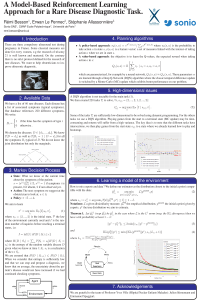
In this work, we study the problem of inferring a discrete probability distribution using both expert knowledge and empirical data.
This is an important issue for many applications where the scarcity of data prevents a purely empirical approach. In this context, it is common to rely first on an a priori from initial domain knowledge before proceeding to an online data acquisition. We are particularly interested in the intermediate regime, where we do not have enough data to do without the initial a priori of the experts, but enough to correct it if necessary.
We formalize expert knowledge as a set of priors, e.g. on the marginals or on the support of distribution. The expert distribution is defined as the distribution of the maximum entropy that satisfies the constraints set by the experts. In turn, empirical data is used to construct the empirical distribution.
We present a new method for objectively choosing the weight to be given to the experts in relation to the data. We define our estimator as the projection of the experts on the confidence interval centered on the empirical distribution. This is the closest distribution from the experts which is consistent with the observed data. The confidence level is the unique parameter of this method.
We show, both empirically and theoretically, that our proposed estimator is always more efficient than the best of the two models (expert or data alone) within a constant.
Our estimator allows a bad a priori to be abandoned relatively quickly when the inconsistency of the data collected with the initial a priori is observed. At the same time, this same mixture makes it possible to keep the initial a priori if it is good. We prove empirically that our method outperforms a parametric Bayesian approach in such a task.
Keywords
maximum entropy
mixing expert and data
Kullback–Leibler centroid
Manuscript
sciforum-029156.pdf
Poster
sciforum-029156.pdf
Confined Polymers as Self-Avoiding Random Walks on Restricted Lattices
On Conditional Tsallis Entropy