Event submissions
Published

This submission belongs to the session Session 2. Information Theory, Probability and Statistics of the event Entropy 2021: The Scientific Tool of the 21st Century
Published date
05 May, 2021
Citation
Andreia Teixeira, André Souto, Luís Antunes, On Conditional Tsallis Entropy, in Proceedings of Entropy 2021: The Scientific Tool of the 21st Century, 5 May–7 May 2021, MDPI: Basel, Switzerland, doi: 10.3390/Entropy2021-09750
Share
Email
Facebook
Twitter
LinkedIn
On Conditional Tsallis Entropy

Andreia Teixeira 1,2,3
'%3e%3cpath%20d='M12.6647%2010.9104C12.4176%2010.325%2012.0589%209.7933%2011.6088%209.34485C11.16%208.89511%2010.6283%208.53653%2010.0432%208.28891C10.038%208.28629%2010.0327%208.28498%2010.0275%208.28236C10.8437%207.69282%2011.3743%206.73252%2011.3743%205.64907C11.3743%203.85423%209.92005%202.40002%208.12522%202.40002C6.33038%202.40002%204.87618%203.85423%204.87618%205.64907C4.87618%206.73252%205.40677%207.69282%206.22296%208.28367C6.21772%208.28629%206.21248%208.2876%206.20724%208.29022C5.62031%208.53783%205.09365%208.89287%204.64167%209.34616C4.19192%209.79496%203.83334%2010.3266%203.58573%2010.9117C3.34247%2011.4846%203.21128%2012.0987%203.19925%2012.721C3.1989%2012.735%203.20135%2012.7489%203.20646%2012.7619C3.21157%2012.7749%203.21924%2012.7868%203.22901%2012.7968C3.23877%2012.8068%203.25045%2012.8148%203.26334%2012.8202C3.27623%2012.8256%203.29007%2012.8284%203.30406%2012.8284H4.09012C4.14776%2012.8284%204.19362%2012.7825%204.19493%2012.7262C4.22113%2011.7148%204.62726%2010.7676%205.34519%2010.0497C6.08802%209.30686%207.07452%208.89811%208.12522%208.89811C9.17592%208.89811%2010.1624%209.30686%2010.9052%2010.0497C11.6232%2010.7676%2012.0293%2011.7148%2012.0555%2012.7262C12.0568%2012.7839%2012.1027%2012.8284%2012.1603%2012.8284H12.9464C12.9604%2012.8284%2012.9742%2012.8256%2012.9871%2012.8202C13%2012.8148%2013.0117%2012.8068%2013.0214%2012.7968C13.0312%2012.7868%2013.0389%2012.7749%2013.044%2012.7619C13.0491%2012.7489%2013.0515%2012.735%2013.0512%2012.721C13.0381%2012.0947%2012.9084%2011.4856%2012.6647%2010.9104ZM8.12522%207.90243C7.52388%207.90243%206.95792%207.66793%206.53214%207.24215C6.10636%206.81636%205.87185%206.2504%205.87185%205.64907C5.87185%205.04773%206.10636%204.48177%206.53214%204.05599C6.95792%203.63021%207.52388%203.3957%208.12522%203.3957C8.72655%203.3957%209.29252%203.63021%209.7183%204.05599C10.1441%204.48177%2010.3786%205.04773%2010.3786%205.64907C10.3786%206.2504%2010.1441%206.81636%209.7183%207.24215C9.29252%207.66793%208.72655%207.90243%208.12522%207.90243Z'%20fill='%235D1EE1'/%3e%3c/g%3e%3c/svg%3e)
André Souto 4,5,6
Luís Antunes 7,8
1. Centre for Health Technology and Services Research (CINTESIS), Faculty of Medicine University of Porto,
Porto, Portugal
2. Health Information and Decision Sciences Department - MEDCIDS, Faculty of Medicine, University of Porto,
Porto, Portugal
3. ARC4DigiT, Polytechnic Institute of Viana do Castelo, Viana do Castelo, Portugal
4. Departamento de Informática Faculdade de Ciências da Universidade de Lisboa, Lisboa, Portugal
5. LASIGE, Universidade de Lisboa, Lisboa, Portugal
6. Instituto de Telecomunicações, Portugal
7. Institute for Systems and Computer Engineering, Technology and Science (INESC-TEC), Porto, Portugal
8. DCC-FCUP, University of Porto, Porto, Portugal
Abstract
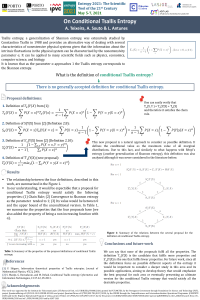
Tsallis entropy, a generalisation of Shannon entropy that depends on a parameter alpha, provides an alternative way of dealing with several characteristics of nonextensive physical systems given that the information about the intrinsic fluctuations in the physical system can be characterized by the nonextensivity parameter alpha. It is known that as the parameter alpha approaches 1, the Tsallis entropy corresponds to the Shannon entropy. Unlike for Shannon entropy, but similarly to Rényi entropy (yet another generalisation of Shannon entropy that also depends on a parameter alpha and converges to Shannon entropy when alpha approaches 1), there is no commonly accepted definition for the conditional Tsallis entropy. In this work, we revisit the notion of conditional Tsallis entropy by studying some natural and desirable properties in the existing proposals: when alpha tends to 1, the usual conditional Shannon entropy should be recovered; the conditional Tsallis entropy should not exceed the unconditional Tsallis entropy; and the conditional Tsallis entropy should have values between 0 and the maximum value of the unconditional version. We also introduce a new proposal for conditional Tsallis entropy and compare it with the existing ones.
Keywords
Tsallis entropy
Conditional Tsallis entropies
Manuscript
sciforum-029276.pdf
Poster
poster.pdf
A Model-Based Reinforcement Learning Approach for a Rare Disease Diagnostic Task
Predicting Human Responses to Syllogism Tasks Following the Principle of Maximum Entropy