Event submissions
Published

This submission belongs to the session Session 2. Information Theory, Probability and Statistics of the event Entropy 2021: The Scientific Tool of the 21st Century
Published date
05 May, 2021
Citation
Maria Ribeiro, Teresa Henriques, Luísa Castro, Andreia Teixeira, André Souto, Luís Antunes, Cristina Costa-Santos, The Entropy Universe, in Proceedings of Entropy 2021: The Scientific Tool of the 21st Century, 5 May–7 May 2021, MDPI: Basel, Switzerland, doi: 10.3390/Entropy2021-09752
Share
Email
Facebook
Twitter
LinkedIn
The Entropy Universe
'%3e%3cpath%20d='M12.6647%2010.9104C12.4176%2010.325%2012.0589%209.7933%2011.6088%209.34485C11.16%208.89511%2010.6283%208.53653%2010.0432%208.28891C10.038%208.28629%2010.0327%208.28498%2010.0275%208.28236C10.8437%207.69282%2011.3743%206.73252%2011.3743%205.64907C11.3743%203.85423%209.92005%202.40002%208.12522%202.40002C6.33038%202.40002%204.87618%203.85423%204.87618%205.64907C4.87618%206.73252%205.40677%207.69282%206.22296%208.28367C6.21772%208.28629%206.21248%208.2876%206.20724%208.29022C5.62031%208.53783%205.09365%208.89287%204.64167%209.34616C4.19192%209.79496%203.83334%2010.3266%203.58573%2010.9117C3.34247%2011.4846%203.21128%2012.0987%203.19925%2012.721C3.1989%2012.735%203.20135%2012.7489%203.20646%2012.7619C3.21157%2012.7749%203.21924%2012.7868%203.22901%2012.7968C3.23877%2012.8068%203.25045%2012.8148%203.26334%2012.8202C3.27623%2012.8256%203.29007%2012.8284%203.30406%2012.8284H4.09012C4.14776%2012.8284%204.19362%2012.7825%204.19493%2012.7262C4.22113%2011.7148%204.62726%2010.7676%205.34519%2010.0497C6.08802%209.30686%207.07452%208.89811%208.12522%208.89811C9.17592%208.89811%2010.1624%209.30686%2010.9052%2010.0497C11.6232%2010.7676%2012.0293%2011.7148%2012.0555%2012.7262C12.0568%2012.7839%2012.1027%2012.8284%2012.1603%2012.8284H12.9464C12.9604%2012.8284%2012.9742%2012.8256%2012.9871%2012.8202C13%2012.8148%2013.0117%2012.8068%2013.0214%2012.7968C13.0312%2012.7868%2013.0389%2012.7749%2013.044%2012.7619C13.0491%2012.7489%2013.0515%2012.735%2013.0512%2012.721C13.0381%2012.0947%2012.9084%2011.4856%2012.6647%2010.9104ZM8.12522%207.90243C7.52388%207.90243%206.95792%207.66793%206.53214%207.24215C6.10636%206.81636%205.87185%206.2504%205.87185%205.64907C5.87185%205.04773%206.10636%204.48177%206.53214%204.05599C6.95792%203.63021%207.52388%203.3957%208.12522%203.3957C8.72655%203.3957%209.29252%203.63021%209.7183%204.05599C10.1441%204.48177%2010.3786%205.04773%2010.3786%205.64907C10.3786%206.2504%2010.1441%206.81636%209.7183%207.24215C9.29252%207.66793%208.72655%207.90243%208.12522%207.90243Z'%20fill='%235D1EE1'/%3e%3c/g%3e%3c/svg%3e)
Maria Ribeiro 1,2

Teresa Henriques 3,4

Luísa Castro 1,3

Andreia Teixeira 3,4,5
André Souto 6,7,8
Luís Antunes 2,9

Cristina Costa-Santos 3,4
1. Center for Research in Advanced Computing Systems, Institute for Systems and Computer Engineering, Technology and Science (CRACS/INESC-TEC), Porto, Portugal
2. Computer Science Department, Faculty of Sciences, University of Porto, Porto, Portugal
3. Centre for Health Technology and Services Research (CINTESIS), Faculty of Medicine University of Porto, Porto, Portugal
4. Health Information and Decision Sciences Department - MEDCIDS, Faculty of Medicine, University of Porto, Porto, Portugal
5. Instituto Politécnico de Viana do Castelo, Viana do Castelo, Portugal
6. Departamento de Informática Faculdade de Ciências da Universidade de Lisboa, Lisboa, Portugal
7. LASIGE, Universidade de Lisboa, Lisboa, Portugal
8. Instituto de Telecomunicações, Portugal
9. Institute for Systems and Computer Engineering, Technology and Science (INESC-TEC), Porto, Portugal
Abstract
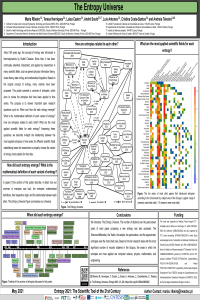
About 160 years ago, the concept of entropy was introduced in thermodynamics by Rudolf Clausius. Since then, it has been continually extended, interpreted, and applied by researchers in many scientific fields, such as general physics information theory, chaos theory, data mining, and mathematical linguistics. Based on the original concept of entropy, many variants have been proposed. This paper presents a universe of entropies, which aims to review the entropies that had been applied to time series. The purpose is to answer important open research questions such as: How did each entropy emerge? What is the mathematical definition of each variant of entropy? How are entropies related to each other? What are the most applied scientific fields for each entropy? Answering these questions, we describe in-depth the relationship between the most applied entropies in time series for different scientific fields establishing bases for researchers to properly choose the variant of entropy most suitable for their data.
The number of citations over the past fifteen years of each paper proposing a new entropy, was accessed. The Shannon/differential, the Tsallis, the sample, the permutation, and the approximate entropy were the most cited entropies. Based on the ten categories with the most significant number of records obtained in the Scopus categories, the areas in which the entropies are more applied are computer science, physics, mathematics, and engineering. From the top ten, the application area with less citations of papers proposing new entropies is the medical category.
Keywords
Entropies measures
applications
review
information theory
time series
Manuscript
sciforum-030222.pdf
Poster
The Entropy Universe - Entropy2021.pdf
Predicting Human Responses to Syllogism Tasks Following the Principle of Maximum Entropy
Information Geometry of Estimating Functions in Parametric Statistical Models