Event submissions
Published

This submission belongs to the session Session 2. Information Theory, Probability and Statistics of the event Entropy 2021: The Scientific Tool of the 21st Century
Published date
05 May, 2021
Citation
Hiroshi Matsuzoe, Gauge freedom of entropies on q-Gaussian distributions, in Proceedings of Entropy 2021: The Scientific Tool of the 21st Century, 5 May–7 May 2021, MDPI: Basel, Switzerland, doi: 10.3390/Entropy2021-09754
Share
Email
Facebook
Twitter
LinkedIn
Gauge freedom of entropies on q-Gaussian distributions
'%3e%3cpath%20d='M12.6647%2010.9104C12.4176%2010.325%2012.0589%209.7933%2011.6088%209.34485C11.16%208.89511%2010.6283%208.53653%2010.0432%208.28891C10.038%208.28629%2010.0327%208.28498%2010.0275%208.28236C10.8437%207.69282%2011.3743%206.73252%2011.3743%205.64907C11.3743%203.85423%209.92005%202.40002%208.12522%202.40002C6.33038%202.40002%204.87618%203.85423%204.87618%205.64907C4.87618%206.73252%205.40677%207.69282%206.22296%208.28367C6.21772%208.28629%206.21248%208.2876%206.20724%208.29022C5.62031%208.53783%205.09365%208.89287%204.64167%209.34616C4.19192%209.79496%203.83334%2010.3266%203.58573%2010.9117C3.34247%2011.4846%203.21128%2012.0987%203.19925%2012.721C3.1989%2012.735%203.20135%2012.7489%203.20646%2012.7619C3.21157%2012.7749%203.21924%2012.7868%203.22901%2012.7968C3.23877%2012.8068%203.25045%2012.8148%203.26334%2012.8202C3.27623%2012.8256%203.29007%2012.8284%203.30406%2012.8284H4.09012C4.14776%2012.8284%204.19362%2012.7825%204.19493%2012.7262C4.22113%2011.7148%204.62726%2010.7676%205.34519%2010.0497C6.08802%209.30686%207.07452%208.89811%208.12522%208.89811C9.17592%208.89811%2010.1624%209.30686%2010.9052%2010.0497C11.6232%2010.7676%2012.0293%2011.7148%2012.0555%2012.7262C12.0568%2012.7839%2012.1027%2012.8284%2012.1603%2012.8284H12.9464C12.9604%2012.8284%2012.9742%2012.8256%2012.9871%2012.8202C13%2012.8148%2013.0117%2012.8068%2013.0214%2012.7968C13.0312%2012.7868%2013.0389%2012.7749%2013.044%2012.7619C13.0491%2012.7489%2013.0515%2012.735%2013.0512%2012.721C13.0381%2012.0947%2012.9084%2011.4856%2012.6647%2010.9104ZM8.12522%207.90243C7.52388%207.90243%206.95792%207.66793%206.53214%207.24215C6.10636%206.81636%205.87185%206.2504%205.87185%205.64907C5.87185%205.04773%206.10636%204.48177%206.53214%204.05599C6.95792%203.63021%207.52388%203.3957%208.12522%203.3957C8.72655%203.3957%209.29252%203.63021%209.7183%204.05599C10.1441%204.48177%2010.3786%205.04773%2010.3786%205.64907C10.3786%206.2504%2010.1441%206.81636%209.7183%207.24215C9.29252%207.66793%208.72655%207.90243%208.12522%207.90243Z'%20fill='%235D1EE1'/%3e%3c/g%3e%3c/svg%3e)
Hiroshi Matsuzoe 1
1. Nagoya Institute of Technology
Abstract
This is a joint work with Asuka Takatsu at Tokyo Metropolitan University.
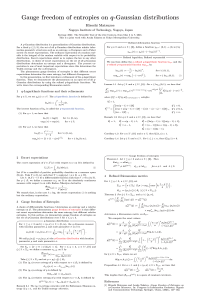
A q-Gaussian distribution is a generalization of an ordinary Gaussian distribution. The set of all q-Gaussian distributions admits information geometric structures such as an entropy, a divergence and a Fisher metric via escort expectations. The ordinary expectation of a random variable is the integral of the random variable with respect to its probability distribution. Escort expectations admit us to replace the law to any other distributions. A choice of escort expectations on the set of all q-Gaussian distributions determines an entropy and a divergence. The q-escort expectation is one of most important expectations since this determines the Tsallis entropy and the alpha-divergence.
The phenomenon gauge freedom of entropies is that different escort expectations determine the same entropy, but different divergences.
In this talk, we first introduce a refinement of the q-logarithmic function. Then we demonstrate the phenomenon on an open set of all q-Gaussian distributions by using the refined q-logarithmic functions. We write down the corresponding Riemannian metric.
Keywords
Information geometry
gauge freedom of entropies
efined q-logarithmic function
q-Gaussian distribution
Manuscript
sciforum-030271.pdf
Poster
Entropy-matsuzoe_a0.pdf
Information Geometry of Estimating Functions in Parametric Statistical Models
A Kolmogorov Complexity for multidisciplinary domains