Event submissions
Published

This submission belongs to the session Session 6. Entropy in Multidisciplinary Applications of the event Entropy 2021: The Scientific Tool of the 21st Century
Published date
05 May, 2021
Citation
Caroline Roithner, Helmut Rechberger, Statistical entropy opens a new way to assess the recyclability of products, in Proceedings of Entropy 2021: The Scientific Tool of the 21st Century, 5 May–7 May 2021, MDPI: Basel, Switzerland, doi: 10.3390/Entropy2021-09764
Share
Email
Facebook
Twitter
LinkedIn
Statistical entropy opens a new way to assess the recyclability of products
'%3e%3cpath%20d='M12.6647%2010.9104C12.4176%2010.325%2012.0589%209.7933%2011.6088%209.34485C11.16%208.89511%2010.6283%208.53653%2010.0432%208.28891C10.038%208.28629%2010.0327%208.28498%2010.0275%208.28236C10.8437%207.69282%2011.3743%206.73252%2011.3743%205.64907C11.3743%203.85423%209.92005%202.40002%208.12522%202.40002C6.33038%202.40002%204.87618%203.85423%204.87618%205.64907C4.87618%206.73252%205.40677%207.69282%206.22296%208.28367C6.21772%208.28629%206.21248%208.2876%206.20724%208.29022C5.62031%208.53783%205.09365%208.89287%204.64167%209.34616C4.19192%209.79496%203.83334%2010.3266%203.58573%2010.9117C3.34247%2011.4846%203.21128%2012.0987%203.19925%2012.721C3.1989%2012.735%203.20135%2012.7489%203.20646%2012.7619C3.21157%2012.7749%203.21924%2012.7868%203.22901%2012.7968C3.23877%2012.8068%203.25045%2012.8148%203.26334%2012.8202C3.27623%2012.8256%203.29007%2012.8284%203.30406%2012.8284H4.09012C4.14776%2012.8284%204.19362%2012.7825%204.19493%2012.7262C4.22113%2011.7148%204.62726%2010.7676%205.34519%2010.0497C6.08802%209.30686%207.07452%208.89811%208.12522%208.89811C9.17592%208.89811%2010.1624%209.30686%2010.9052%2010.0497C11.6232%2010.7676%2012.0293%2011.7148%2012.0555%2012.7262C12.0568%2012.7839%2012.1027%2012.8284%2012.1603%2012.8284H12.9464C12.9604%2012.8284%2012.9742%2012.8256%2012.9871%2012.8202C13%2012.8148%2013.0117%2012.8068%2013.0214%2012.7968C13.0312%2012.7868%2013.0389%2012.7749%2013.044%2012.7619C13.0491%2012.7489%2013.0515%2012.735%2013.0512%2012.721C13.0381%2012.0947%2012.9084%2011.4856%2012.6647%2010.9104ZM8.12522%207.90243C7.52388%207.90243%206.95792%207.66793%206.53214%207.24215C6.10636%206.81636%205.87185%206.2504%205.87185%205.64907C5.87185%205.04773%206.10636%204.48177%206.53214%204.05599C6.95792%203.63021%207.52388%203.3957%208.12522%203.3957C8.72655%203.3957%209.29252%203.63021%209.7183%204.05599C10.1441%204.48177%2010.3786%205.04773%2010.3786%205.64907C10.3786%206.2504%2010.1441%206.81636%209.7183%207.24215C9.29252%207.66793%208.72655%207.90243%208.12522%207.90243Z'%20fill='%235D1EE1'/%3e%3c/g%3e%3c/svg%3e)
Caroline Roithner 1
Helmut Rechberger 1
1. TU Wien, Institute for Water Quality and Resource Management
Abstract
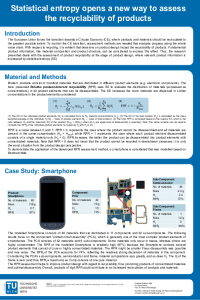
Statistical entropy is applied to assess various treatment technologies in waste management. It measures the effect of a treatment on waste flows, and thus the mixing/concentrating of materials and substances. The stronger the mixing, the higher is the produced statistical entropy (which is in accordance to the law of thermodynamics), and vice versa. For example, recyclers aim to generate outputs of concentrated target materials out of a mixed waste input, which corresponds to a statistical entropy decrease. The recycling effectiveness increases, the lower the statistical entropy is. Besides assessment of processes, statistical entropy can also be used to assess individual products and their material distribution respectively. Thus, complex products that consist of manifold materials show an increased material distribution/mixing, which again translates into high statistical entropy. As recycling efforts increase, the more complex products are, it seems feasible to assess the product inherent recyclability by statistical entropy. The lower the statistical entropy of the product, the higher is the recyclability. Because material concentrations can vary substantially within the different product components, information on the product structure needs to be considered too. Thus, the developed statistical entropy approach bases on material concentrations and information on the product assembly. To demonstrate the new application of statistical entropy, a case study is presented in which the recyclability of a typical smartphone is evaluated. The results show that statistical entropy is an appropriate metric to describe the recyclability of products and enables important insights in the design of products. It could act as a planning tool for product designers and manufacturers to promote products of higher recyclability. Further, the new statistical entropy approach could be of relevance for the implementation of the European Union’s Circular Economy Package.
Keywords
Recyclability
Statistical entropy
Smartphone
Product design
Circular Economy
Manuscript
sciforum-043475.pdf
Poster
Poster_Roithner_Rechberger.pdf
Hellinger Entropy Concept: multidisciplinary applications.
Detection of internal defects in concrete and evaluation of a healthy part of concrete by non-contact acoustic inspection using normalized spectral entropy