Event submissions
Published

This submission belongs to the session Session 6. Entropy in Multidisciplinary Applications of the event Entropy 2021: The Scientific Tool of the 21st Century
Published date
05 May, 2021
Citation
Luísa Castro, Filipa Barros, Sandra C. Soares, Susana Brás, ECG and EDA information transfer on emotion evaluation, in Proceedings of Entropy 2021: The Scientific Tool of the 21st Century, 5 May–7 May 2021, MDPI: Basel, Switzerland, doi: 10.3390/Entropy2021-09766
Share
Email
Facebook
Twitter
LinkedIn
ECG and EDA information transfer on emotion evaluation
'%3e%3cpath%20d='M12.6647%2010.9104C12.4176%2010.325%2012.0589%209.7933%2011.6088%209.34485C11.16%208.89511%2010.6283%208.53653%2010.0432%208.28891C10.038%208.28629%2010.0327%208.28498%2010.0275%208.28236C10.8437%207.69282%2011.3743%206.73252%2011.3743%205.64907C11.3743%203.85423%209.92005%202.40002%208.12522%202.40002C6.33038%202.40002%204.87618%203.85423%204.87618%205.64907C4.87618%206.73252%205.40677%207.69282%206.22296%208.28367C6.21772%208.28629%206.21248%208.2876%206.20724%208.29022C5.62031%208.53783%205.09365%208.89287%204.64167%209.34616C4.19192%209.79496%203.83334%2010.3266%203.58573%2010.9117C3.34247%2011.4846%203.21128%2012.0987%203.19925%2012.721C3.1989%2012.735%203.20135%2012.7489%203.20646%2012.7619C3.21157%2012.7749%203.21924%2012.7868%203.22901%2012.7968C3.23877%2012.8068%203.25045%2012.8148%203.26334%2012.8202C3.27623%2012.8256%203.29007%2012.8284%203.30406%2012.8284H4.09012C4.14776%2012.8284%204.19362%2012.7825%204.19493%2012.7262C4.22113%2011.7148%204.62726%2010.7676%205.34519%2010.0497C6.08802%209.30686%207.07452%208.89811%208.12522%208.89811C9.17592%208.89811%2010.1624%209.30686%2010.9052%2010.0497C11.6232%2010.7676%2012.0293%2011.7148%2012.0555%2012.7262C12.0568%2012.7839%2012.1027%2012.8284%2012.1603%2012.8284H12.9464C12.9604%2012.8284%2012.9742%2012.8256%2012.9871%2012.8202C13%2012.8148%2013.0117%2012.8068%2013.0214%2012.7968C13.0312%2012.7868%2013.0389%2012.7749%2013.044%2012.7619C13.0491%2012.7489%2013.0515%2012.735%2013.0512%2012.721C13.0381%2012.0947%2012.9084%2011.4856%2012.6647%2010.9104ZM8.12522%207.90243C7.52388%207.90243%206.95792%207.66793%206.53214%207.24215C6.10636%206.81636%205.87185%206.2504%205.87185%205.64907C5.87185%205.04773%206.10636%204.48177%206.53214%204.05599C6.95792%203.63021%207.52388%203.3957%208.12522%203.3957C8.72655%203.3957%209.29252%203.63021%209.7183%204.05599C10.1441%204.48177%2010.3786%205.04773%2010.3786%205.64907C10.3786%206.2504%2010.1441%206.81636%209.7183%207.24215C9.29252%207.66793%208.72655%207.90243%208.12522%207.90243Z'%20fill='%235D1EE1'/%3e%3c/g%3e%3c/svg%3e)
Luísa Castro 1,2
Filipa Barros 3
Sandra C. Soares 3

Susana Brás 4,5
1. INESC TEC - Institute for Systems and Computer Engineering, Technology and Science, Engineering Faculty, University of Porto, Porto, Portugal
2. Center for Health Technology and Services Research, Porto Medical School, University of Porto, Porto, Portugal
3. William James Center for Research, DEP, University of Aveiro, Aveiro, Portugal
4. IEETA - Institute of Electronics and Informatics Engineering of Aveiro, University of Aveiro, Aveiro, Portugal
5. DETI, University of Aveiro, Aveiro, Portugal
Abstract
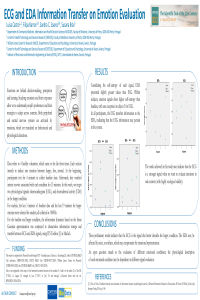
Emotions are behind decision-making, perception and learning. Studying emotions and their responses allow us to understand people’s preferences and their strategies to adapt across contexts. Both peripheral and central nervous systems are activated by emotions, which are translated on behavioural and physiological alterations.
Data from 4 participants were collected in healthy volunteers, which came to the lab three times. Each session intends to induce one emotion between happy, fear, neutral. At the beginning, participants rest for 4 minutes to collect baseline data. Afterwards, they watched intense movies associated with each condition for 25 minutes. In this work, we target two physiological signals: electrocardiogram (ECG), and electrodermal activity (EDA) in the happy condition.
In this work, it is intended to study the information transfer between signals. For the baseline and happy condition, the information dynamics based on the linear Gaussian approximation was computed to characterize information storage and transfer between ECG and EDA signals.
The major idea is to present the signals more feasible for data collection in emotion quantification. The ecological validity of the studies is truly compromised when the experimenter affects the usual participants’ daily routine by electrode placement, which ultimately may influence the participant reactions to stimuli, and therefore, masking the quantitative signal evaluation.
Considering the self-entropy of each signal, EDA and ECG present similar values. It was observed that in all participants, the ECG transfers information to the EDA, indicating that the ECG information may pertain in the system. Literature indicates that the EDA is one of the first signals in emotion response, nevertheless, this signal is highly noisy. Hence, this and the result achieved in this study may indicate that the ECG is a stronger signal when we want to evaluate emotions in real contexts (with highly ecological validity).
Keywords
Emotion
physiological signals
information transfer
entropy
Manuscript
sciforum-030218.pdf
Poster
POSTER_V1.pdf
Detection of internal defects in concrete and evaluation of a healthy part of concrete by non-contact acoustic inspection using normalized spectral entropy
Design of high-C Cr-Co-Ni medium entropy alloy for tribological applications