Event submissions
Published

This submission belongs to the session Session 6. Entropy in Multidisciplinary Applications of the event Entropy 2021: The Scientific Tool of the 21st Century
Published date
05 May, 2021
Citation
Gustavo Bertoli, Guilherme Y. Koga, Fernanda C. Puosso, Amy J. Clarke, Claudio S. Kiminami, Francisco G. Coury, Design of high-C Cr-Co-Ni medium entropy alloy for tribological applications, in Proceedings of Entropy 2021: The Scientific Tool of the 21st Century, 5 May–7 May 2021, MDPI: Basel, Switzerland, doi: 10.3390/Entropy2021-09767
Share
Email
Facebook
Twitter
LinkedIn
Design of high-C Cr-Co-Ni medium entropy alloy for tribological applications
'%3e%3cpath%20d='M12.6647%2010.9104C12.4176%2010.325%2012.0589%209.7933%2011.6088%209.34485C11.16%208.89511%2010.6283%208.53653%2010.0432%208.28891C10.038%208.28629%2010.0327%208.28498%2010.0275%208.28236C10.8437%207.69282%2011.3743%206.73252%2011.3743%205.64907C11.3743%203.85423%209.92005%202.40002%208.12522%202.40002C6.33038%202.40002%204.87618%203.85423%204.87618%205.64907C4.87618%206.73252%205.40677%207.69282%206.22296%208.28367C6.21772%208.28629%206.21248%208.2876%206.20724%208.29022C5.62031%208.53783%205.09365%208.89287%204.64167%209.34616C4.19192%209.79496%203.83334%2010.3266%203.58573%2010.9117C3.34247%2011.4846%203.21128%2012.0987%203.19925%2012.721C3.1989%2012.735%203.20135%2012.7489%203.20646%2012.7619C3.21157%2012.7749%203.21924%2012.7868%203.22901%2012.7968C3.23877%2012.8068%203.25045%2012.8148%203.26334%2012.8202C3.27623%2012.8256%203.29007%2012.8284%203.30406%2012.8284H4.09012C4.14776%2012.8284%204.19362%2012.7825%204.19493%2012.7262C4.22113%2011.7148%204.62726%2010.7676%205.34519%2010.0497C6.08802%209.30686%207.07452%208.89811%208.12522%208.89811C9.17592%208.89811%2010.1624%209.30686%2010.9052%2010.0497C11.6232%2010.7676%2012.0293%2011.7148%2012.0555%2012.7262C12.0568%2012.7839%2012.1027%2012.8284%2012.1603%2012.8284H12.9464C12.9604%2012.8284%2012.9742%2012.8256%2012.9871%2012.8202C13%2012.8148%2013.0117%2012.8068%2013.0214%2012.7968C13.0312%2012.7868%2013.0389%2012.7749%2013.044%2012.7619C13.0491%2012.7489%2013.0515%2012.735%2013.0512%2012.721C13.0381%2012.0947%2012.9084%2011.4856%2012.6647%2010.9104ZM8.12522%207.90243C7.52388%207.90243%206.95792%207.66793%206.53214%207.24215C6.10636%206.81636%205.87185%206.2504%205.87185%205.64907C5.87185%205.04773%206.10636%204.48177%206.53214%204.05599C6.95792%203.63021%207.52388%203.3957%208.12522%203.3957C8.72655%203.3957%209.29252%203.63021%209.7183%204.05599C10.1441%204.48177%2010.3786%205.04773%2010.3786%205.64907C10.3786%206.2504%2010.1441%206.81636%209.7183%207.24215C9.29252%207.66793%208.72655%207.90243%208.12522%207.90243Z'%20fill='%235D1EE1'/%3e%3c/g%3e%3c/svg%3e)
Gustavo Bertoli 1

Guilherme Y. Koga 2
Fernanda C. Puosso 2
Amy J. Clarke 3
Claudio S. Kiminami 2

Francisco G. Coury 2
1. Federal University of São Carlos, Graduate Program in Materials Science and Engineering, Rod. Washington Luis, km 235, CEP 13565-905 São Carlos, SP, Brazil
2. Federal University of São Carlos, Department of Materials Science and Engineering, Rod. Washington Luis, km 235, CEP 13565-905 São Carlos, SP, Brazil
3. Colorado School of Mines, George S. Ansell Department of Metallurgical and Materials Engineering, 1500 Illinois St., Golden, CO, 80401, USA
Abstract
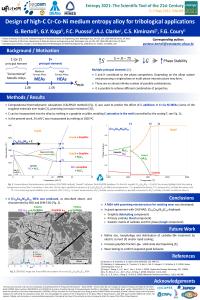
Medium and high entropy alloys (MEAs/HEAs), which typically have three or more main elements, were initially designed to have high configurational entropy (Sconf) stabilizing a simple, single-phase solid solution (SS) over multi-phase alloys. Having multiple main elements will indeed increase the Sconf of simple SSs, but it may decrease the enthalpy also increase, in a lower degree, Sconf of other complex phases, leading to multi-phase microstructures. Therefore, although the initial idea behind MEAs/HEAs was refuted, the interest remains, the focus shifted to exploring its vast compositional field, which includes an almost infinite number of alloys. Some of them with potentially better properties than those existing today. The Cantor alloy (equiatomic CrMnFeCoNi) and the equiatomic CrCoNi alloy, both single-phase with face-centered cubic (FCC) structure, are among the toughest materials ever reported. In this work, computational thermodynamic calculations (CALPHAD method) predicted that C additions in the Cr40Co40Ni20 MEA favor the formation of a promising multi-phase microstructure for wear applications. A large amount of C was incorporated into the alloy by melting in a graphite crucible, this process allowed C saturation in the melt, which as will be shown, can be well controlled by carefully selecting the casting temperature, in this case we achieved 24 at% C by melting at 1600 ºC. A Cr30.4Co30.4Ni15.2C24 MEA was produced, characterized by X-ray diffraction (XRD) and scanning electron microscopy (SEM) equipped with energy-dispersive spectroscopy (EDS). Experimental results revealed a microstructure composed of: graphite flakes, hard primary Cr-rich carbides, and a tough eutectic matrix of FCC phase and carbides; in good agreement with thermodynamic calculations. These findings highlight the great flexibility and potential in MEAs/HEAs design, making it possible to obtain microstructures and sets of properties that are beneficial for a given application.
Keywords
Medium entropy alloys
Multi-phase alloys
Cr-Co-Ni alloys
Alloy design
Phase equilibria
CALPHAD
Manuscript
sciforum-044153.pdf
Poster
Poster Entropy - GB.pdf
ECG and EDA information transfer on emotion evaluation
NEAR ZERO ENERGY BUILDINGS ENTROPY PERFORMANCE