Event submissions
Published

This submission belongs to the session Session 6. Entropy in Multidisciplinary Applications of the event Entropy 2021: The Scientific Tool of the 21st Century
Published date
05 May, 2021
Citation
Nesma HOUMANI, Majd ABAZID, Jerome BOUDY, Bernadette DORIZZI, Epoch-based Entropy : A Statistical EEG Marker for Alzheimer’s Disease Detection, in Proceedings of Entropy 2021: The Scientific Tool of the 21st Century, 5 May–7 May 2021, MDPI: Basel, Switzerland, doi: 10.3390/Entropy2021-09771
Share
Email
Facebook
Twitter
LinkedIn
Epoch-based Entropy : A Statistical EEG Marker for Alzheimer’s Disease Detection
'%3e%3cpath%20d='M12.6647%2010.9104C12.4176%2010.325%2012.0589%209.7933%2011.6088%209.34485C11.16%208.89511%2010.6283%208.53653%2010.0432%208.28891C10.038%208.28629%2010.0327%208.28498%2010.0275%208.28236C10.8437%207.69282%2011.3743%206.73252%2011.3743%205.64907C11.3743%203.85423%209.92005%202.40002%208.12522%202.40002C6.33038%202.40002%204.87618%203.85423%204.87618%205.64907C4.87618%206.73252%205.40677%207.69282%206.22296%208.28367C6.21772%208.28629%206.21248%208.2876%206.20724%208.29022C5.62031%208.53783%205.09365%208.89287%204.64167%209.34616C4.19192%209.79496%203.83334%2010.3266%203.58573%2010.9117C3.34247%2011.4846%203.21128%2012.0987%203.19925%2012.721C3.1989%2012.735%203.20135%2012.7489%203.20646%2012.7619C3.21157%2012.7749%203.21924%2012.7868%203.22901%2012.7968C3.23877%2012.8068%203.25045%2012.8148%203.26334%2012.8202C3.27623%2012.8256%203.29007%2012.8284%203.30406%2012.8284H4.09012C4.14776%2012.8284%204.19362%2012.7825%204.19493%2012.7262C4.22113%2011.7148%204.62726%2010.7676%205.34519%2010.0497C6.08802%209.30686%207.07452%208.89811%208.12522%208.89811C9.17592%208.89811%2010.1624%209.30686%2010.9052%2010.0497C11.6232%2010.7676%2012.0293%2011.7148%2012.0555%2012.7262C12.0568%2012.7839%2012.1027%2012.8284%2012.1603%2012.8284H12.9464C12.9604%2012.8284%2012.9742%2012.8256%2012.9871%2012.8202C13%2012.8148%2013.0117%2012.8068%2013.0214%2012.7968C13.0312%2012.7868%2013.0389%2012.7749%2013.044%2012.7619C13.0491%2012.7489%2013.0515%2012.735%2013.0512%2012.721C13.0381%2012.0947%2012.9084%2011.4856%2012.6647%2010.9104ZM8.12522%207.90243C7.52388%207.90243%206.95792%207.66793%206.53214%207.24215C6.10636%206.81636%205.87185%206.2504%205.87185%205.64907C5.87185%205.04773%206.10636%204.48177%206.53214%204.05599C6.95792%203.63021%207.52388%203.3957%208.12522%203.3957C8.72655%203.3957%209.29252%203.63021%209.7183%204.05599C10.1441%204.48177%2010.3786%205.04773%2010.3786%205.64907C10.3786%206.2504%2010.1441%206.81636%209.7183%207.24215C9.29252%207.66793%208.72655%207.90243%208.12522%207.90243Z'%20fill='%235D1EE1'/%3e%3c/g%3e%3c/svg%3e)
Nesma HOUMANI 1
Majd ABAZID 1
Jerome BOUDY 1
Bernadette DORIZZI 1
1. Telecom SudParis
Abstract
The utility of electroencephalography (EEG) in Alzheimer’s disease (AD) research has been demonstrated over several decades in numerous studies. EEG markers have been employed successfully to investigate AD-related alterations, by comparing EEG recordings of AD patients to those of healthy subjects.
It is widely admitted that AD leads to a reduction in the complexity of EEG signals and changes in EEG synchrony. These modifications in EEG recordings have been used as discriminative features for AD diagnosis using several complexity, especially entropy-based measures, and synchrony measures. Usually, these measures are applied with two main drawbacks: first, they are computed on the whole EEG sequences without addressing the problem of EEG non-stationarity; secondly such measures do not consider the EEG signal as a multidimensional time series: the prevailing paradigms extract information from EEG signals by averaging them over channels.
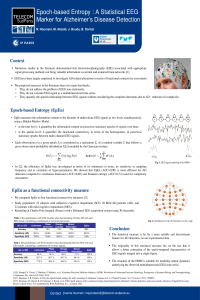
We expose a new EEG marker based on an entropy measure, termed epoch-based entropy. This measure quantifies the information content or the disorder of EEG signals both at the time level and spatial level, using local density estimation by a Hidden Markov Model on inter-channel stationary epochs.
We investigated the classification performance of this EEG marker, its robustness to noise, and its sensitivity to sampling frequency and to variations of hyper-parameters. We showed that this measure is efficient for AD detection since the statistical modelling of the multidimensional EEG signal allows characterizing the information content induced by the coupling of neural activity in EEG signals recorded at different locations.
Houmani N, Vialatte F, Gallego-Jutglà E, Dreyfus G, et al. Diagnosis of Alzheimer's disease with Electroencephalography in a differential framework, PlosOne, 2018; 13(3):e0193607. eCollection 2018.
Keywords
Epoch-based entropy
Hidden Markov Model
Electroencephalography
Statistical Modeling
Neurodegenerative disorders
Manuscript
sciforum-044198.pdf
Poster
Poster_conference entropy.pdf
Sample entropy approach to the examination of cardio-respiratory coupling in response to cardiac resynchronization therapy
From Network Reconstruction to Network Econometrics: unbiased estimation of average effects