Event submissions
Published

This submission belongs to the session Session 6. Entropy in Multidisciplinary Applications of the event Entropy 2021: The Scientific Tool of the 21st Century
Published date
05 May, 2021
Citation
Ana Paula Rocha, Helder Pinto, Celestino Amado, Maria Eduarda Silva, Riccardo Pernice, Michal Javorka, Luca Faes, Assessing Transfer Entropy in cardiovascular and respiratory time series: A VARFI approach, in Proceedings of Entropy 2021: The Scientific Tool of the 21st Century, 5 May–7 May 2021, MDPI: Basel, Switzerland, doi: 10.3390/Entropy2021-09774
Share
Email
Facebook
Twitter
LinkedIn
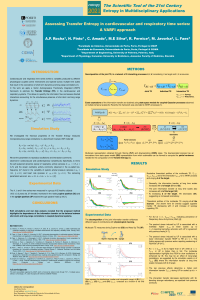
Assessing Transfer Entropy in cardiovascular and respiratory time series: A VARFI approach
'%3e%3cpath%20d='M12.6647%2010.9104C12.4176%2010.325%2012.0589%209.7933%2011.6088%209.34485C11.16%208.89511%2010.6283%208.53653%2010.0432%208.28891C10.038%208.28629%2010.0327%208.28498%2010.0275%208.28236C10.8437%207.69282%2011.3743%206.73252%2011.3743%205.64907C11.3743%203.85423%209.92005%202.40002%208.12522%202.40002C6.33038%202.40002%204.87618%203.85423%204.87618%205.64907C4.87618%206.73252%205.40677%207.69282%206.22296%208.28367C6.21772%208.28629%206.21248%208.2876%206.20724%208.29022C5.62031%208.53783%205.09365%208.89287%204.64167%209.34616C4.19192%209.79496%203.83334%2010.3266%203.58573%2010.9117C3.34247%2011.4846%203.21128%2012.0987%203.19925%2012.721C3.1989%2012.735%203.20135%2012.7489%203.20646%2012.7619C3.21157%2012.7749%203.21924%2012.7868%203.22901%2012.7968C3.23877%2012.8068%203.25045%2012.8148%203.26334%2012.8202C3.27623%2012.8256%203.29007%2012.8284%203.30406%2012.8284H4.09012C4.14776%2012.8284%204.19362%2012.7825%204.19493%2012.7262C4.22113%2011.7148%204.62726%2010.7676%205.34519%2010.0497C6.08802%209.30686%207.07452%208.89811%208.12522%208.89811C9.17592%208.89811%2010.1624%209.30686%2010.9052%2010.0497C11.6232%2010.7676%2012.0293%2011.7148%2012.0555%2012.7262C12.0568%2012.7839%2012.1027%2012.8284%2012.1603%2012.8284H12.9464C12.9604%2012.8284%2012.9742%2012.8256%2012.9871%2012.8202C13%2012.8148%2013.0117%2012.8068%2013.0214%2012.7968C13.0312%2012.7868%2013.0389%2012.7749%2013.044%2012.7619C13.0491%2012.7489%2013.0515%2012.735%2013.0512%2012.721C13.0381%2012.0947%2012.9084%2011.4856%2012.6647%2010.9104ZM8.12522%207.90243C7.52388%207.90243%206.95792%207.66793%206.53214%207.24215C6.10636%206.81636%205.87185%206.2504%205.87185%205.64907C5.87185%205.04773%206.10636%204.48177%206.53214%204.05599C6.95792%203.63021%207.52388%203.3957%208.12522%203.3957C8.72655%203.3957%209.29252%203.63021%209.7183%204.05599C10.1441%204.48177%2010.3786%205.04773%2010.3786%205.64907C10.3786%206.2504%2010.1441%206.81636%209.7183%207.24215C9.29252%207.66793%208.72655%207.90243%208.12522%207.90243Z'%20fill='%235D1EE1'/%3e%3c/g%3e%3c/svg%3e)
Ana Paula Rocha 1,2
Helder Pinto 1,2
Celestino Amado 2
Maria Eduarda Silva 3,4

Riccardo Pernice 5
Michal Javorka 6,7

Luca Faes 5
1. Faculdade de Ciências, Universidade do Porto
2. Centro de Matemática da Universidade do Porto (CMUP)
3. Faculdade de Economia, Universidade do Porto
4. Centro de Investigação e Desenvolvimento em Matemática e Aplicações (CIDMA)
5. Department of Engineering, University of Palermo
6. Department of Physiology, Comenius University of Bratislava, Jessenius Faculty of Medicine
7. Biomedical Center Martin, Comenius University in Bratislava, Jessenius Faculty of Medicine
Abstract
In the study of complex biomedical systems represented by multivariate stochastic processes, such as the cardiovascular and respiratory systems, an issue of great relevance is the description of the system dynamics spanning multiple temporal scales. Recently, the quantification of multiscale complexity based on linear parametric models, incorporating autoregressive coefficients and fractional integration, encompassing short term dynamics and long-range correlations, was extended to multivariate time series. Within this Vector AutoRegressive Fractionally Integrated (VARFI) framework formalized for Gaussian processes, in this work we propose to estimate the Transfer Entropy, or equivalently Granger Causality, in the cardiovascular and respiratory systems. This allows to quantify the information flow and assess directed interactions accounting for the simultaneous presence of short-term dynamics and long-range correlations. The proposed approach is first tested on simulations of benchmark VARFI processes where the transfer entropy could be computed from the known model parameters. Then, it is applied to experimental data consisting of heart period, systolic arterial pressure and respiration time series measured in healthy subjects monitored at rest and during mental and postural stress. Both simulations and real data analysis revealed that the proposed method highlights the dependence of the information transfer on the balance between short-term and long-range correlations in coupled dynamical systems.
Keywords
transfer entropy
granger causality
multivariate time series
multiscale complexity
vector autoregressive fractionally integrated (VARFI) models
heart rate variability (HRV)
systolic arterial pressure (SAP)
Manuscript
sciforum-044218.pdf
Poster
044218-APRochaetal.pdf
Analysing discursive communities and semantic networks on Twitter: an entropy-based approach
Maximum Entropy Method Applied to Time-series Data in Real-time Time-Dependent Density Functional Theory