Event submissions
Published

This submission belongs to the session Session 5. Complex Systems of the event Entropy 2021: The Scientific Tool of the 21st Century
Published date
05 May, 2021
Citation
Maria Ribeiro, Luísa Castro, Luís Antunes, Cristina Costa-Santos, Teresa Henriques, Complexity as cardiorespiratory coupling measure in neonates with different gestational ages, in Proceedings of Entropy 2021: The Scientific Tool of the 21st Century, 5 May–7 May 2021, MDPI: Basel, Switzerland, doi: 10.3390/Entropy2021-09785
Share
Email
Facebook
Twitter
LinkedIn
Complexity as cardiorespiratory coupling measure in neonates with different gestational ages
'%3e%3cpath%20d='M12.6647%2010.9104C12.4176%2010.325%2012.0589%209.7933%2011.6088%209.34485C11.16%208.89511%2010.6283%208.53653%2010.0432%208.28891C10.038%208.28629%2010.0327%208.28498%2010.0275%208.28236C10.8437%207.69282%2011.3743%206.73252%2011.3743%205.64907C11.3743%203.85423%209.92005%202.40002%208.12522%202.40002C6.33038%202.40002%204.87618%203.85423%204.87618%205.64907C4.87618%206.73252%205.40677%207.69282%206.22296%208.28367C6.21772%208.28629%206.21248%208.2876%206.20724%208.29022C5.62031%208.53783%205.09365%208.89287%204.64167%209.34616C4.19192%209.79496%203.83334%2010.3266%203.58573%2010.9117C3.34247%2011.4846%203.21128%2012.0987%203.19925%2012.721C3.1989%2012.735%203.20135%2012.7489%203.20646%2012.7619C3.21157%2012.7749%203.21924%2012.7868%203.22901%2012.7968C3.23877%2012.8068%203.25045%2012.8148%203.26334%2012.8202C3.27623%2012.8256%203.29007%2012.8284%203.30406%2012.8284H4.09012C4.14776%2012.8284%204.19362%2012.7825%204.19493%2012.7262C4.22113%2011.7148%204.62726%2010.7676%205.34519%2010.0497C6.08802%209.30686%207.07452%208.89811%208.12522%208.89811C9.17592%208.89811%2010.1624%209.30686%2010.9052%2010.0497C11.6232%2010.7676%2012.0293%2011.7148%2012.0555%2012.7262C12.0568%2012.7839%2012.1027%2012.8284%2012.1603%2012.8284H12.9464C12.9604%2012.8284%2012.9742%2012.8256%2012.9871%2012.8202C13%2012.8148%2013.0117%2012.8068%2013.0214%2012.7968C13.0312%2012.7868%2013.0389%2012.7749%2013.044%2012.7619C13.0491%2012.7489%2013.0515%2012.735%2013.0512%2012.721C13.0381%2012.0947%2012.9084%2011.4856%2012.6647%2010.9104ZM8.12522%207.90243C7.52388%207.90243%206.95792%207.66793%206.53214%207.24215C6.10636%206.81636%205.87185%206.2504%205.87185%205.64907C5.87185%205.04773%206.10636%204.48177%206.53214%204.05599C6.95792%203.63021%207.52388%203.3957%208.12522%203.3957C8.72655%203.3957%209.29252%203.63021%209.7183%204.05599C10.1441%204.48177%2010.3786%205.04773%2010.3786%205.64907C10.3786%206.2504%2010.1441%206.81636%209.7183%207.24215C9.29252%207.66793%208.72655%207.90243%208.12522%207.90243Z'%20fill='%235D1EE1'/%3e%3c/g%3e%3c/svg%3e)
Maria Ribeiro 1,2

Luísa Castro 1,3
Luís Antunes 4

Cristina Costa-Santos 5

Teresa Henriques 3,6
1. Center for Research in Advanced Computing Systems, Institute for Systems and Computer Engineering, Technology and Science (CRACS/INESC-TEC), Porto, Portugal
2. Computer Science Department, Faculty of Sciences, University of Porto, Porto, Portugal
3. Centre for Health Technology and Services Research (CINTESIS), Faculty of Medicine University of Porto, Porto, Portugal
4. Computer Science Department, Faculty of Science, University of Porto, Rua do Campo Alegre 1021/1055, 4169-007 Porto, Portugal;
Institute for Systems and Computer Engineering, Technology and Science (INESC-TEC), Porto, Portugal
5. Centre for Health Technology and Services Research (CINTESIS), Faculty of Medicine University of Porto, Porto, Portugal; Health Information and Decision Sciences Department - MEDCIDS, Faculty of Medicine, University of Porto, Porto, Portugal
6. Health Information and Decision Sciences Department - MEDCIDS, Faculty of Medicine, University of Porto, Porto, Portugal
Abstract
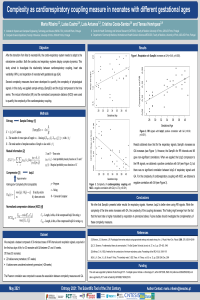
After the transition from fetal to neonatal life, the cardio-respiratory system needs to adapt to the extrauterine condition. Both the cardiac and respiratory systems display complex dynamics. This study aimed to investigate the relationship between cardiorespiratory coupling, heart rate variability (HRV), and respiration of neonatal with gestational age (GA). Several complexity measures have been developed to quantify the complexity of physiological signals. In this study, we applied sample entropy (SampEn) and the bzip2 compressor to the time series. The mutual information (MI) and the normalized compression distance (NCD) were used to quantify the complexity of the cardiorespiratory coupling.
We analyzed a dataset composed of 30-minutes traces of RR intervals and respiration signals, acquired in the first two days of life, for 33 neonates with GA between 27 and 41 weeks. Of these 33 neonates, 22 babies were premature (<37 weeks), and 4 babies were considered extremely premature (<28 weeks). The Pearson correlation was computed to assess the association between complexity measures and GA.
Results obtained show that for the respiratory signals, SampEn increases as GA increases (r=0.46, p=0.008). However, the SampEn for RR intervals and MI gave non-significant correlations. When we applied the bzip2 compressor to the RR signals, we obtained a positive correlation with GA (r=0.69, p<0.001), but there is no significant correlation between bzip2 of respiratory signals and GA. For the complexity of cardiorespiratory coupling with NCD, we obtained a negative correlation with GA (r=-0.74, p<0.001).
We infer that SampEn presents better results for respiratory signals. However, bzip2 is better when using RR signals. While the complexity of the time series increases with GA, the complexity of the coupling decreases. This finding might emerge from the fact that the heart rate is highly modulated by respiration in premature babies. Future studies should investigate the complementary of these complexity measures.
Keywords
Cardiorespiratory coupling
neonatal
bzip2 compressor
sample entropy
mutual information
normalized compression distance
Manuscript
sciforum-030251.pdf
Poster
Poster cardiorespiratory coupling Entropy2021.pdf
Complexity inside and outside the brain: how to manage internal (interoceptive) and external (domotics) environment during adaptive inter-actions
Entropy-driven Phase Transition of Semiflexible Hard-Sphere Polymer Packings in Two and Three Dimensions