Event submissions
Published

This submission belongs to the session Session 5. Complex Systems of the event Entropy 2021: The Scientific Tool of the 21st Century
Published date
05 May, 2021
Citation
Vassilios Gavriil, Alkiviadis-Constantinos Cefalas, Zoe Kollia, Evangelia Sarantopoulou, Chaotic and thermodynamic interplay in nanocavities, in Proceedings of Entropy 2021: The Scientific Tool of the 21st Century, 5 May–7 May 2021, MDPI: Basel, Switzerland, doi: 10.3390/Entropy2021-09787
Share
Email
Facebook
Twitter
LinkedIn
Chaotic and thermodynamic interplay in nanocavities
'%3e%3cpath%20d='M12.6647%2010.9104C12.4176%2010.325%2012.0589%209.7933%2011.6088%209.34485C11.16%208.89511%2010.6283%208.53653%2010.0432%208.28891C10.038%208.28629%2010.0327%208.28498%2010.0275%208.28236C10.8437%207.69282%2011.3743%206.73252%2011.3743%205.64907C11.3743%203.85423%209.92005%202.40002%208.12522%202.40002C6.33038%202.40002%204.87618%203.85423%204.87618%205.64907C4.87618%206.73252%205.40677%207.69282%206.22296%208.28367C6.21772%208.28629%206.21248%208.2876%206.20724%208.29022C5.62031%208.53783%205.09365%208.89287%204.64167%209.34616C4.19192%209.79496%203.83334%2010.3266%203.58573%2010.9117C3.34247%2011.4846%203.21128%2012.0987%203.19925%2012.721C3.1989%2012.735%203.20135%2012.7489%203.20646%2012.7619C3.21157%2012.7749%203.21924%2012.7868%203.22901%2012.7968C3.23877%2012.8068%203.25045%2012.8148%203.26334%2012.8202C3.27623%2012.8256%203.29007%2012.8284%203.30406%2012.8284H4.09012C4.14776%2012.8284%204.19362%2012.7825%204.19493%2012.7262C4.22113%2011.7148%204.62726%2010.7676%205.34519%2010.0497C6.08802%209.30686%207.07452%208.89811%208.12522%208.89811C9.17592%208.89811%2010.1624%209.30686%2010.9052%2010.0497C11.6232%2010.7676%2012.0293%2011.7148%2012.0555%2012.7262C12.0568%2012.7839%2012.1027%2012.8284%2012.1603%2012.8284H12.9464C12.9604%2012.8284%2012.9742%2012.8256%2012.9871%2012.8202C13%2012.8148%2013.0117%2012.8068%2013.0214%2012.7968C13.0312%2012.7868%2013.0389%2012.7749%2013.044%2012.7619C13.0491%2012.7489%2013.0515%2012.735%2013.0512%2012.721C13.0381%2012.0947%2012.9084%2011.4856%2012.6647%2010.9104ZM8.12522%207.90243C7.52388%207.90243%206.95792%207.66793%206.53214%207.24215C6.10636%206.81636%205.87185%206.2504%205.87185%205.64907C5.87185%205.04773%206.10636%204.48177%206.53214%204.05599C6.95792%203.63021%207.52388%203.3957%208.12522%203.3957C8.72655%203.3957%209.29252%203.63021%209.7183%204.05599C10.1441%204.48177%2010.3786%205.04773%2010.3786%205.64907C10.3786%206.2504%2010.1441%206.81636%209.7183%207.24215C9.29252%207.66793%208.72655%207.90243%208.12522%207.90243Z'%20fill='%235D1EE1'/%3e%3c/g%3e%3c/svg%3e)
Vassilios Gavriil 1
Alkiviadis-Constantinos Cefalas 1
Zoe Kollia 1

Evangelia Sarantopoulou 1
1. National Hellenic Research Foundation, Theoretical and Physical Chemistry Institute
Abstract
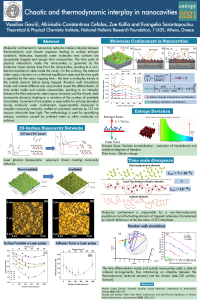
Molecular confinement in nanocavity networks implies interplay between thermodynamic and chaotic response leading to surface entropic variations. Molecules, especially water molecules near surfaces are successively trapped and escape from nanocavities [1]. The time scale of physical interactions inside the nanocavities is governed by the molecular mean escape time from the nanocavities, pointing to a non-thermal equilibrium state inside the cavity. On the contrary, the external water vapour domain is in a thermal equilibrium state and the time scale is specified by the mean trapping time - the time a molecules travels in the outside domain before being trapped. Random walk simulations inside and outside different size nanocavities reveal the differentiation of time scales inside and outside nanocavities, pointing to an interplay between the thermodynamic state (vapor domain) and the chaotic state (nanocavity domain), leading to a variation of the number of available microstates [2]. Increment of microstates is responsible for entropy deviation during molecular water confinement, experimentally measured in complex nanocavity networks, crafted on polymeric matrixes by 157 nm vacuum ultraviolet laser light. The methodology is used for quantifying entropic variations caused by confined water or other molecules on surfaces.
[1] F. Ruggeri and M. Krishnan, “Entropic Trapping of a Singly Charged Molecule in Solution,” Nano Lett., vol. 18, no. 6, pp. 3773–3779, Jun. 2018, doi: 10.1021/acs.nanolett.8b01011.
[2] V. Gavriil, M. Chatzichristidi, D. Christofilos, G. A. Kourouklis, Z. Kollia, E. Bakalis, A.-C. C. Cefalas, and E. Sarantopoulou, “Entropy and Random Walk Trails Water Confinement and Non-Thermal Equilibrium in Photon-Induced Nanocavities,” Nanomaterials, vol. 10, no. 6, p. 1101, Jun. 2020, doi: 10.3390/nano10061101.
Keywords
nanocavities
entropy
complex systems
molecular confinement
water molecules
time scale variation
non thermal equilibrium
Manuscript
sciforum-044201.pdf
Poster
Entropy2021_Poster_Gavriil_NHRF.pdf
Entropy-driven Phase Transition of Semiflexible Hard-Sphere Polymer Packings in Two and Three Dimensions
Bi-dimensional colored fuzzy entropy applied to melanoma dermoscopic images