Event submissions
Published

This submission belongs to the session Session 6. Entropy in Multidisciplinary Applications of the event Entropy 2021: The Scientific Tool of the 21st Century
Published date
05 May, 2021
Citation
Qiang Li, Measuring Functional Connectivity of Human Intra-Cortex Regions with Total Correlation, in Proceedings of Entropy 2021: The Scientific Tool of the 21st Century, 5 May–7 May 2021, MDPI: Basel, Switzerland, doi: 10.3390/Entropy2021-09797
Share
Email
Facebook
Twitter
LinkedIn
Measuring Functional Connectivity of Human Intra-Cortex Regions with Total Correlation

Qiang Li 1
1. University of Valencia
Abstract
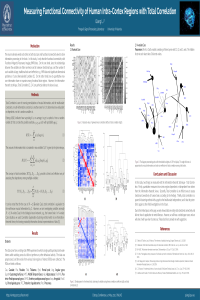
The economy of brain organization makes the primate brain consume less energy but efficiency. The neurons densely wired each other dependent on both anatomy structure connectivity and functional connectivity. Here, I only describe functional connectivity with Functional Magnetic Resonance Imaging (fMRI) data. Most importantly, how to quantitative measure information share or separate among functional brain regions, what’s worse, fMRI data exist large dimensional problems or “curse dimensionality” [1]. However, the multivariate total correlation method can perfectly address the above problems. In this paper, two things measured with the information-theoretic technique - total correlation [2, 3, 4]. First and foremost, quantitative measures intra-cortex regions dependent or independent from others from the information-theoretic view. Second, quantitative measures of intra-cortex functional connectivity play a crucial role in the mental clinical diagnosis.
The brain's sensitivity to the perceptual environment then adapts and responds to the outside world. The information integrated and separated happens in the brain and consumes less energy [5, 6]. In other words, the brain can be treated as an energy, entropy, physical complex system, or it's a naturally perfect stochastic complex system. Mathematically, the brain function can be denoted as: R = S(X), X represents stimuli from the outside world, S refers to unknown nonlinear functions which describe brain information processes, and R denotes response. In this paper, we use functional brain atlases to extract time series, then information estimated with total correlation, it can capture non-linear or even non-monotonic relationships in the high-dimensional data compared to other approaches, e.g. Spearman-ρ [7] and the Kendall-τ [8]et al.
In summary, this paper shows the estimated intra-cortex brain region's functional connectivity and also addresses non-linear relationships in the brain signal through total correlation.
Appendix:
[1...8]. https://docs.google.com/document/d/1MZ8rdNcn4x8U4Zjm27jb1WZZ-K3WUX2QA-ts1lWvClI/edit?usp=sharing
Keywords
Functional connectivity
Intra-cortex
Tatal correlation
Manuscript
sciforum-032526.pdf
Poster
sciforum-032526.pdf
Entropy of Vostok Ice Core Data and Kalman Filter Harmonic Bank Climate Predictor
Evaluation of the performance of permutation entropy variants for classifying auditory evoked potentials