Event submissions
Published

This submission belongs to the session Session 6. Entropy in Multidisciplinary Applications of the event Entropy 2021: The Scientific Tool of the 21st Century
Published date
05 May, 2021
Citation
Diego de Araujo Santana, Kayque Rodrigues Santos, Claudio Shyinti Kiminami, Francisco Gil Coury, Design and characterization of Cr₂₉.₇Co₂₉.₇Ni₃₅.₄Al₄.₀Ti₁.₂ precipitation hardened high entropy alloy, in Proceedings of Entropy 2021: The Scientific Tool of the 21st Century, 5 May–7 May 2021, MDPI: Basel, Switzerland, doi: 10.3390/Entropy2021-09799
Share
Email
Facebook
Twitter
LinkedIn
Design and characterization of Cr29.7Co29.7Ni35.4Al4.0Ti1.2 precipitation hardened high entropy alloy
'%3e%3cpath%20d='M12.6647%2010.9104C12.4176%2010.325%2012.0589%209.7933%2011.6088%209.34485C11.16%208.89511%2010.6283%208.53653%2010.0432%208.28891C10.038%208.28629%2010.0327%208.28498%2010.0275%208.28236C10.8437%207.69282%2011.3743%206.73252%2011.3743%205.64907C11.3743%203.85423%209.92005%202.40002%208.12522%202.40002C6.33038%202.40002%204.87618%203.85423%204.87618%205.64907C4.87618%206.73252%205.40677%207.69282%206.22296%208.28367C6.21772%208.28629%206.21248%208.2876%206.20724%208.29022C5.62031%208.53783%205.09365%208.89287%204.64167%209.34616C4.19192%209.79496%203.83334%2010.3266%203.58573%2010.9117C3.34247%2011.4846%203.21128%2012.0987%203.19925%2012.721C3.1989%2012.735%203.20135%2012.7489%203.20646%2012.7619C3.21157%2012.7749%203.21924%2012.7868%203.22901%2012.7968C3.23877%2012.8068%203.25045%2012.8148%203.26334%2012.8202C3.27623%2012.8256%203.29007%2012.8284%203.30406%2012.8284H4.09012C4.14776%2012.8284%204.19362%2012.7825%204.19493%2012.7262C4.22113%2011.7148%204.62726%2010.7676%205.34519%2010.0497C6.08802%209.30686%207.07452%208.89811%208.12522%208.89811C9.17592%208.89811%2010.1624%209.30686%2010.9052%2010.0497C11.6232%2010.7676%2012.0293%2011.7148%2012.0555%2012.7262C12.0568%2012.7839%2012.1027%2012.8284%2012.1603%2012.8284H12.9464C12.9604%2012.8284%2012.9742%2012.8256%2012.9871%2012.8202C13%2012.8148%2013.0117%2012.8068%2013.0214%2012.7968C13.0312%2012.7868%2013.0389%2012.7749%2013.044%2012.7619C13.0491%2012.7489%2013.0515%2012.735%2013.0512%2012.721C13.0381%2012.0947%2012.9084%2011.4856%2012.6647%2010.9104ZM8.12522%207.90243C7.52388%207.90243%206.95792%207.66793%206.53214%207.24215C6.10636%206.81636%205.87185%206.2504%205.87185%205.64907C5.87185%205.04773%206.10636%204.48177%206.53214%204.05599C6.95792%203.63021%207.52388%203.3957%208.12522%203.3957C8.72655%203.3957%209.29252%203.63021%209.7183%204.05599C10.1441%204.48177%2010.3786%205.04773%2010.3786%205.64907C10.3786%206.2504%2010.1441%206.81636%209.7183%207.24215C9.29252%207.66793%208.72655%207.90243%208.12522%207.90243Z'%20fill='%235D1EE1'/%3e%3c/g%3e%3c/svg%3e)
Diego de Araujo Santana 1
Kayque Rodrigues Santos 1
Claudio Shyinti Kiminami 1

Francisco Gil Coury 1
1. UFSCar
Abstract
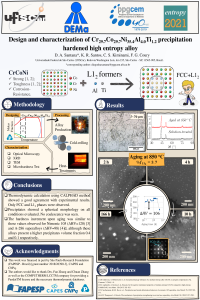
In 2004 a new class of metallic alloys, called high entropy alloys (HEA), was introduced in the literature. The main concept behind these alloys is that they have multiple main elements instead of only one or two. Therefore, they can exist under a vast compositional landscape, most of which is yet to be explored. In the early studies on HEAs, a great effort was made on searching for single-phase alloys with optimized properties, mainly those with a face-centered cubic structure (FCC). Recently, in the so-called “second generation” of HEAs, research focus has been broadened to multi-phase alloys. In particular, those alloys with FCC matrix plus L12 precipitates or BCC matrix with B2 precipitates to compete with traditional superalloys. In the present work, CALPHAD method (via Pandat® software) was used to aid the design of a new precipitation hardened, namely Cr29.7Co29.7Ni35.4Al4.0Ti1.2 (a.t %), with a FCC matrix and L12 precipitates. The alloy was produced, solution-treat, cold-rolled and annealed, the alloy was then cut into different pieces and aged at 850 °C for different times. The microstructure was composed of spherical precipitates distributed uniformly in the FCC matrix. The characterization of the microstructure showed that thermodynamic calculation was accurate. The improvement in mechanical properties caused by introducing the ordered precipitates, analyzed through microhardness test, showed a promising mechanical behavior of the new designed alloy.
Keywords
High entropyalloy
Precipitation hardening
Superalloy
Manuscript
sciforum-044154.pdf
Poster
Poster.pdf
Evaluation of the performance of permutation entropy variants for classifying auditory evoked potentials
Entropy: from Thermodynamics to Information Theory