Event submissions
Published

This submission belongs to the session Session 6. Entropy in Multidisciplinary Applications of the event Entropy 2021: The Scientific Tool of the 21st Century
Published date
05 May, 2021
Citation
José María López Belinchón, Miguel Ángel López Guerrero, Raúl Alcaraz Martínez, On the estimation the probability of cardiovascular and cerebrovascular events in hypertensive patients using nonlinear analysis, time and frequency domain methods., in Proceedings of Entropy 2021: The Scientific Tool of the 21st Century, 5 May–7 May 2021, MDPI: Basel, Switzerland, doi: 10.3390/Entropy2021-09804
Share
Email
Facebook
Twitter
LinkedIn
On the estimation the probability of cardiovascular and cerebrovascular events in hypertensive patients using nonlinear analysis, time and frequency domain methods.
'%3e%3cpath%20d='M12.6647%2010.9104C12.4176%2010.325%2012.0589%209.7933%2011.6088%209.34485C11.16%208.89511%2010.6283%208.53653%2010.0432%208.28891C10.038%208.28629%2010.0327%208.28498%2010.0275%208.28236C10.8437%207.69282%2011.3743%206.73252%2011.3743%205.64907C11.3743%203.85423%209.92005%202.40002%208.12522%202.40002C6.33038%202.40002%204.87618%203.85423%204.87618%205.64907C4.87618%206.73252%205.40677%207.69282%206.22296%208.28367C6.21772%208.28629%206.21248%208.2876%206.20724%208.29022C5.62031%208.53783%205.09365%208.89287%204.64167%209.34616C4.19192%209.79496%203.83334%2010.3266%203.58573%2010.9117C3.34247%2011.4846%203.21128%2012.0987%203.19925%2012.721C3.1989%2012.735%203.20135%2012.7489%203.20646%2012.7619C3.21157%2012.7749%203.21924%2012.7868%203.22901%2012.7968C3.23877%2012.8068%203.25045%2012.8148%203.26334%2012.8202C3.27623%2012.8256%203.29007%2012.8284%203.30406%2012.8284H4.09012C4.14776%2012.8284%204.19362%2012.7825%204.19493%2012.7262C4.22113%2011.7148%204.62726%2010.7676%205.34519%2010.0497C6.08802%209.30686%207.07452%208.89811%208.12522%208.89811C9.17592%208.89811%2010.1624%209.30686%2010.9052%2010.0497C11.6232%2010.7676%2012.0293%2011.7148%2012.0555%2012.7262C12.0568%2012.7839%2012.1027%2012.8284%2012.1603%2012.8284H12.9464C12.9604%2012.8284%2012.9742%2012.8256%2012.9871%2012.8202C13%2012.8148%2013.0117%2012.8068%2013.0214%2012.7968C13.0312%2012.7868%2013.0389%2012.7749%2013.044%2012.7619C13.0491%2012.7489%2013.0515%2012.735%2013.0512%2012.721C13.0381%2012.0947%2012.9084%2011.4856%2012.6647%2010.9104ZM8.12522%207.90243C7.52388%207.90243%206.95792%207.66793%206.53214%207.24215C6.10636%206.81636%205.87185%206.2504%205.87185%205.64907C5.87185%205.04773%206.10636%204.48177%206.53214%204.05599C6.95792%203.63021%207.52388%203.3957%208.12522%203.3957C8.72655%203.3957%209.29252%203.63021%209.7183%204.05599C10.1441%204.48177%2010.3786%205.04773%2010.3786%205.64907C10.3786%206.2504%2010.1441%206.81636%209.7183%207.24215C9.29252%207.66793%208.72655%207.90243%208.12522%207.90243Z'%20fill='%235D1EE1'/%3e%3c/g%3e%3c/svg%3e)
José María López Belinchón 1

Miguel Ángel López Guerrero 2
Raúl Alcaraz Martínez 3
1. SIDIS Research Group, Department of Mathematics, Polytechnic School of Cuenca, University of Castilla-La Mancha, 16071 Cuenca,
Spain
2. SIDIS Research Group, Department of Mathematics and Institute of Applied Mathematics in Science and Engineering (IMACI),
Polytechnic School of Cuenca, University of Castilla-La Mancha, 16071 Cuenca, Spain
3. Research Group in Electronic, Biomedical and Telecommunication Engineering, University of Castilla-La Mancha (UCLM), 16071
Cuenca, Spain
Abstract
Abstract
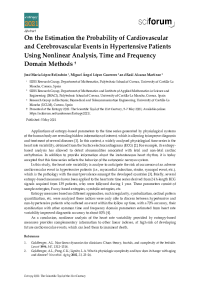
Applications of entropy-based parameters to the time series generated by physiological systems of the human body are revealing hidden information of interest, which is allowing to improve diagnosis and treatment of several diseases [2]. In this context, a widely analysed physiological time series is the heart rate variability, obtained from the Surface electrocardiograma (ECG) [1]. For example, its entropy-based analysis has allowed to detect abnormalities associated with letal and non-letal cardiac arrhythmias. In addition to provide information about the instantaneous heart rhythm, it is today accepted that this time series reflects the behavior of the autonomic nervous system.
In this study, the heart rate variability is analyse to anticipate the risk of occurence of an adverse cardiovascular event in hypertensive patients (i.e., myocardial infarction, stroke, syncopal event, etc.), which is the pathology with the most prevalence amongst the developed countries [3]. Briefly, several entropy-based measures haven been applied to the heart rate time series derived from 24 hour-length ECG signals acquired from 139 patients, who were followed during 1 year. These parameters consist of sample entropies, Fuzzy-based entropies, symbolic entropies, etc.
Entropy measures based on different approaches, such irregularity, symbolization, ordinal pattern quantification, etc. were analyzed these indices were only able to discern between hypertensive and non-hypertensive patients who suffered an event within the follow up time, with a 70% accuracy, their combination with other common time and frequency domain parameters estimated from heart rate variability improved diagnostic accuracy to about 80% [4].
As a conclusion, nonlinear analysis of the heart rate variability provided by entropy-based measures provides complementary information to other linear indexes, at high-risk of developing future cardiovascular events, which can lead them to imminent death.
[1] Goldberger A.L., Peng C.K., and Lipsitz L.A., What is physiologic complexity and how does it change with aging and disease? Neurobiol Aging 23: 23-26, 2002. [2] Goldberger, A.L. Non-linear dynamics for clinicians: Chaos theory, fractals, and complexity at the bedside. Lancet 347: 1312-1314, 1996. [3] Spasic S.Z., and Kesic S., Nonlinearity in living systems: Theoretical and practical perspectives on metrics of physiological signal complexity, Front Physiol 10: 298, 2019. [4] Solaro N., Malacarne M., Pagani, M., and Lucini, D., Cardiac baroreflex, HRV, and statistic: An interdisciplinary approach in hypertension. Front Physiol 10: 478, 2019.
Keywords
Entropy
Nonlinear analysis
Multidisciplinary science
Heart Rate Variability
Manuscript
sciforum-044191.pdf
Poster
sciforum-044191.pdf
Thermodynamics Beyond Molecules: Statistical Mechanics of Probability Distributions and Stochastic Processes
Different scenarios leading to hyperchaos development in radiophysical generators