Event submissions
Published

This submission belongs to the session Session 3. Thermodynamics of the event Entropy 2021: The Scientific Tool of the 21st Century
Published date
05 May, 2021
Citation
Luis Eduardo Vidal-Miranda, Juan Carlos Chimal-Eguía, Juan Carlos Pacheco-Paez, Ricardo Teodoro Páez-Hernández, Efficiency of an arrangement in series of irreversible thermal engines working at maximum power., in Proceedings of Entropy 2021: The Scientific Tool of the 21st Century, 5 May–7 May 2021, MDPI: Basel, Switzerland, doi: 10.3390/Entropy2021-09818
Share
Email
Facebook
Twitter
LinkedIn
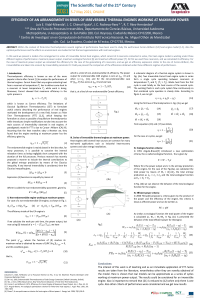
Efficiency of an arrangement in series of irreversible thermal engines working at maximum power.
'%3e%3cpath%20d='M12.6647%2010.9104C12.4176%2010.325%2012.0589%209.7933%2011.6088%209.34485C11.16%208.89511%2010.6283%208.53653%2010.0432%208.28891C10.038%208.28629%2010.0327%208.28498%2010.0275%208.28236C10.8437%207.69282%2011.3743%206.73252%2011.3743%205.64907C11.3743%203.85423%209.92005%202.40002%208.12522%202.40002C6.33038%202.40002%204.87618%203.85423%204.87618%205.64907C4.87618%206.73252%205.40677%207.69282%206.22296%208.28367C6.21772%208.28629%206.21248%208.2876%206.20724%208.29022C5.62031%208.53783%205.09365%208.89287%204.64167%209.34616C4.19192%209.79496%203.83334%2010.3266%203.58573%2010.9117C3.34247%2011.4846%203.21128%2012.0987%203.19925%2012.721C3.1989%2012.735%203.20135%2012.7489%203.20646%2012.7619C3.21157%2012.7749%203.21924%2012.7868%203.22901%2012.7968C3.23877%2012.8068%203.25045%2012.8148%203.26334%2012.8202C3.27623%2012.8256%203.29007%2012.8284%203.30406%2012.8284H4.09012C4.14776%2012.8284%204.19362%2012.7825%204.19493%2012.7262C4.22113%2011.7148%204.62726%2010.7676%205.34519%2010.0497C6.08802%209.30686%207.07452%208.89811%208.12522%208.89811C9.17592%208.89811%2010.1624%209.30686%2010.9052%2010.0497C11.6232%2010.7676%2012.0293%2011.7148%2012.0555%2012.7262C12.0568%2012.7839%2012.1027%2012.8284%2012.1603%2012.8284H12.9464C12.9604%2012.8284%2012.9742%2012.8256%2012.9871%2012.8202C13%2012.8148%2013.0117%2012.8068%2013.0214%2012.7968C13.0312%2012.7868%2013.0389%2012.7749%2013.044%2012.7619C13.0491%2012.7489%2013.0515%2012.735%2013.0512%2012.721C13.0381%2012.0947%2012.9084%2011.4856%2012.6647%2010.9104ZM8.12522%207.90243C7.52388%207.90243%206.95792%207.66793%206.53214%207.24215C6.10636%206.81636%205.87185%206.2504%205.87185%205.64907C5.87185%205.04773%206.10636%204.48177%206.53214%204.05599C6.95792%203.63021%207.52388%203.3957%208.12522%203.3957C8.72655%203.3957%209.29252%203.63021%209.7183%204.05599C10.1441%204.48177%2010.3786%205.04773%2010.3786%205.64907C10.3786%206.2504%2010.1441%206.81636%209.7183%207.24215C9.29252%207.66793%208.72655%207.90243%208.12522%207.90243Z'%20fill='%235D1EE1'/%3e%3c/g%3e%3c/svg%3e)
Luis Eduardo Vidal-Miranda 1
Juan Carlos Chimal-Eguía 2
Juan Carlos Pacheco-Paez 3,4
Ricardo Teodoro Páez-Hernández 5
1. Universidad Autónoma Metropolitana, Unidad Azcapotzalco. A. San Pablo 180, Col. Reynosa, Ciudad de México CP 02200, Mexico
2. Centro de Investigaci´on en Computación del Instituto Polit´ecnico Nacional, Av. Miguel Othón de Mendizábal s/n. Col. La Escalera, Ciudad de M´exico, CP 07738, Mexico
3. Facultad de Estudios Superiores, Acatlán UNAM, División de Matemáticas en Ingeniería, Departamento de Matemáticas Aplicadas y Computación.
4. (post doc) Área de Física de Procesos Irreversibles, Departamento de Ciencias Básicas, Universidad Autónoma Metropolitana, Unidad Azcapotzalco. A. San Pablo 180, Col. Reynosa, Ciudad de México CP 02200, Mexico
5. Área de Física de Procesos Irreversibles, Departamento de Ciencias Básicas, Universidad Autónoma Metropolitana, Unidad Azcapotzalco. A. San Pablo 180, Col. Reynosa, Ciudad de México CP 02200, Mexico
Abstract
Within the context of finite-time thermodynamics several regimes of performance have been used to study the well known Curzon-Ahlborn (CA) heat engine model [1-5]. Also the optimal performance and the effects on environment are studied to find the best approximation with real heat engines.
In this work we present a model of an arrangement in series of irreversible Carnot heat engines, which consist of k reservoirs connected in series, this heat engine model is working under three different regime of performance: maximum power output, maximum ecological function [6] and maximum efficient power [7]. At first we used three reservoirs, and we calculated its efficiency. For the case of maximum power output we calculated the efficiency for the case of the generalizing of k reservoirs, and we get an efficiency expression similar to the one of Curzon-Ahlborn, the irreversibilities are taken into account by irreversibility parameter R. Finally we present the comparison of the efficiencies obtained under three differents regimes of performance.
Keywords
optimal efficiency
performance
arrangement irreversibles
maximum efficient power.
Manuscript
sciforum-044190.pdf
Poster
sciforum-044190.pdf
The Intrinsic Entropy as Substitute for the Market Volatility of Underlying Securities
Do Entropic Biodiversity Methods Outcompete Alternatives?