Event submissions
Published

This submission belongs to the session Session 6. Entropy in Multidisciplinary Applications of the event Entropy 2021: The Scientific Tool of the 21st Century
Published date
05 May, 2021
Citation
William Bruce Sherwin, Do Entropic Biodiversity Methods Outcompete Alternatives?, in Proceedings of Entropy 2021: The Scientific Tool of the 21st Century, 5 May–7 May 2021, MDPI: Basel, Switzerland, doi: 10.3390/Entropy2021-09819
Share
Email
Facebook
Twitter
LinkedIn
Do Entropic Biodiversity Methods Outcompete Alternatives?

William Bruce Sherwin 1
1. Evolution and Ecology Research Centre, School of Biological Earth and Environmental Science, University of New South Wales, Sydney, NSW 2052, Australia
Abstract
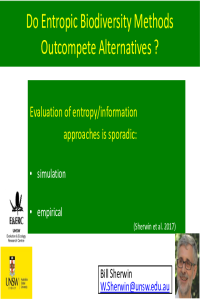
The journal ‘Entropy’ is full of elegant entropy/information approaches for all aspects of biology and medicine, from molecular interactions to landscape diversity. But do these methods work as well as (or better than) alternative methods? Often this is not evaluated by either simulation or empirical data, with some exceptions (eg: Sherwin et al. 2017); here I concentrate on two newer evaluations:
Assessing frequency differentiation between groups, times or locations; I focus on the very popular Bray-Curtis measure and its entropic competitors.
I assess Bray-Curtis’ fit to several groups of criteria. First, it fits many basic requirements for any diversity measure. Secondly, I examine its independence from confounding effects. Finally, I look at its sensitivity to natural changes, threats, or management that affect underlying dispersal, adaptation, random change, or generation of novelty. If we can forecast a measure such as Bray-Curtis under various conditions, then we can evaluate effects of past events, and forecast effects of future management. I show that Bray-Curtis can be forecast from underlying biological processes, but that the forecasting ability is improved by converting it into closely related entropy/information measures.
Incorporating functional differences between the variants (eg, DNA sequence, expression, morphology) into biodiversity measures.
Past methods have met counterintuitive stumbling-blocks, such as negative diversity, and apparent differentiation depending heavily on variability within-group. Attempts to minimise these problems have resulted in measures with poor sensitivity to functional differences between variants – which the method was supposed to incorporate! A novel approach, based on three related entropy measures, avoids these counterintuitive problems (Chao et al 2019).
Sherwin W et al. 2017. Trends Ecol. Evol. 32:948
Chao A et al. 2019. Ecol. Monog. doi.org/10.1002/ecm.1343
Keywords
Bray-Curtis
Biodiversity
Functional Diversity
Shannon
Differentiation
Manuscript
sciforum-029220.pdf
Poster
Entropy 210505 210420.pdf
Efficiency of an arrangement in series of irreversible thermal engines working at maximum power.
Simulation Studies of Entropy-Driven Crystallization in Athermal Chain Packings in the Bulk and Under Confinement