Event submissions
Published

This submission belongs to the session Session 6. Entropy in Multidisciplinary Applications of the event Entropy 2021: The Scientific Tool of the 21st Century
Published date
05 May, 2021
Citation
Silvin Knight, Louise Newman, John O'Connor, Rose Anne Kenny, Roman Romero-Ortuno, Approximate entropies of resting state continuous neurocardiovascular physiological signals are associated with physical frailty in older adults, in Proceedings of Entropy 2021: The Scientific Tool of the 21st Century, 5 May–7 May 2021, MDPI: Basel, Switzerland, doi: 10.3390/Entropy2021-09841
Share
Email
Facebook
Twitter
LinkedIn
Approximate entropies of resting state continuous neurocardiovascular physiological signals are associated with physical frailty in older adults

Silvin Knight 1,2

Louise Newman 1,2
'%3e%3cpath%20d='M12.6647%2010.9104C12.4176%2010.325%2012.0589%209.7933%2011.6088%209.34485C11.16%208.89511%2010.6283%208.53653%2010.0432%208.28891C10.038%208.28629%2010.0327%208.28498%2010.0275%208.28236C10.8437%207.69282%2011.3743%206.73252%2011.3743%205.64907C11.3743%203.85423%209.92005%202.40002%208.12522%202.40002C6.33038%202.40002%204.87618%203.85423%204.87618%205.64907C4.87618%206.73252%205.40677%207.69282%206.22296%208.28367C6.21772%208.28629%206.21248%208.2876%206.20724%208.29022C5.62031%208.53783%205.09365%208.89287%204.64167%209.34616C4.19192%209.79496%203.83334%2010.3266%203.58573%2010.9117C3.34247%2011.4846%203.21128%2012.0987%203.19925%2012.721C3.1989%2012.735%203.20135%2012.7489%203.20646%2012.7619C3.21157%2012.7749%203.21924%2012.7868%203.22901%2012.7968C3.23877%2012.8068%203.25045%2012.8148%203.26334%2012.8202C3.27623%2012.8256%203.29007%2012.8284%203.30406%2012.8284H4.09012C4.14776%2012.8284%204.19362%2012.7825%204.19493%2012.7262C4.22113%2011.7148%204.62726%2010.7676%205.34519%2010.0497C6.08802%209.30686%207.07452%208.89811%208.12522%208.89811C9.17592%208.89811%2010.1624%209.30686%2010.9052%2010.0497C11.6232%2010.7676%2012.0293%2011.7148%2012.0555%2012.7262C12.0568%2012.7839%2012.1027%2012.8284%2012.1603%2012.8284H12.9464C12.9604%2012.8284%2012.9742%2012.8256%2012.9871%2012.8202C13%2012.8148%2013.0117%2012.8068%2013.0214%2012.7968C13.0312%2012.7868%2013.0389%2012.7749%2013.044%2012.7619C13.0491%2012.7489%2013.0515%2012.735%2013.0512%2012.721C13.0381%2012.0947%2012.9084%2011.4856%2012.6647%2010.9104ZM8.12522%207.90243C7.52388%207.90243%206.95792%207.66793%206.53214%207.24215C6.10636%206.81636%205.87185%206.2504%205.87185%205.64907C5.87185%205.04773%206.10636%204.48177%206.53214%204.05599C6.95792%203.63021%207.52388%203.3957%208.12522%203.3957C8.72655%203.3957%209.29252%203.63021%209.7183%204.05599C10.1441%204.48177%2010.3786%205.04773%2010.3786%205.64907C10.3786%206.2504%2010.1441%206.81636%209.7183%207.24215C9.29252%207.66793%208.72655%207.90243%208.12522%207.90243Z'%20fill='%235D1EE1'/%3e%3c/g%3e%3c/svg%3e)
John O'Connor 1,2
Rose Anne Kenny 1,2,3

Roman Romero-Ortuno 1,2,3
1. The Irish Longitudinal Study on Ageing (TILDA), Trinity College Dublin, University of Dublin, Ireland
2. Discipline of Medical Gerontology, School of Medicine, Trinity College Dublin, University of Dublin, Ireland
3. Mercer’s Institute for Successful Ageing (MISA), St James’s Hospital, Dublin, Ireland
Abstract
Frailty in older adults is characterised by dysregulation in multiple physiological systems. The frailty phenotype is defined on the basis of exhaustion, unexplained weight loss, weakness, slowness and low physical activity (one or two: pre-frail; 3 or more: frail). Our aim was to explore if increasing frailty is associated with the complexity of resting state physiological signals in a large cohort of community-dwelling older adults, enrolled as part of The Irish Longitudinal Study on Ageing (TILDA).
Systolic/diastolic blood pressure (SBP/DBP), mean arterial pressure (MAP), and heart rate (HR) were measured in 3,154 participants (66.2% non-frail; 31.3% pre-frail; 2.5% frail) using a Finometer® device at 200Hz; and frontal lobe oxygenation (tissue saturation index (TSI)) in 2,749 individuals (66.3% non-frail; 31.3% pre-frail; 2.4% frail) at 50Hz using an Artinis Portalite® near infrared spectroscopy system. Data were acquired continuously during five minutes of supine rest and the last minute (downsampled to 5Hz) was utilised in these analyses. The complexity of signals was quantified using approximate entropy (ApEn) with m=2 and an optimal r derived via multiple iterations, implemented in Matlab (R2019a). Statistical analysis was performed using multivariate linear regression models in STATA (v14.1), controlling for age, sex, education, antihypertensive medication, diabetes, number of cardiovascular conditions, smoking, alcohol, and depression.
Mean age for both groups was 64.3±8.1 years and 53% were female. The pre-frail group was associated with significantly increased ApEn for all measures investigated (sBP: β=0.014, P≤0.001; dBP: β=0.009, P=0.002; MAP: β=0.012, P≤0.001; HR: β=0.011, P=0.003; TSI: β=0.009, P=0.002). Likewise, the frail group was associated with further increased ApEn for all measures investigated (sBP: β=0.031, P=0.002; dBP: β=0.028, P=0.003; MAP: β=0.038, P≤0.001; HR: β=0.034, P=0.001; TSI: β=0.018, P=0.029).
Approximate entropy seems to be a sensitive method to capture increasing signal complexity in multiple physiological systems associated with the frailty phenotype during resting state.
Keywords
physical frailty
resting state
continuous physiological monitoring
hemodynamics
near infrared spectroscopy
cerebral oxygenation
approximate entropy
Manuscript
sciforum-030250.pdf
Poster
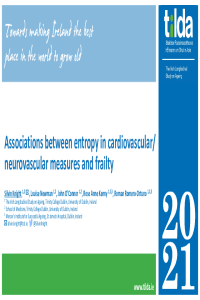
Knight et al Entropy 2021 SLIDES.pdf
Conformational and translational-rotational entropy from molecular ensembles
An information geometry approach for unifying mean field theories of asymmetric kinetic Ising systems