Event submissions
Published
 10.3390/ECA2021-09884 (registering DOI)
 This submission belongs to the session F. Poster of the event The 1st International Electronic Conference on Antibiotics
Published date
05 May, 2021
Citation
Md. Sanower Hossain, Zannat Urbi, Raffaele Capasso, Antibiofilm activity of Andrographis paniculata, Andrographolide and its derivatives: A Systematic Review, in Proceedings of The 1st International Electronic Conference on Antibiotics, 8 May–17 May 2021, MDPI: Basel, Switzerland, doi: 10.3390/ECA2021-09884
Share
Email
Facebook
Twitter
LinkedIn
Antibiofilm activity of Andrographis paniculata, Andrographolide and its derivatives: A Systematic Review

Md. Sanower Hossain 1
'%3e%3cpath%20d='M12.6647%2010.9104C12.4176%2010.325%2012.0589%209.7933%2011.6088%209.34485C11.16%208.89511%2010.6283%208.53653%2010.0432%208.28891C10.038%208.28629%2010.0327%208.28498%2010.0275%208.28236C10.8437%207.69282%2011.3743%206.73252%2011.3743%205.64907C11.3743%203.85423%209.92005%202.40002%208.12522%202.40002C6.33038%202.40002%204.87618%203.85423%204.87618%205.64907C4.87618%206.73252%205.40677%207.69282%206.22296%208.28367C6.21772%208.28629%206.21248%208.2876%206.20724%208.29022C5.62031%208.53783%205.09365%208.89287%204.64167%209.34616C4.19192%209.79496%203.83334%2010.3266%203.58573%2010.9117C3.34247%2011.4846%203.21128%2012.0987%203.19925%2012.721C3.1989%2012.735%203.20135%2012.7489%203.20646%2012.7619C3.21157%2012.7749%203.21924%2012.7868%203.22901%2012.7968C3.23877%2012.8068%203.25045%2012.8148%203.26334%2012.8202C3.27623%2012.8256%203.29007%2012.8284%203.30406%2012.8284H4.09012C4.14776%2012.8284%204.19362%2012.7825%204.19493%2012.7262C4.22113%2011.7148%204.62726%2010.7676%205.34519%2010.0497C6.08802%209.30686%207.07452%208.89811%208.12522%208.89811C9.17592%208.89811%2010.1624%209.30686%2010.9052%2010.0497C11.6232%2010.7676%2012.0293%2011.7148%2012.0555%2012.7262C12.0568%2012.7839%2012.1027%2012.8284%2012.1603%2012.8284H12.9464C12.9604%2012.8284%2012.9742%2012.8256%2012.9871%2012.8202C13%2012.8148%2013.0117%2012.8068%2013.0214%2012.7968C13.0312%2012.7868%2013.0389%2012.7749%2013.044%2012.7619C13.0491%2012.7489%2013.0515%2012.735%2013.0512%2012.721C13.0381%2012.0947%2012.9084%2011.4856%2012.6647%2010.9104ZM8.12522%207.90243C7.52388%207.90243%206.95792%207.66793%206.53214%207.24215C6.10636%206.81636%205.87185%206.2504%205.87185%205.64907C5.87185%205.04773%206.10636%204.48177%206.53214%204.05599C6.95792%203.63021%207.52388%203.3957%208.12522%203.3957C8.72655%203.3957%209.29252%203.63021%209.7183%204.05599C10.1441%204.48177%2010.3786%205.04773%2010.3786%205.64907C10.3786%206.2504%2010.1441%206.81636%209.7183%207.24215C9.29252%207.66793%208.72655%207.90243%208.12522%207.90243Z'%20fill='%235D1EE1'/%3e%3c/g%3e%3c/svg%3e)
Zannat Urbi 2

Raffaele Capasso 3
1. Department of Biomedical Science, Kulliyyah of Allied Health Sciences, International Islamic University Malaysia, 25200 Kuantan, Malaysia
2. Department of Industrial Biotechnology, Faculty of Industrial Sciences & Technology, Universiti Malaysia Pahang, 26300 Kuantan, Pahang, Malaysia
3. Department of Agricultural Sciences, University of Naples Federico II, 80055 Portici, Italy
Abstract
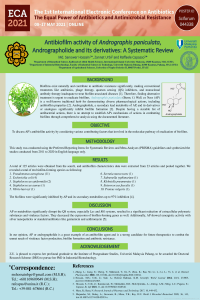
Biofilms exist naturally and contribute to antibiotic resistance significantly, making conventional treatments like antibiotics, phage therapy, quorum sensing (QS) inhibitors, and monoclonal antibody therapy inadequate to treat biofilm-associated diseases. Therefore, finding alternative treatment is urgent to cease biofilms. Andrographis paniculata (AP) is well known for demonstrating diverse pharmacological actions, including antibiofilm properties. Andrographolide, a secondary lead metabolite of AP, and its derivatives or analogues significantly inhibit biofilm formation. Despite having a sizeable list of antibacterial actions, there is no attempt to establish AP's mechanisms of actions in combatting biofilms through comprehensive analysis using the documented literature. Therefore, this systematic review aims to discuss this by considering various contributing factors to AP's anti-biofilm activity. This study conducted using the Preferred Reporting Items for Systematic Reviews and Meta-Analyses (PRISMA) guidelines and synthesized the studies conducted from 2011 to 2020. A total of 125 articles were obtained from the search, and antibiofilm characteristics data were extracted from 23 articles and pooled together. We revealed a total of ten biofilm-forming species of Pseudomonas aeruginosa (11), Escherichia coli (4), Staphylococcus epidermidis (2), Staphylococcus aureus, Vibrio harveyi, Serratia marcescens, Salmonella typhimurium, Klebsiella pneumoniae, Enterococcus faecalis, Proteus vulgaris. The biofilms were significantly inhibited by AP and its secondary metabolites up to 97% inhibition. AP or metabolites significantly disrupt the QS system, especially Las and Rhl systems, resulted in a significant reduction of extracellular polymeric substances and virulence factors. They decreased the expression of biofilm-forming genes as well. Additionally, AP showed synergistic activity with silver nanoparticles or standard antibiotics like gentamicin and azithromycin. In our opinion, AP or andrographolide is a great example of an anti-biofilm agent and is a strong candidate for future therapeutics to combat the unmet needs of virulence factor production, biofilm formation and antibiotic resistance.
Keywords
antibiotic resistance
biofilm
natural product
quorum-sensing
virulence factors
Manuscript
ECA2021 Ando Proceeding abstract.pdf
Poster
ECA Ando Poster.pdf
Susceptibility of ocular Staphylococcus aureus to antibiotics and multipurpose disinfecting solutions.
A Systematic Review on the Prevalence of Antibiotic Resistant Staphylococcus aureus in Human Source in Bangladesh