Event submissions
Published
 10.3390/ECA2021-09885 (registering DOI)
 This submission belongs to the session F. Poster of the event The 1st International Electronic Conference on Antibiotics
Published date
05 May, 2021
Citation
Md. Sanower Hossain, Md. Monsur Ahammed, Nurullah Mashhur, Sadia Afrin, A Systematic Review on the Prevalence of Antibiotic Resistant Staphylococcus aureus in Human Source in Bangladesh, in Proceedings of The 1st International Electronic Conference on Antibiotics, 8 May–17 May 2021, MDPI: Basel, Switzerland, doi: 10.3390/ECA2021-09885
Share
Email
Facebook
Twitter
LinkedIn
A Systematic Review on the Prevalence of Antibiotic Resistant Staphylococcus aureus in Human Source in Bangladesh

Md. Sanower Hossain 1
'%3e%3cpath%20d='M12.6647%2010.9104C12.4176%2010.325%2012.0589%209.7933%2011.6088%209.34485C11.16%208.89511%2010.6283%208.53653%2010.0432%208.28891C10.038%208.28629%2010.0327%208.28498%2010.0275%208.28236C10.8437%207.69282%2011.3743%206.73252%2011.3743%205.64907C11.3743%203.85423%209.92005%202.40002%208.12522%202.40002C6.33038%202.40002%204.87618%203.85423%204.87618%205.64907C4.87618%206.73252%205.40677%207.69282%206.22296%208.28367C6.21772%208.28629%206.21248%208.2876%206.20724%208.29022C5.62031%208.53783%205.09365%208.89287%204.64167%209.34616C4.19192%209.79496%203.83334%2010.3266%203.58573%2010.9117C3.34247%2011.4846%203.21128%2012.0987%203.19925%2012.721C3.1989%2012.735%203.20135%2012.7489%203.20646%2012.7619C3.21157%2012.7749%203.21924%2012.7868%203.22901%2012.7968C3.23877%2012.8068%203.25045%2012.8148%203.26334%2012.8202C3.27623%2012.8256%203.29007%2012.8284%203.30406%2012.8284H4.09012C4.14776%2012.8284%204.19362%2012.7825%204.19493%2012.7262C4.22113%2011.7148%204.62726%2010.7676%205.34519%2010.0497C6.08802%209.30686%207.07452%208.89811%208.12522%208.89811C9.17592%208.89811%2010.1624%209.30686%2010.9052%2010.0497C11.6232%2010.7676%2012.0293%2011.7148%2012.0555%2012.7262C12.0568%2012.7839%2012.1027%2012.8284%2012.1603%2012.8284H12.9464C12.9604%2012.8284%2012.9742%2012.8256%2012.9871%2012.8202C13%2012.8148%2013.0117%2012.8068%2013.0214%2012.7968C13.0312%2012.7868%2013.0389%2012.7749%2013.044%2012.7619C13.0491%2012.7489%2013.0515%2012.735%2013.0512%2012.721C13.0381%2012.0947%2012.9084%2011.4856%2012.6647%2010.9104ZM8.12522%207.90243C7.52388%207.90243%206.95792%207.66793%206.53214%207.24215C6.10636%206.81636%205.87185%206.2504%205.87185%205.64907C5.87185%205.04773%206.10636%204.48177%206.53214%204.05599C6.95792%203.63021%207.52388%203.3957%208.12522%203.3957C8.72655%203.3957%209.29252%203.63021%209.7183%204.05599C10.1441%204.48177%2010.3786%205.04773%2010.3786%205.64907C10.3786%206.2504%2010.1441%206.81636%209.7183%207.24215C9.29252%207.66793%208.72655%207.90243%208.12522%207.90243Z'%20fill='%235D1EE1'/%3e%3c/g%3e%3c/svg%3e)
Md. Monsur Ahammed 2
Nurullah Mashhur 2
Sadia Afrin 2
1. Department of Biomedical Science, Kulliyyah of Allied Health Sciences, International Islamic University Malaysia, 25200 Kuantan, Malaysia
2. Department of Biochemistry and Molecular Biology, Mawlana Bhashani Science and Technology University, 1902 Tangail, Bangladesh
Abstract
Antibiotic resistance is growing health concerning issue in the present world. Misuse and overuse of antibiotics and lack of proper monitoring in the healthcare sector has caused a tremendous growth of antibiotic resistance (ABR) worldwide, especially in developing countries like Bangladesh. Staphylococcus aureus is still the prevalent cause of nosocomial infections, and it is becoming more of a community issue as more patients are treated outside of the hospital environment. Therefore, this systematic review was conducted to delineate the prevalence of ABR in S. aureus isolates in patients of various categories in Bangladesh. Bangladesh Journal Online, Scopus, PubMed and EBSCO databases were searched for studies conducted in the last 20 years following PRISMA guidelines. The literature search revealed 160 potentially relevant records were obtained from the database search. Through the screening process, 33 relevant studies investigated the resistance pattern of S. aureus from human isolates were included. The reported data produced a pooled prevalence of ABR (top ten resistant antibiotics) in S. aureus in Bangladesh from human sample: Penicillin (84.75%, interquartile range, IQR, 44.75), Ampicillin (83.75%, IQR 14.475), Oxacillin (77.5%, IQR 44.675), Cefoxitin (72%, IQR 24.55), Tetracycline (68%, IQR 34.3), Amoxicillin (67.375%, IQR 40.95), Ceftazidime (67%, IQR 16.125), Netilmicin (60.625%, IQR 20.625), Cefixime (60%, IQR 13.725), Cefuroxime (60%, IQR 9). A total of 64.52% of studies were conducted in the Dhaka district. The reported studies demonstrated the evidence of the high prevalence of ABR S. aureus in patients in Bangladesh. Even though this is limited data, this study's findings might help the policymakers developing the policy to contain the spread of ABR in Bangladesh to support the world One Health goal. Implementing nationwide surveillance and strict monitoring of antibiotic usage is highly recommended.
Keywords
antibiotic resistance
community
human
infectious disease
surveillance
Manuscript
ECA2021 Proceedings Abstract.pdf
Poster
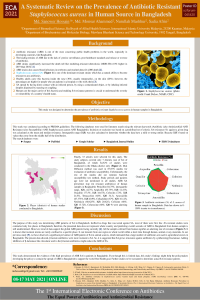
ECA 2021 Human Sample ABR Poster.pdf
Antibiofilm activity of Andrographis paniculata, Andrographolide and its derivatives: A Systematic Review
Direct disk diffusion test during bacteremia : evaluation of antibiotic susceptibility results